
Art, Conservation & Archaeology
Supporting Cultural Heritage Analysis
Understanding our Cultural Heritage lies in a detailed knowledge of the objects that comprise that heritage. Learning about how an object was created, its origin, and how to preserve it for future generations, are goals we all share.
Bruker supports these goals through instrumentation that provides measurement capabilities ranging from point-by-point analysis to large area scanning, at the scale of millimeters down to micrometers. Our tools support nearly all analytical needs for Fine Art and Museum objects, as well as field- and lab-based Archaeological characterization.

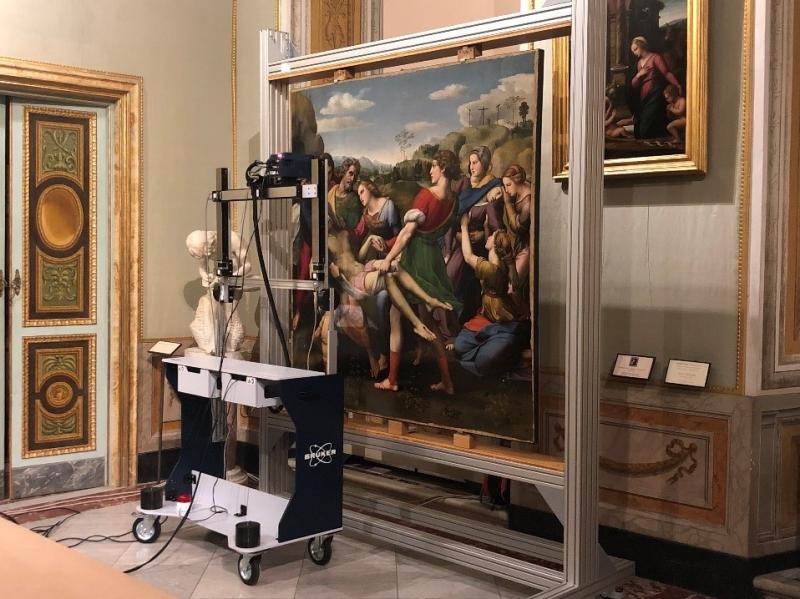
The Mobile Lab in Conservation and Archaeology

Not every painting, object or artifact can be brought to the lab for study. A painting may be on permanent display. The artwork may be on the walls of a 15th century villa or the ceiling of a church. Measurements may need to be made on the site of an archaeological dig. The solution is to go portable.
Bruker can help you take the lab to where you need to be for your project, with a range of mobile and fully portable non-invasive analytical tools designed to work almost anywhere and anytime. Our handheld and ultraportable tripod mounted devices are designed to run continuously for hours from internal batteries, or from an external battery pack, removing the need for a proximal power supply. Many of the portable instruments are designed with touch-screen interfaces for completely untethered analysis, or from a laptop, making on-site and remote analytical work easy. Check out the TRACER family of handheld XRF spectrometers or the ELIO mobile mapping XRF instrument for spot and mapping elemental solutions. For correlation with elemental data or identification of organic and other molecular structures, look for the BRAVO portable Raman and the ALPHA II portable FT-IR analyzers.
Engineering New Solutions to Questions in Art & Conservation

Techniques and approaches in analysis of cultural heritage materials are ever evolving. What directions do you need to go to solve your research questions?
A team of engineers is continuously working on advanced prototypes and special projects with partner museums and university groups in the Art and Conservation family.
Videos on Art & Conservation
You can view our latest videos below. To watch all of our videos visit our Art, Conservation & Archaeology playlist.