Turning Imperfect Sample Preparation into Definitive EBSD Results: eWARP in Action
Can reliable EBSD data be obtained without good surface preparation?
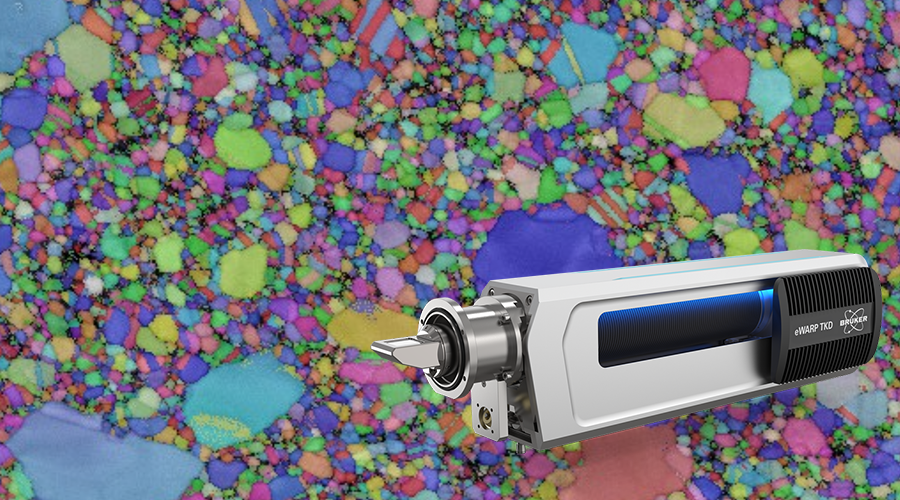
Yes, with the award-winning eWARP direct electron detector, which combines exceptional signal efficiency with a wide-area pixelated design optimized for EBSD, establishing a new standard for the characterization of challenging specimens, including poorly prepared surfaces and beam-sensitive materials.
The example shown here is a ferritic iron dagger of approximately 400 years old. Produced by pre-industrial smelting and forging, the material exhibits low chemical purity, numerous slag inclusions, pronounced microstructural heterogeneity, and a preparation response that is both soft and highly anisotropic.
Despite receiving only coarse mechanical polishing, eWARP delivers reliable EBSD data under exactly the type of constrained conditions that limit conventional approaches.

How does direct electron detection compare to conventional EBSD detectors?
In a direct comparison, a small piece of the dagger was measured with the CMOS-based eFlash FS (indirect detection) camera and with the eWARP direct detector.
The surface is heavily scratched and the sub-surface deformed, a condition that typically compromises indexing and considerably slows down acquisition. eWARP still retrieved sufficient signal, delivering a five times higher indexing rate at a data acquisition speed 24 times faster. Rather than incrementally improving EBSD, it extends EBSD analysis to samples that indirect detection cannot handle.

Why does signal quality matter more than post-processing?
Data reliability is set by the quality of the measured Kikuchi patterns. Dictionary indexing, template matching and reconstruction algorithms can raise apparent indexing rates, but are not always applicable, and might smooth out real microstructural variation or cause indexing errors.
In the results acquired by indirect detector, incorrect orientation assignments appear despite using higher pattern resolution (see Kikuchi pattern A). The signal efficiency of eWARP allows accurate indexing directly from the measurement (see Kikuchi pattern B), so orientation gradients and intragranular heterogeneity are preserved rather than inferred. Better data at the source leads to more reliable insight.
Sample courtesy: Petr Žákovský, Institute of Archaeology CAS, Brno


Pattern A (left) one of the highest-quality Kikuchi pattern extracted from the datastet in figure 1, acquired with the CMOS-based indirect EBSD detector. Acquired at 20 kV and 42 nA and a pattern resolution of 320 × 240 pixels. Pattern B is extracted from the eWARP direct detector dataset and is displayed with indexed bands overlaid in red. Acquired at the same accelerating voltage (20 kV) but with only 13 nA beam current
and a pattern resolution of 100 × 100 wide-area pixels, the eWARP pattern provides robust indexing performance under these challenging preparation conditions.
Learn More About eWARP
Discover how the eWARP detector redefines EBSD performance under challenging, real-world conditions, combining unmatched acquisition speed with high-fidelity signal quality.