On-Demand Session: Advances in AFM for the Characterization of 2D Materials
Introduction
PRESENTATION HIGHLIGHTS:
[00:00:00] Introduction and Outline
[00:00:20] Graphene Discovery, aided by Bruker AFM
[00:01:27] Van der Waals heterostructures
[00:03:00] Tapping Mode of Moiré Pattern of Epitaxial Graphene on hBN
[00:03:50] Role of SPM in investigation of VdW materials & heterostructures
High-Resolution Imaging
PRESENTATION HIGHLIGHTS:
[00:00:14] Moiré Patterns affect a variety of properties & associated AFM modes
[00:01:33] Torsional Force Microscopy (TFM)
[00:03:05] Torsional Resonance and TFM
[00:04:45] TFM has made Moiré and lattice imaging routine
[00:06:05] Moiré and lattice resolution or point defects: TFM
[00:07:42] Atomic Resolution
[00:09:46] Moiré and lattice resolution or atomic defects: CAFM
[00:11:42] Practicalities
[00:14:00] Simultaneous TFM and C-AFM?
Property Characterization
PRESENTATION HIGHLIGHTS:
[00:01:45] Nanomechanical Characterization
[00:04:40] Nanoelectrical Characterization
[00:07:46] Scanning Microwave Impedance Microscopy (sMIM) on buried structure
[00:07:46] Scanning Microwave Impedance Microscopy (sMIM) on buried structure
[00:010:04] sMIM at domain stacking wall
NanoChemical Characterization
PRESENTATION HIGHLIGHTS:
[00:00:08] Co-localized AFM-Raman on Graphene flake
[00:02:23] Practical Aspects for Co-Localization
[00:03:47] Photothermal AFM-IR on Chemical Patterned
[00:05:34] AFM-IR on Rhombohedral Graphene
[00:06:33] AFM-IR spectroscopy and imaging of Rhombohedral Graphene
[00:07:32] Correlated AFM-IR & sMIM
[00:08:19] Photothermal AFM-IR for Subsurface Imaging
[00:08:47] AFM-IR study of phonon polaritons
Nanolithography & Nanomanipulation
PRESENTATION HIGHLIGHTS:
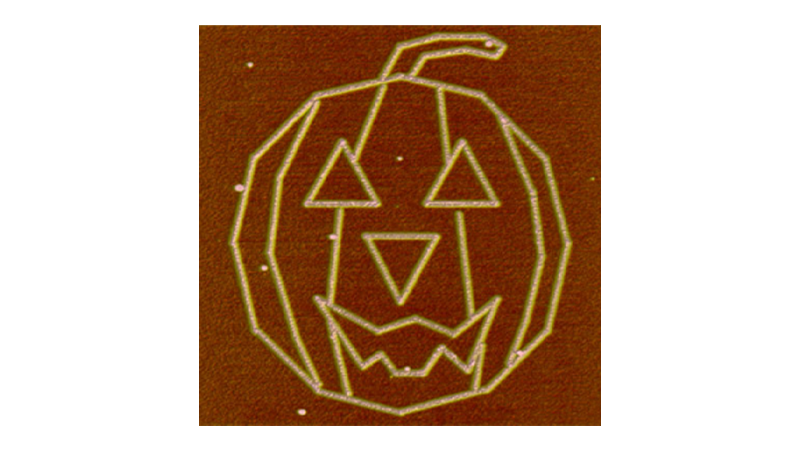
[00:00:40] Nano-Lithography Review
[00:01:27] Nano-Lithography (Electrical)
[00:02:20] Nanoman software
[00:04:44] Nano-Lithography case study
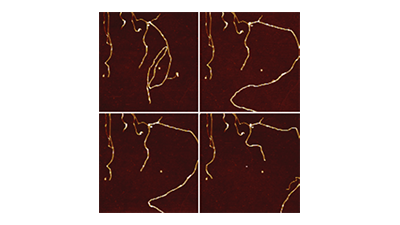
[00:06:40] Twistable electronics with dynamically rotatable heterostructures
[00:07:44] 2D material friction measurement with nano-lithography scripts
[00:08:28] Nano-Lithography with heater accessory
Quantum Twisting Microscopy
PRESENTATION HIGHLIGHTS:
[00:00:10] Quantum Twisting Microscope
[00:01:21] Revealing Electron–Electron Interactions in Graphene at Room Temperature with a Quantum Twisting Microscope
2D Material Cleaning
PRESENTATION HIGHLIGHTS:
[00:00:00] 2D material cleaning by AFM scan
[00:01:25] Probe solution for cleaning
Question & Answer
PRESENTATION HIGHLIGHTS:
[00:00:00] If TFM can routinely resolve lattice and moiré patterns but not point defects, is that a limitation fundamentally set by contact mechanics, by the torsional resonance transfer function, or by the contrast mechanism itself?
[00:01:00] Is a glove box needed for 2D material imaging or studying 2D materials, and can it be done in ambient?
[00:02:28] If the domain wall contrast is not describable by stacking order alone, then in what sense is AFM-IR actually identifying stacking unambiguously rather than just producing wavelength-dependent contrast that is later interpreted post hoc?
[00:04:02] Is there currently any AFM exfoliation technique similar to 2D flakes for nanomanufacturing functionality? As shown in the PowerPoint, AFM tips can be used for rotation in heterostructures, but can AFM be used for further exfoliation on already exfoliated flakes to obtain clean monolayers?
[00:06:25] Is it possible to combine such high-resolution AFM modes and force spectroscopy to 2D materials? What about tip functionalization?