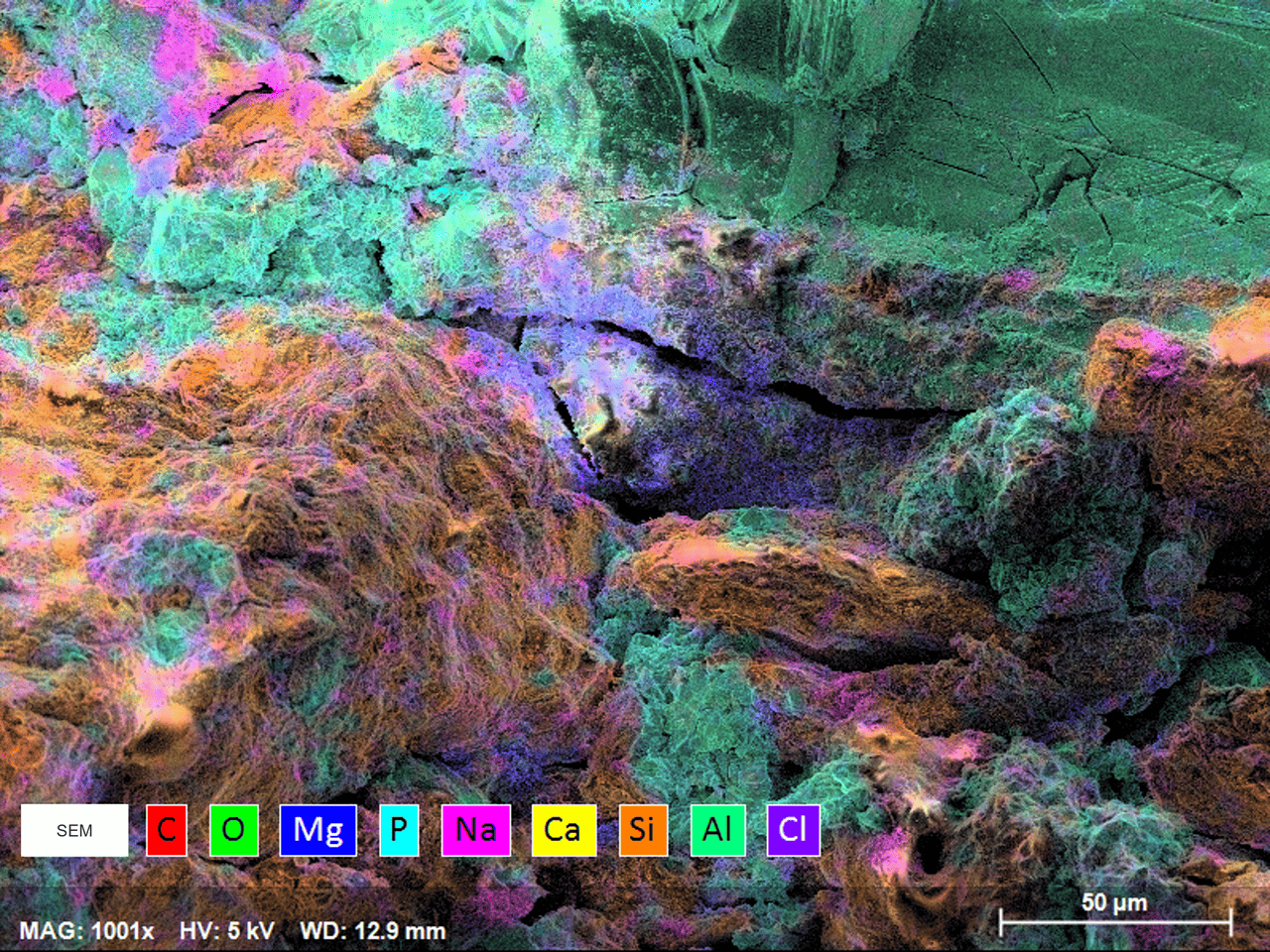
Ultra-Low Probe Current SEM EDS Mapping of Unprepared Pharmaceutical Specimen
The combination of Scanning Electron Microscopy (SEM) and Energy Dispersive Spectroscopy (EDS) is a powerful analytical technique that provides high-resolution imaging and elemental analysis essential for the material characterization of pharmaceutical samples, from the micro- to the nanoscale. This characterization is crucial for particle morphology studies, mapping the elemental composition of active pharmaceutical ingredients (APIs), quality control, contamination assessment, foreign particle analysis, formulation development, etc.
For non-conductive pharmaceutical specimens, low-vacuum SEM imaging is commonly used to mitigate surface charging where additional sample preparation or C-coating could affect sample integrity. However, low-vacuum conditions often introduce beam distortion, increased noise, and reduced X-ray signal intensity. This makes EDS analysis inefficient, especially for pharmaceutical samples with low X-ray yield. On the other hand, high-vacuum SEM mode offers SEM imaging and EDS mapping at high signal quality and resolution.
This is what we demonstrate in this study: to minimize surface charging, the SEM was operated at high vacuum and ultra-low probe currents of 18 pA at 5 kV (Fig. 1). The XFlash® FlatQUAD EDS detector EDS detector positioned in close proximity to the sample, provided high sensitivity and enabled high quality maps despite the weak X-ray signals resulting from the gentle beam conditions, which enabled elemental mapping at submicron scale on an un-coated non-conductive sample.
Maintaining high vacuum conditions and ultra-low probe currents ensures high-resolution EDS maps, even for beam sensitive and charging samples (Fig. 2). While conventional inclined EDS detectors typically fail to collect sufficient signal under low-dose conditions, the optimal sample-detector geometry, large solid angle > 1.1 sr and high sensitivity of the XFlash® FlatQUAD detector detector enables EDS mapping with high count rates. The 4-segment annular design of XFlash® FlatQUAD guarantees signal collection from topographic samples by minimizing shadowing and data loss from shadowed regions (Fig. 3).