
iDiffBB – Standard and Widebore Diffusometry Probes
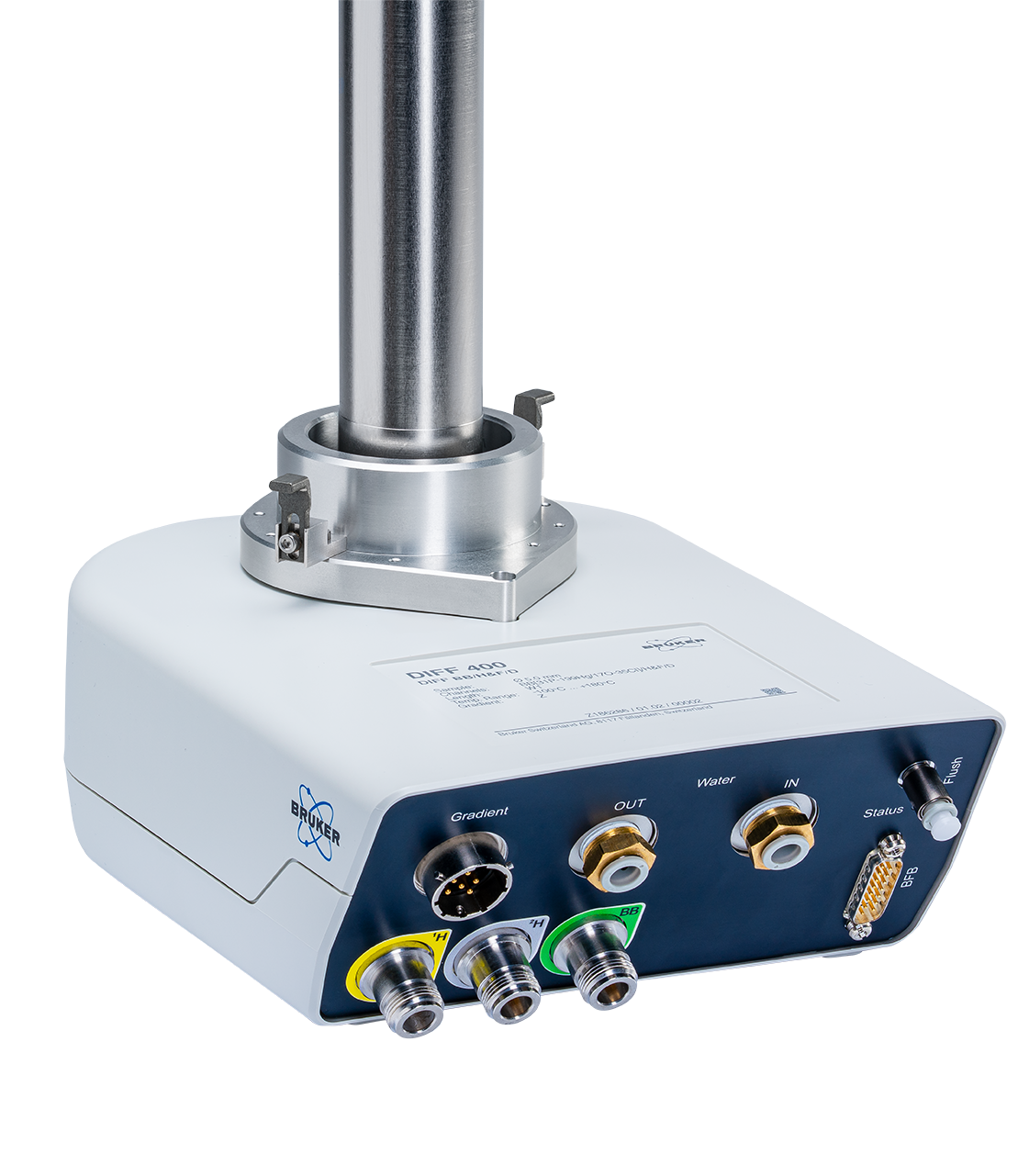
The iDiffBB (standard bore) and iDiffBBWB (wide bore) probes are broadband gradient probes optimized for very strong gradient pulses and suitable for 5 mm sample tubes. The probes offer 1H-19F, X-broadband and a lock channel as well as a wide temperature range from -100 °C to 180 °C.
Bruker’s diffusometry iProbes for 5 mm NMR sample tubes cover a wide temperature range from -100 °C to 180 °C. While the standard bore version iDiffBB offers up to 17 T/m gradient strength, the wide bore version iDiffBBWB offers up to 28.5 T/m. The iDiffBB probes are broadband gradient probes (31P-35Cl) with Automatic Tuning Module (ATM) for NMR diffusometry that allows to measure diffusivities down to 1x10-14 m2/s (iDiffBB) or 1x10-15 m2/s (iDiffBBWB) for samples with T1 > 1s and T2 > 100 ms. The probes provide a high-performance water cooled single axis gradient, variable temperature measurements are possible in the range of -100 °C to 180 °C. Together with the ATM this allows a series of fully automatic variable temperature experiments. The broadband channel configuration enables to observe a wide range of nuclei from 1H down to 35Cl.

Features
- Standard or Wide Bore Probe version
- Gradient strength of up to 17 T/m (standard bore) or 28.5 T/m (wide bore), water cooled
- 1H-19F / X-BroadBand (31P-35Cl) / Lock Channel
- Automatic Tuning Module (ATM)
- Sample transfer via SB-BST
- Variable Temperature Control (compatible to Bruker variable temperature equipment)
- BBI or BBO configuration
- Built-in deuterium filter optional (allows 2H and 6Li diffusometry experiments)



Specifications
| iDiffBB/WB | |
| Bore | SB / WB |
| 1H frequency range | 300 – 800 MHz |
| RF channels | 1H-19F, 31P-35Cl. 2H Lock |
| Requirements | MR Diffusion / MR Microscopy Accessory |
| ATMA | Yes |
| Gradient | |
| Directions | z |
| Gradient strength per direction | 17 T/m (SB) or 28.5 T/m (WB) |
| Cooling | Water |
| Maximum current tested | 60 A |
| RF Coil | BBO or BBI design, one coil tunable 1H-19F + 2H lock, second coil BB tunable 31P – 35Cl |
| Standard sample temperature range (5 mm) | -100 °C - 180 °C |
| Sample diameter | 5 mm |
Accessories
- Diff Software Application
- Dynamic Center for data processing
- Compatible with IconNMR/SpinPilot and Bruker Sample changers for automation