Case Study: Comparative Drug Profiling for Preclinical Development in Psychiatry
Accelerate Your Drug Discovery Pipeline with an In Vivo Circuit-Based Approach
In this case study, readers will learn about how the Inscopix Discovery Lab has developed an application to develop new treatments for psychiatric disorders, including depression and schizophrenia. See how real-time brain imaging in freely behaving rodents can reveal how candidate antidepressants engage neural circuits, providing critical insights into target engagement, dose-response, and pharmacodynamics.
Contents include:
- In vivo circuit-based profiling offers more insights compared to traditional in vitro assays
- Inscopix neurobehavioral profiling can distinguish between compounds, including Ketamine, Traxoprodil, and DMT
- A growing reference library lets researchers make more informed decisions on dose-finding and lead candidate prioritization
- The Inscopix Discovery Lab offers both standardized and custom-designed neurobehavioral studies
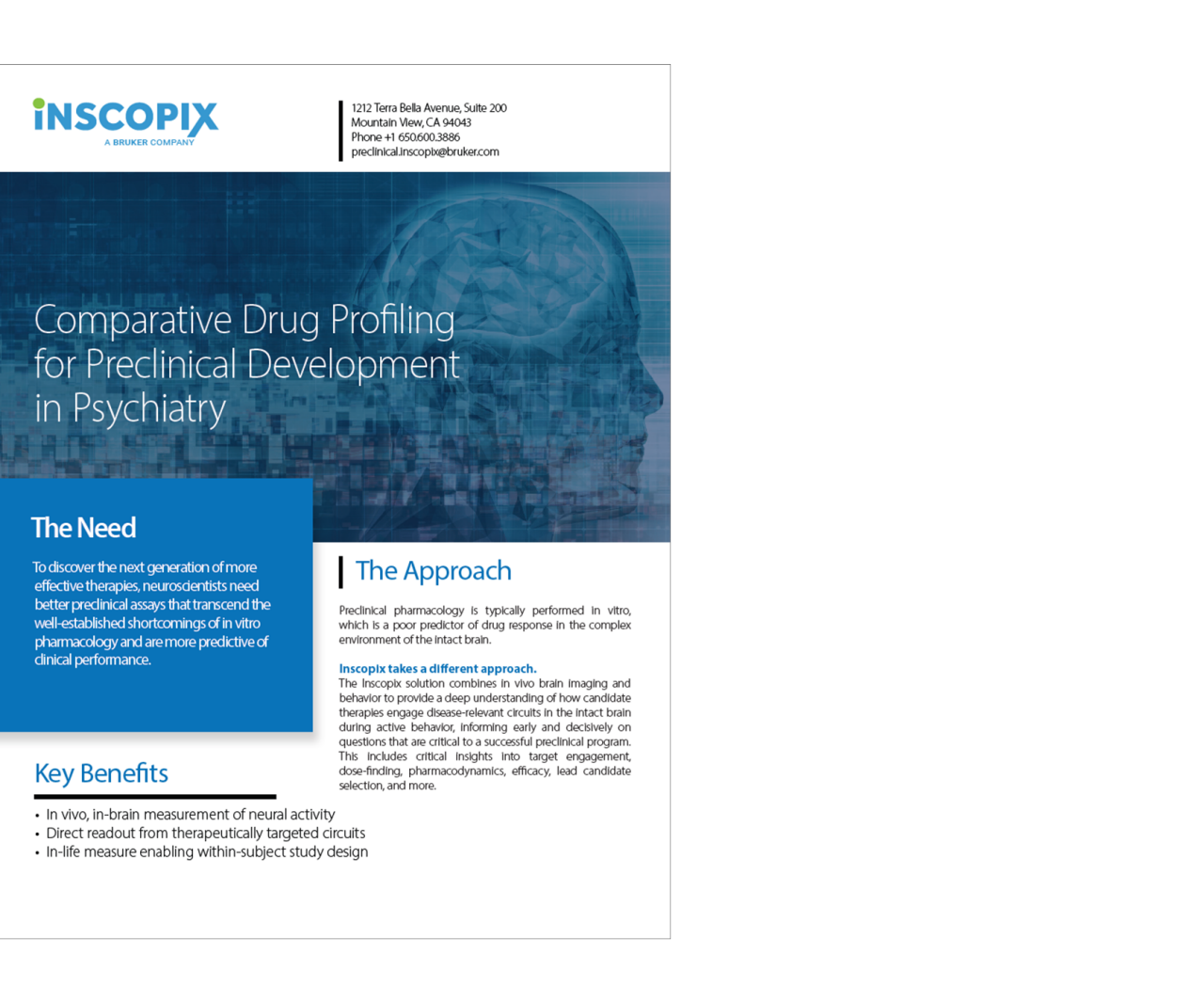
The Need
To discover the next generation of more effective therapies, neuroscientists need better preclinical assays that transcend the well-established shortcomings of in vitro pharmacology and are more predictive of clinical performance.
The Approach
Preclinical pharmacology is typically performed in vitro, which is a poor predictor of drug response in the complex environment of the intact brain.
Inscopix takes a different approach.
The Inscopix solution combines in vivo brain imaging and behavior to provide a deep understanding of how candidate therapies engage disease-relevant circuits in the intact brain during active behavior, informing early and decisively on questions that are critical to a successful preclinical program. This includes critical insights into target engagement, dose-finding, pharmacodynamics, efficacy, lead candidate selection, and more.
Key Benefits
- In vivo, in-brain measurement of neural activity
- Direct readout from therapeutically targeted circuits
- In-life measure enabling within-subject study design
Case Study: Cortical Circuit Profiling of Rapid-Acting Antidepressants
Compare the effects of your compound to those in our growing reference library, which includes Ketamine and the most promising psychedelics and related analogs currently in development. This informs dose-finding studies, lead candidate selection, and potential efficacy.


Each drug is represented by a unique color, with saturation indicating dose for group means. Ketamine, Traxoprodil, and DMT form distinct clusters within the PCA space, with doses of the same drug showing a coherent trajectory, indicating a dose-dependent relationship in neural metric alteration. Conversely, Rapastinel’s lack of separation from the vehicle control suggests negligible impact on the neural metrics, corroborating clinical trial findings.
Transform your neuroscience drug development
The Inscopix Discovery Lab is a state-of-the-art in vivo rodent R&D facility with a schedule 1 license and a team of neuroscientists and brain imaging and behavior experts. We conduct fee-for-service contract research studies in support of preclinical psychiatry programs, offering several standardized assays as well as custom neurobehavioral studies designed in collaboration with our clients. Contact us for more information to find out how we can meet the needs of your drug discovery programs.