
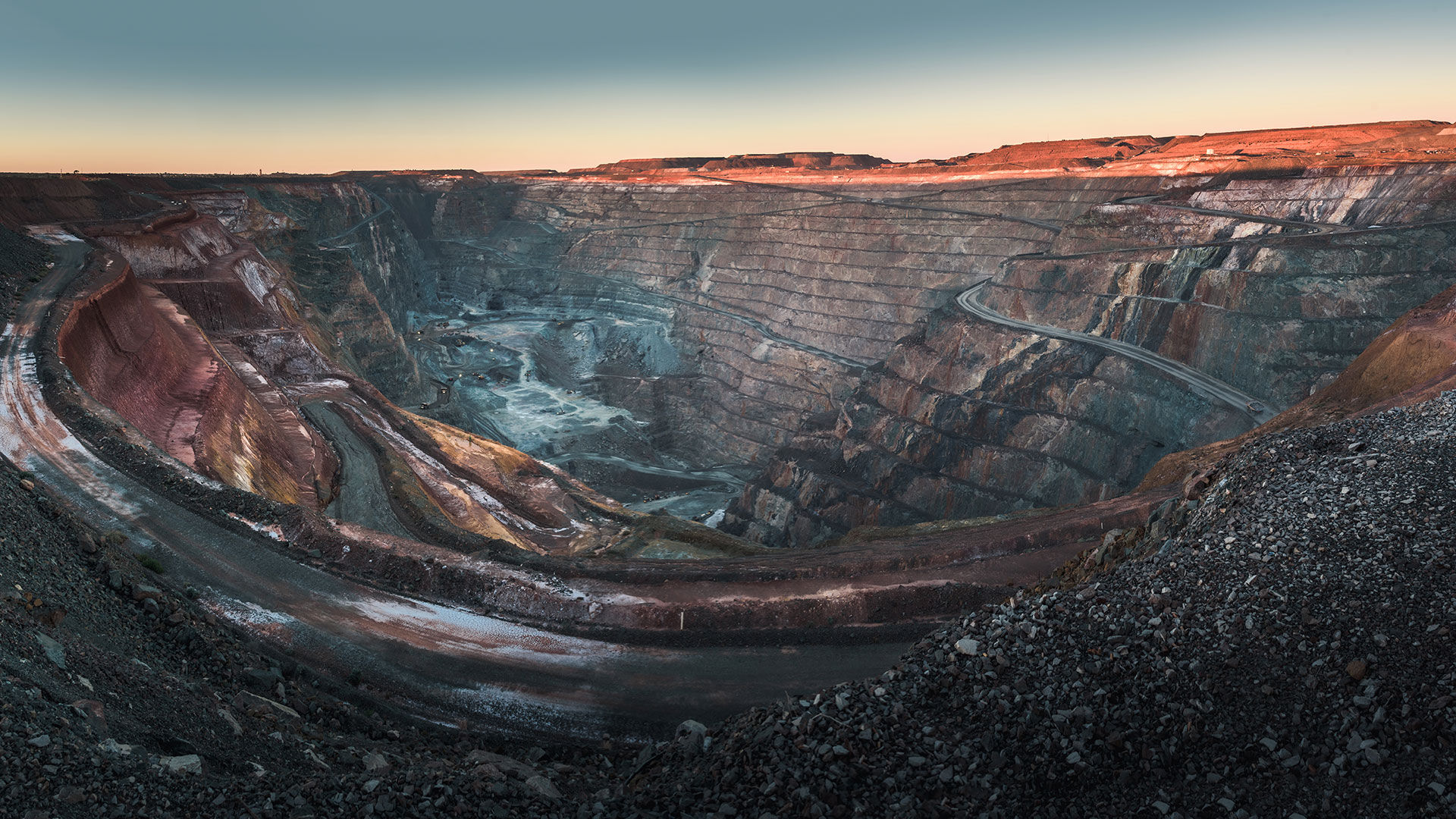
Mining
Supporting Mining Operations at Scale
Reliable decisions in mining depend on fast access to consistent material data without increasing analytical effort or infrastructure complexity. The ALPHA II soil Analyzer supports this by simplifying material assessment, reducing reliance on multiple techniques, and enabling efficient handling of high sample loads. The result is a more streamlined analytical process that delivers stable, comparable results across varying operational conditions.

Mining-Related Soil and Material Assessment
In mining environments, the Soil Analyzer can already be applied to fine-grained and weathered materials such as:
- Overburden and spoil heap materials
- Tailings-related fines
- Remediation and rehabilitation substrates
These materials share characteristics with soils in terms of particle size, heterogeneity, and compositional variability. FT-IR spectroscopy enables their rapid characterization, providing insight into composition and key chemical indicators from a single measurement.
This supports decisions in areas such as:
- Material classification and handling
- Rehabilitation planning
- Monitoring of reclaimed or treated sites
The advantage is not a completely new workflow, but a simpler and faster way to generate the same type of information consistently across large sample sets.

Mining: Beyond Soils Toward Mineral Mixtures and Cores
With appropriate calibration models, FT-IR can extend beyond soil-like materials into rapid characterization of mineral mixtures, including:
- Ores with complex mineralogical composition
- Blended or processed materials
- Fine fractions from crushing and grinding
The same principle applies to drill core analysis, especially for:
- Weathered or altered zones
- Fine-grained or mixed materials
- Screening and pre-classification workflows
FT-IR provides rapid, non-destructive measurements that can deliver compositional information in minutes, compared to slower laboratory-based techniques.

Why Integrating FT-IR Into Workflows is Worth it
Adopting FT-IR is not about replacing established analytical techniques across the board. It is about optimizing how and when different methods are used.
With the right implementation, FT-IR enables:
- Faster decision points by screening large numbers of samples early.
- Reduced analytical load on more complex and expensive techniques.
- Higher sampling density, improving spatial and statistical confidence.
- Consistent data generation, independent of operator variability.
In selected use cases, where calibration quality and sample types align, FT-IR can go further and substitute classical methods for routine parameters, especially when speed and scalability are critical.
This creates a clear shift in workflow design:
From selective, slow measurements
➔ to broad, data-driven coverage with targeted confirmation where needed
A Tool that Grows With Your Applications
The ALPHA II Soil Analyzer is not limited to a fixed set of parameters or applications. Its value increases as calibration models evolve and data volumes grow.
What starts as a fast and reliable soil analysis solution can develop into a central tool for material characterization across environmental and industrial workflows.
This makes it a practical investment today and a scalable platform for future analytical needs.