Tech Note: Simplifying Precision Viscoelastic Characterization with nanoDMA IV
Precise Dynamic Loading for Nanoscale Viscoelastic Characterization
Accurate nanoscale dynamic mechanical analysis (nanoDMA) measurements require a well-controlled displacement amplitude throughout the test. In practice, this is challenging because contact stiffness continually evolves with depth and material response, altering the dynamic response and introducing variations in displacement amplitude that are unrelated to the material itself.
This technical note introduces the dual-loop displacement control, real-time stiffness feedback, and preconfigured control gains that define nanoDMA IV. Case studies on samples representing five material classes, spanning orders of magnitude in stiffness, illustrate continuous measurement (CMX) and frequency sweep testing with a constant dynamic displacement amplitude.
Readers can expect to find:
- An overview of dual-loop displacement control and real-time stiffness feedback in nanoDMA IV
- Descriptions of preconfigured control gains for five material categories
- Case studies of continuous measurement (CMX) and frequency sweep testing across a wide range of stiffnesses
KEYWORDS: Nanoindentation; Hysitron; TN1504; Bruker; Technical Note; TI 990; TriboIndenter; nanoDMA IV; Dynamic Mechanical Analysis; Viscoelastic Characterization; CMX; Frequency Sweep

Simplifying Precision Viscoelastic Characterization with nanoDMA IV
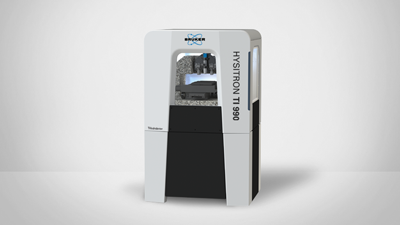
Accurate nanoscale dynamic mechanical analysis (nanoDMA®) measurements require a well‑controlled displacement amplitude throughout the test. In practice, this is challenging because contact stiffness continually evolves with depth and material response, altering the dynamic response and introducing variations in displacement amplitude that are unrelated to the material itself. This limitation is addressed using dual‑loop displacement control in nanoDMA IV on the Hysitron TI 990 TriboIndenter®, which ensures a constant dynamic displacement amplitude, removing the need to tune load functions on a material‑to‑material basis. This technical note describes the control approach used in nanoDMA IV and its role in improving measurement consistency and data reliability for continuous measurement (CMX) and frequency sweep testing across a wide range of materials.
FEATURED PRODUCTS AND TECHNOLOGIES:
Measurement Challenges in Displacement‑Controlled nanoDMA
Dynamic mechanical analysis (DMA) is widely used to characterize the viscoelastic behavior of bulk materials across a range of time‑ and frequency‑dependent conditions. Nanoscale DMA with a nanoindenter (nanoDMA) extends this viscoelastic characterization to thin films, complex polymers, and materials that evolve under load — applications where precise control of dynamic loading is critical. During nanoDMA, a small oscillatory displacement is applied during indentation, and the resulting response is used to determine properties such as storage modulus and loss modulus.
The oscillatory signal applied during nanoDMA is subsequently influenced by the evolving contact between probe and material. Increases in contact stiffness during indentation alter the relationship between applied load and resulting displacement. During frequency sweeps, this effect can be compounded by material changes caused by varying frequency.
When oscillation amplitude is not actively controlled by the instrument software, these changes can lead to drift or distortion of the dynamic displacement, complicating data interpretation. Impacts are particularly evident when measurements rely on stability over time or depth, as with continuous measurement (CMX) tests and frequency sweep experiments.
Traditional approaches address these challenges by manual adjustment of test parameters (control gains and load functions) to maintain a constant dynamic displacement amplitude. Not only is this manual process iterative and time‑consuming, it may also limit direct comparison between measurements performed on different materials or under different conditions.
With nanoDMA IV, however, displacement‑controlled dynamic testing delivers unmatched stability, precision, and ease of use. By employing a dual‑loop control architecture with intelligent stiffness feedback, nanoDMA IV maintains constant dynamic displacement amplitude even as contact conditions change during indentation.
Technology Innovations Enabling nanoDMA IV
Defining features of nanoDMA IV are its dual‑loop displacement control and real‑time stiffness feedback. It also provides additional ease‑of‑use benefits through pre‑configured control gains.
Parameter and Condition Stabilization
Dual‑loop displacement control is used to maintain a constant dynamic displacement amplitude throughout nanoDMA IV testing. The dynamic signal is generated by modulating the displacement control setpoint, ensuring that:
- The system continuously measures the resulting displacement amplitude.
- A secondary feedback loop adjusts the control signal in real time such that the target amplitude (e.g., 1 nm) is maintained with exceptional stability.
This architecture minimizes dynamic interference with the primary displacement loop, enabling high‑fidelity oscillatory motion even in demanding test conditions. The control architecture also allows for displacement control of the quasi‑static component without interfering with the dynamic amplitude control.
In parallel, nanoDMA IV implements real‑time stiffness feedback. With this stiffness‑aware dynamic control, the system computes a pseudo‑stiffness value during every oscillation cycle, and dynamic conditions remain stable even as the material creeps, relaxes, or transitions. This delivers highly repeatable measurements, reliable viscoelastic property determination, and consistent data across depth, frequency, and material type.
Usability Enhancements
Preconfigured control gains offered in nanoDMA IV are tailored to five material categories covering a broad range of sample stiffnesses: gels/elastomers, soft polymers, engineering polymers, glasses/low‑stiffness metals, and high‑modulus materials. Users just select the material class that most closely matches their sample, and the software automatically applies optimized dynamic and quasi‑static control parameters.
These predefined settings eliminate the need for advanced tuning and produce expert‑quality dynamic data in minutes, without limiting user flexibility. The presets prevent over‑ or under‑driving the material and ensure stable oscillations for extremely soft or extremely stiff materials, from ultrasoft hydrogels to stiff ceramics and metals. Advanced users may unlock gain parameters for fine tuning, but this is rarely necessary.
Figure 1 shows the interface used to select and modify preconfigured control gains. Gain values can be reviewed and adjusted as needed by unlocking the predefined settings for the selected material category.l type.

Case Studies
The following case studies demonstrate how nanoDMA IV can be used for CMX and frequency sweep testing.
Continuous Measurement of X (CMX)
CMX tests were performed on samples representing the five material classes, spanning orders of magnitude in stiffness. The load–displacement curves in Figure 2 demonstrate how stiffness is expressed by the different sample types. Distinct displacement ranges and load requirements are observed for each material, indicating variation in mechanical response across the tested material classes.
For CMX tests, the displacement amplitude is measured during the loading segment. For these experiments, 1 nm was selected for all the samples, but any displacement amplitude can be defined to suit specific sample or testing needs.
Across all five material classes, nanoDMA IV delivers flat, precise dynamic amplitudes throughout the entire loading profile as the depth increases. All materials tested with nanoDMA IV maintain a stable 1 nm displacement amplitude throughout the loading phase of the CMX tests (Figure 3a). Maximum depth is achieved without amplitude distortion, with a smooth, noise‑free response independent of material stiffness.
In contrast, the load amplitude required to sustain this constant 1 nm oscillation varies substantially between materials, reflecting differences in stiffness and viscoelastic response (Figure 3b). Together, these results highlight the sensitivity and precise control of nanoDMA IV across a wide range of mechanical properties.

Figure 2: Load–displacement curves from CMX tests for (a) LDPE, polycarbonate, fused quartz, and steel, and from frequency sweep test for (b) Sylgard.

Frequency Sweep Measurements
In frequency sweep tests, nanoDMA IV maintains stable dynamic amplitude and constant depth during the hold segments at every frequency. The displacement amplitude is maintained constant across the entire frequency range during the hold segment (Figure 4a). This is observed for all materials and material classes, whether the frequency spacing is segmented using a logarithmic or linear scale.
Similarly, the contact depth remains essentially constant throughout the same hold segment (Figure 4b). Each material maintains a stable contact depth value, showing no noticeable dependence on the applied dynamic frequency, with depth stability maintained even at high frequencies or for stiff materials. This consistency confirms that nanoDMA IV is effectively holding both the target displacement amplitude and penetration depth steady while the frequency is varied.

Conclusion
Bruker's nanoDMA IV on the Hysitron TI 990 TriboIndenter sets a new standard in displacement‑controlled DMA for nanoindentation. Its advanced control architecture, stiffness‑aware feedback, and preconfigured material class presets empower users to generate high‑quality, stable dynamic data across a wide range of materials with little to no manual tuning. Beyond the CMX and frequency sweep testing demonstrated in this technical note, nanoDMA IV also supports creep, stress relaxation, and reference creep.
Author
Radhika Laxminarayana, NRL Development Engineer, Bruker (r.laxminarayana@bruker.com)
©2026 Bruker Corporation. nanoDMA and TriboIndenter are trademarks of Bruker. All other trademarks are the property of their respective companies. All rights reserved. TN1504, Rev. A0.