Tech Note: 3-Point-Bend Testing on the UMT TriboLab
Probing Stress, Strain, and Failure Through Flexural Testing
Flexural testing is widely used to understand mechanical performance in applications where components experience bending rather than pure tension or compression. Three-point-bend configurations provide a controlled and well-established framework for such measurements.
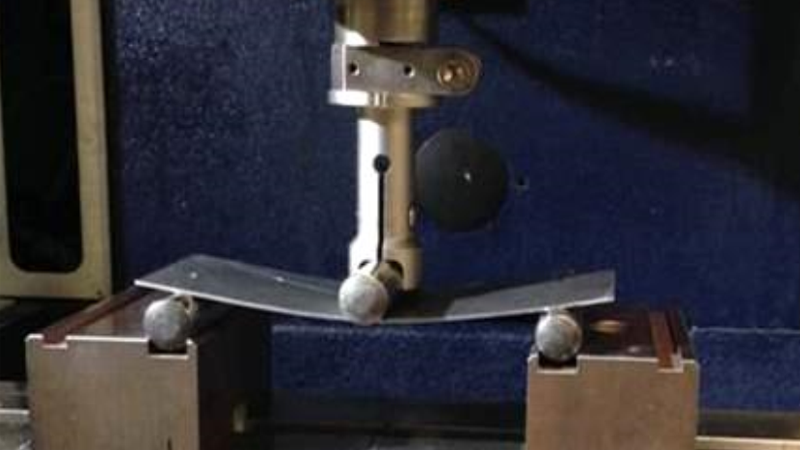
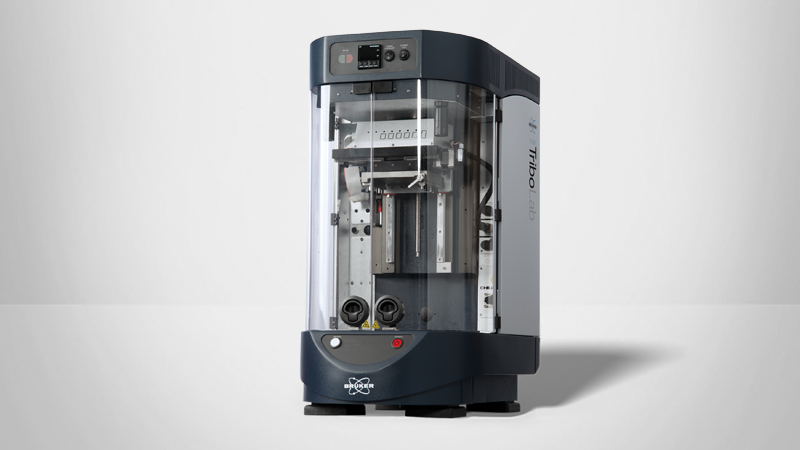
This application note outlines the use of a three-point-bend module on a Bruker UMT to assess bending behavior. It describes testing under load-control or displacement-control modes.
Readers can expect details on:
- Three-point-bend test configurations implemented on the Bruker UMT TriboLab
- Load-controlled and displacement-controlled bending test modes
- The use of standardized flexural and bending test methods
KEYWORDS: Tribometer; Mechanical Tester; Technical Note; Bruker; TN1004; UMT TriboLab; Three-Point Bend Testing; Bending Failure

Why 3-Point-Bend Testing
Elastic modulus in bending (i.e., flexural modulus), stress-strain behavior, and failure limits in bending all can be obtained using the simple sample geometry of a 3-point-bend test. ASTM D790 or ISO 178 covers flexural properties for plastics; ASTM E855 is used for properties of flat metallic spring materials; ASTM C1684 or C1161 covers 3-pointbend testing of ceramics.
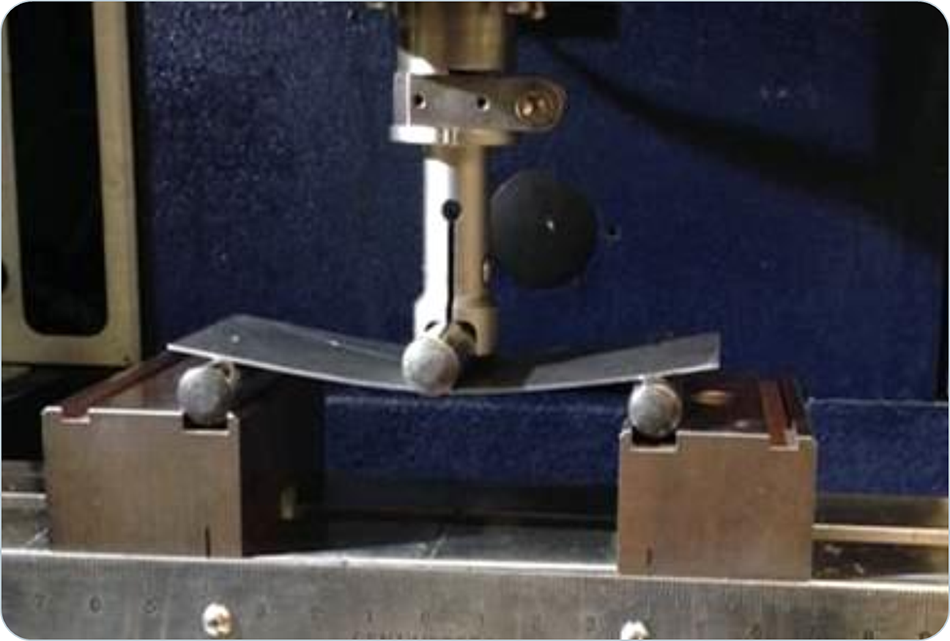
In a 3-point-bend test, the convex side of the sheet or plate is placed in tension, and the outer fibers are subjected to maximum stress and strain. Failure will occur when the strain or elongation exceeds the material’s limits.
Fracture toughness can be determined using a three-point flexural test. In this case, a prenotched sample is used and the procedures of ASTM E-1290 or ISO12135 can be followed. Fatigue properties can be obtained using ASTM D7774. For medical applications, ASTM F2606 is used for 3-point-bend testing of balloonexpandable vascular stents and stent systems.
Bruker’s UMT can be equipped with an easy-touse 3-point-bend module for assessing various properties of laminate and sheet materials. Tests can be run under load-control or displacementcontrol modes.
Use of Acoustic Emission in 3-Point-Bend Tests
In the case of composite materials, failure can occur due to delamination between the fibers and the matrix, prior to complete specimen failure. While this can sometimes be seen in the stress-strain curve data, it can also be detected using an acoustic emission (AE) sensor, and with much higher sensitivity. Failure criteria thus can be defined as the first indication of fiber delamination or breakage, the onset of significant AE signal, or the rise to a specific pre-defined level of AE, as shown in figure below.
The optional AE sensor can be used to assess a number of composite research areas, including surface activation of the fibers, wetting chemistry of the matrix, and fiber surface roughness characteristics.