Resolving Ultra-Fine Retained Austenite Grains in a Martensitic Steel Using Fast, Low-kV EBSD
Martensitic steels are known for their high mechanical properties combining hardness, strength, and wear resistance. Even though they have low ductility and can be brittle, tempering treatments can improve their toughness. In addition to tempering, the presence of retained austenite in martensitic steels is very desired since it influences the mechanical properties by converting to martensite under stress, increasing tensile strength and ductility. This Transformation-Induced Plasticity, known as the TRIP effect, enhances the steel work hardening and energy absorption capacity.
The accurate quantification of retained austenite has always been an important topic due to the required high spatial resolution when using a technique such as electron backscatter diffraction (EBSD).1 A step size of less than 40 nm is required to capture the fine retained austenite features and to allow their quantification. Researchers have always resorted to TKD to detect and characterize those features.
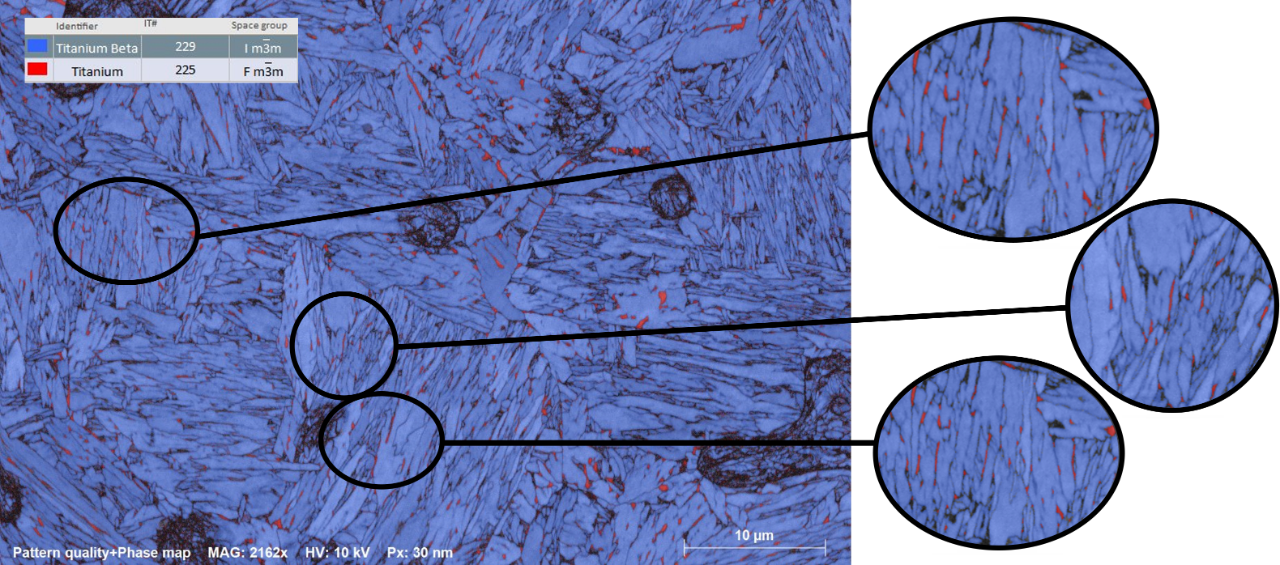
In this example, a bulk martensite sample containing retained austenite FCC phase is analyzed with the eWARP EBSD detector. Unprecedented high spatial resolution EBSD mapping is performed at 10 kV and 12 nA beam current, with a 30 nm pixel size. These measurement conditions resolved the ultrafine austenite grains, allowing for the precise characterization of their size, shape, and orientation distribution. Acquired and indexed at 4,988 frames per second, a 2.68 Mpixel map is indexed at >90% hit rate with 85,7% of BCC martensite phase and 4,56% of FCC austenite phase fractions (Figure 1).
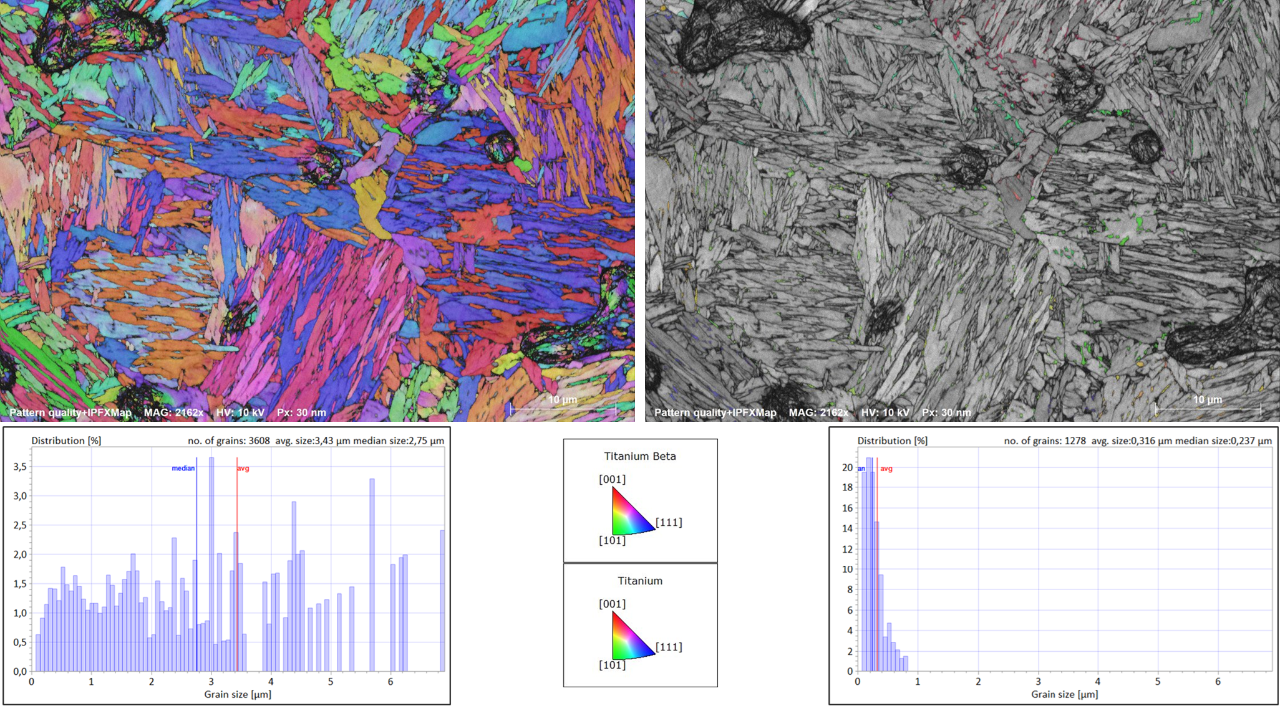
Grain statistics (Figure 2) show the fine austenite structure, with an average size of 300 nm for the 1,278 analyzed grains. The martensitic matrix contains 3,608 grains, averaging 3.4 µm in size. Figure 1 illustrates very thin, needle-shaped austenite grains, measuring 60 to 90 nm in width (2 to 3 pixels).