
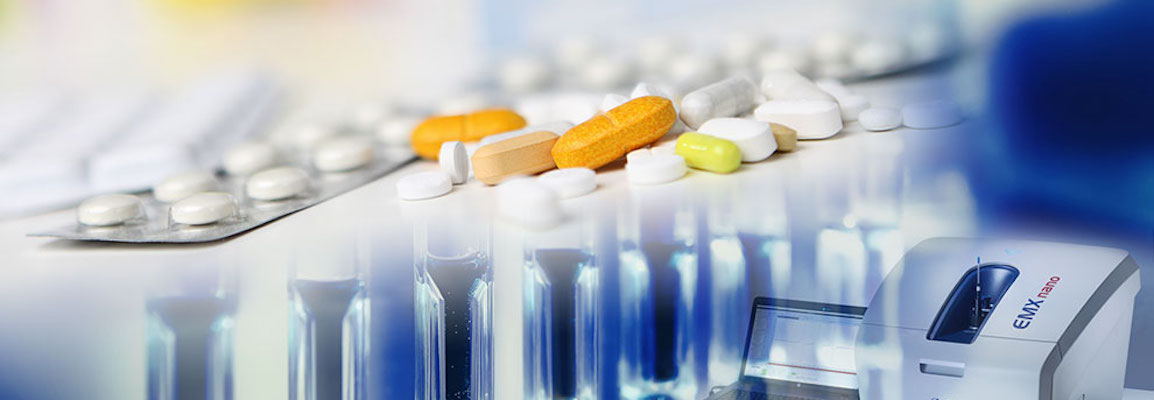
Pharmaceutical Applications of EPR Spectroscopy
The degradation of pharmaceutical products often involves the presence of impurities in the form of free radicals and transition metals. Electron Paramagnetic Resonance (EPR) spectroscopy is the only technique available that can directly and non-invasively detect these impurities. In this webinar, applications scientists Kalina Ranguelova and Ralph Weber from Bruker BioSpin will discuss the use of EPR in the detection of drug impurity, degradation and reaction monitoring.
EPR is 1000 times more sensitive than NMR. By analysing an EPR signal, the user can identify, quantify and monitor temporal behavior of the impurities at extremely low levels - down to parts per billion.
What to Expect
The speakers will introduce Bruker’s EMXnano bench-top EPR spectrometer package, which features the following capabilities:
- Determines cause and extent of degradation using just a tiny sample amount
- SpinCount tool quantifies impurity level and whether further purification is required
- Accommodates room-temperature between 100 and 425 K
- Photochemistry and photooxidation experiments
- Quantifies free radical concentration following sterilization
- Reaction monitoring
Who Should Attend?
- General managers involved in quality control and R&D related to drug degradation
- Academics who collaborate with pharmaceutical companies to develop drugs and optimize reaction conditions
- Researchers who study therapeutic proteins and reactive oxygen species in animals as part of drug development