

Cutting Edge Imaging: Harnessing Diamond Probes for Advanced AFM Performance
Diamond probes enhance AFM precision, throughput, and lifetime
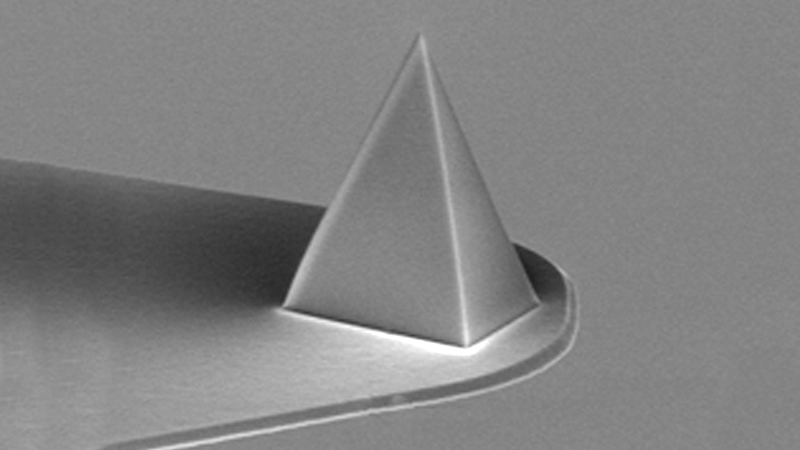
Diamond‑based AFM probes are redefining what is possible in nanoscale characterization, enabling researchers and engineers to push the limits of resolution, durability, and multifunctional measurement. This webinar brings together three experienced AFM specialists to showcase the value of modern diamond probe technologies.
Join us for this webinar to learn about:
- Unique material advantages of diamond probes
- Probe types engineered for high-resolution topography and persistent sharpness
- Electrical imaging and analysis with conductive diamond probes
- Cutting-edge application-driven use cases for diamond probes
Webinar Summary
Diamond‑based AFM probes add immense value for advanced scientific and industrial workflows. This webinar features three experienced AFM specialists—Ian Armstrong, Peter De Wolf, and Hector Cavazos—who will cover:
- Unique material advantages of diamond probes, including exceptional hardness, chemical inertness, conductivity options, and long‑term wear resistance. These properties make diamond‑tipped probes uniquely suited for demanding applications in which conventional silicon or metal-coated silicon probes rapidly degrade or lose fidelity.
- Probe types engineered for high-resolution topography and persistent sharpness, emphasizing how diamond tips maintain imaging quality over rough or abrasive surfaces. Data examples will highlight the consistent performance of diamond probes in roughness quantification, long‑duration wear studies, and high‑speed scanning scenarios.
- Electrical imaging and analysis with conductive diamond probes. Diamond’s conductivity and robustness support stable, repeatable electrical characterization—even under high contact forces. Examples demonstrate how conductive diamond probes excel in techniques such as scanning spreading resistance microscopy (SSRM), TUNA-style current mapping, and nanoscale conductivity measurements on challenging materials.
- Cutting-edge application‑driven case studies, including the use of diamond probes in photomask repair, semiconductor defect analysis, and harsh‑environment metrology. Examples will illustrate how the mechanical resilience and multifunctionality of diamond probes enable workflows not feasible with traditional probe materials.
Attendees will leave with practical guidance for selecting and deploying diamond probes to enhance AFM precision, throughput, and lifetime across a broad range of advanced applications.
Find out more about the technology featured in this webinar or our other solutions for Atomic Force Microscopy:
Speakers

Hector Cavazos, General Manager, Adama Innovations
An entrepreneur from Santa Barbara, California where his AFM career began at Digital Instruments. He has a degree in Applied Mathematics from UC Santa Barbara. He has been a principal and founder of prior start-up companies in the same field with a focus on micro-machining, business, and technology development

Ian Armstrong, Ph.D., Senior Manager AFM Probes, Bruker
Ian Armstrong has worked at Bruker for over 16 years in various roles from applications to product management. He is currently senior manager of Bruker's AFM probes business unit.

Peter De Wolf, Ph.D., Director of Technology & Application Development
Peter De Wolf is director for AFM technology & application development at Bruker Nano Surfaces, covering all applications related to Scanning Probe Microscopy (SPM). He obtained his PhD from IMEC, Belgium on the development of new SPM methods for 2D carrier profiling in semiconductors and has more than 25 years of experience on SPM. He is the author and co-author of over 30 publications related to electrical characterization using SPM. He also owns several SPM patents, and developed several new SPM modes for electrical characterization.