Tech Note: Deciphering Brain Function with the World's First Multi-Region Miniscope
Supporting advanced neuroscience research with a complete hardware and software solution
In this technical note, readers will learn about Bruker’s Quartet multi-region miniscope, a single-channel, multi-region imaging technology for neuroscience research. Discover how it’s lightweight design and unique features support freely behaving paradigms, including rotary assays and swimming tests.
Readers can expect to learn more about:
- Bruker’s Quartet imaging capabilities and benefits to neuroscientists
- Quartet’s hardware and software features, including lightweight imaging fiber bundles and compact GRIN lenses
- How to target hard-to-reach areas with surgical accessories
- Off-head electronics make Quartet suitable for diverse behavioral paradigms
KEYWORDS: Quartet, multi-region miniscope, neuroscience, brain imaging, GRIN lens

Introduction
Simultaneously following the activities of sub-types and/or subpopulations of neurons in multiple brain regions during naturalistic behavior is critical for understanding how the brain encodes, integrates, and processes information. Bruker's Quartet is the only patented multiregion miniscope that offers simultaneous calcium imaging of multiple brain regions in freely behaving animals, enabling greater insights into brain function. This technical note introduces Quartet and its user workflow, and provides examples of brain data the system generates in correlation with various behavior paradigms.
Complete Hardware and Software Solution for Neuroscientists
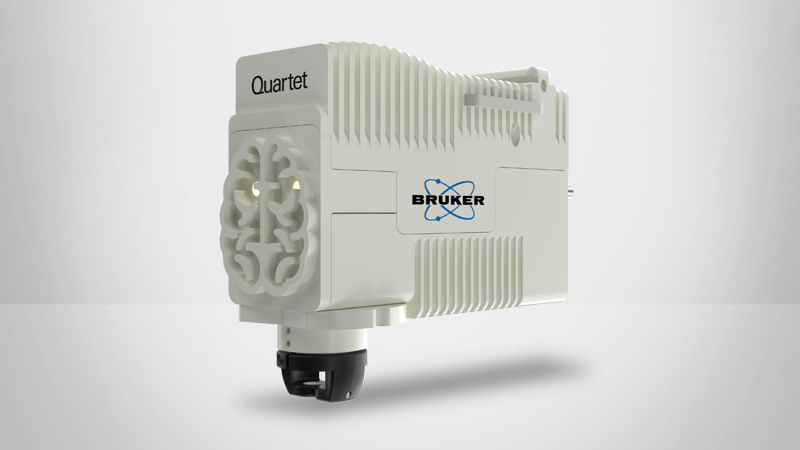
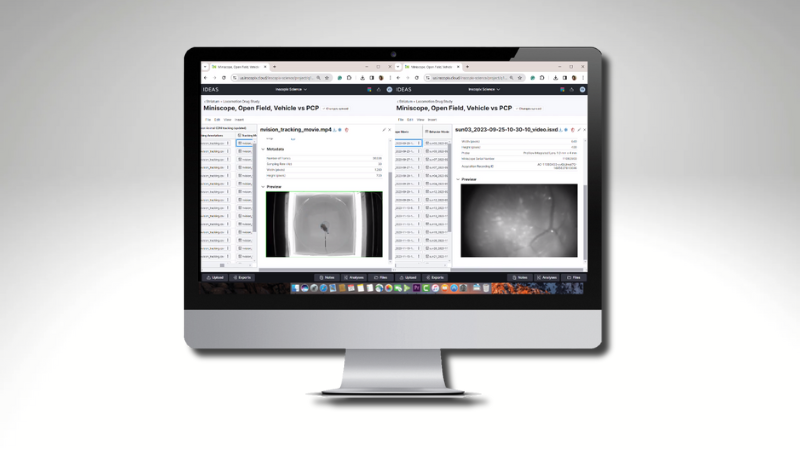
The brain functions as a complex mechanism, predicated on the delicate interplay of communication between inhibitory and excitatory neurons across multiple regions. Quartet is a hardware and software solution for multi-region miniscope imaging that assists neuroscientists conducting preclinical research aimed at understanding the brain at both intraregional and interregional circuit levels. Quartet employs four highly flexible and lightweight imaging fiber bundles, facilitating the imaging of up to four distinct brain areas in subjects engaging in free behavior or enabling the simultaneous imaging of multiple subjects for high-throughput screening. Figure 1 shows how these IFBs enable the transfer of illumination and images to and from the miniature fluorescence microscope, which is away from the head of the animal and gets situated above the behavior paradigm. The software allows users to capture dynamic neuronal signals, adjusting illumination and contrast for optimal data collection. The brain movies are compatible with automated neuronal segmentation, such as IDPS/IDEAS.1,2

Compact and Lightweight GRIN Lens Connectors
Multi-region miniscopes utilize GRIN lens that are designed to have a very small footprint, enabling their use in the most demanding imaging experiments. Figure 2 depicts how a GRIN lens has a cylindrical shape with its flat ends facing the object and the image while a graded refractive index profile created in the glass cylinder enables it to refract the light rays similar to a regular lens. With the correct choice of design, a GRIN lens can form the real image of neurons on its distal end, out of the brain. A second system of optics, such as the imaging fibers of Quartet, then picks up the real image and transmits it to the rest of the microscope.


Up to four GRIN lenses can be surgically implanted into brain regions of interest with Quartet. The GRIN lenses are designed to be implanted at various angles and have a focus-lock mechanism, allowing the imaging of hard-to-reach brain regions in birds, rodents, and juvenile animals. Fitting four GRIN lenses on the head of an animal as small as a mouse has resulted in them having a small size and tear-shaped form factor, collectively weighing less than 1.5 grams. Furthermore, the Piccolo surgical accessory holds the GRIN lens and connects to a stereotaxic frame to facilitate surgeries and accurate targeting of the brain region of interest.
Flexible and Lightweight Imaging Fiber Bundles
During an imaging-behavior session, imaging fibers are connected to the implanted GRIN lenses, via a simple, yet stable, magnetic mechanism. Each imaging fiber bundle is 84 cm in length and these bundles transmit the illumination light from the LED source (470 nm) to the implanted GRIN lenses. The Illumination source is optimized for imaging green fluorescent proteins, such as GCaMP.3 The illumination mode is continuous, and the user can vary the power level from 0 to 1.5 mW. Each GRIN lens focuses the illumination light on the neurons in its proximal end, which is secured in the brain tissue, and then forms the image of neurons above its distal end from the brain. The same illumination imaging fiber bundle then picks up this image and transmits it to the camera through a set of focusing optics.4

Supporting Various Behavioral Paradigms
The imaging fiber bundles' design ensures adaptability across a spectrum of behavioral paradigms, including open field tests, swimming assays, various mazes, (sp) operant boxes such as lever tasks (reward, decision-making), touch screens, and rotary assays.4 Quartet’s seamless integration with external behavior tracking systems allows for concurrent capture of neural and behavioral data.
The swimming test serves as an example of a behavioral assay, which becomes particularly complex when recording brain activity using systems with electronics mounted on the animal's head. However, the Quartet system’s off-the-head electronics enable neuroscientists to easily follow the activities of neurons in multiple brain regions during swimming tests. These experiments are used in various neuroscience investigations, notably as a well-accepted animal model of depression.
The Quartet system's utility also extends to high-throughput screening endeavors, particularly when the dimensions of the behavioral paradigm do not exceed 30 cm X 30 cm, allowing for the implantation of one GRIN lens per subject and the simultaneous brain and behavior recording of up to four subjects.

Innovative Multi-Region Miniscope for Neuroscientists
This technical note discussed the Quartet system, a pioneer single-channel, multi-region imaging technology designed for the observation of circuit-level activity with cellular resolution. It is optimized for GCaMP imaging across distributed brain regions, whether cortical, subcortical, or within deep brain structures. The Quartet's flexibility and lightweight design renders it an invaluable tool for the most rigorous freely behaving paradigms in neuroscience research. Born from the collaborative efforts of scientists and engineers, the Quartet system signifies a significant advancement in the quest to enhance our understanding of the brain, with the ultimate objective of improving the diagnosis and treatment of central nervous system disorders.

References
- Inscopix IDPS/IDEAS.
- Stamatakis, A.M., Resendez, S.L., Chen, K.S., Favero, M., Liang-Guallpa, J., Nassi, J.J., Neufeld, S.Q., Visscher, K. and Ghosh, K.K., Miniature microscopes for manipulating and recording in vivo brain activity. Microscopy, 70(5), pp.399-414 (2021). https://doi.org/10.1093/jmicro/dfab028.
- Bruker Webinar. Multi-region Calcium Imaging in Freely‑behaving Animals. (2023). https://www.bruker.com/en/news-and-events/webinars/2023/multi-region-calcium-imaging-in-freely-behaving-animals.html.
- Bruker Webinar. Exploring Neural Circuits with Quartet: An Innovative Multi-Region Miniscope for Capturing Diverse Calcium Dynamics During Free Behavior. (2024). https://www.bruker.com/en/news-and-events/webinars/2024/exploring-neural-circuits-with-quartet-an-innovative-multi-region-miniscope-for-capturing-diverse-calcium-dynamics-during-free-behavior.html.