NeuraLight 3D Ultra
Spatial Light Modulation (SLM) for Ultima Microscopes
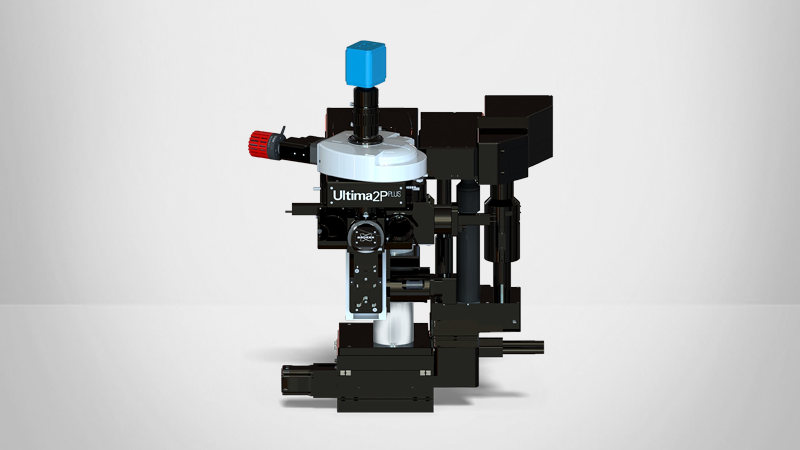
The NeuraLight 3D Ultra™ module provides revolutionary 3D holographic photostimulation capabilities specifically optimized for functional and large-scale studies on brain computation and neural networks.
Building upon Bruker’s previous SLM technology and complementing the functionality of the Ultima family of multiphoton microscopes, the NeuraLight 3D Ultra module utilizes a new, larger, liquid crystal chip that unlocks access to a larger field of view. This enables more uniform optical manipulation of cells with 2x greater axial precision and 4x faster response times that mimic neuronal firing, providing a time resolution well-suited for neuroscience research.

How NeuraLight 3D Ultra Extends Ultima System Capabilities
In this video: Jimmy Fong (Director, Products and Technology, Bruker Fluorescence Microscopy) introduces the NeuraLight 3D Ultra spatial light modulator and explains how its expanded field of view, improved stimulation resolution, and high pattern‑switching speed enable more precise and flexible neural activation. He highlights how the system supports rapid, multi‑site and multi‑plane stimulation, including 3D activation workflows with simultaneous imaging.
The video also covers software and workflow design considerations — showing how Bruker simplifies complex holographic stimulation experiments, supports closed‑loop operation through open APIs, and enables real‑time data analysis, including AI‑based processing.
Contact us or continue reading to learn more.
3D Optical Stimulation and Multiphoton Imaging Combined
Titrate precise, simultaneous, multicell stimulation in a 3D volume for in vivo studies
The NeuraLight 3D Ultra SLM leverages the flexibility of Ultima’s modular platform design, in addition to the new and enhanced liquid crystal chip, to create 3D laser holograms for simultaneous stimulation of cells in three dimensions. Coupled with a set of 6-millimeter galvanometers, NeuraLight 3D Ultra enables multiple stimulation points in a spiral scan pattern for projection in a 3D volume.
Perform multiplexed subcellular photoactivation
NeuraLight 3D Ultra can also generate precise, diffraction-limited points in a 3D space with subcellular resolution. Stimulation patterns targeting individual synapses or groups of synapses can be produced, allowing researchers to probe neural connectivity and signaling. Sequencing of stimulation patterns enables researchers to automate studies examining signal summation in individual neurons or in groups of neurons.

Target Functional Ensembles of Neurons
Rapidly switch between stimulation patterns
The improved time resolution of Neuralight 3D Ultra allows holographic masks to be rapidly changed at an industry-leading rate of 600Hz or within 1.6ms between activation patterns while imaging, recording electrical signals, and triggering behavioral and electrical stimuli data that are collected by an Ultima system. For in vivo studies, this provides a tool to mimic neuronal firing produced by behavioral stimuli. For subcellular studies examining connectivity and signaling, complex signal summation studies can be quickly executed.
Generate 3D activation patterns while imaging and recording electrical signals
The module includes a complete software toolkit for generating 3D activation patterns while imaging and recording electrical signals and triggering behavioral and electrical stimuli. A calibration wizard makes calibration a simple and straightforward process. 3D point location is mapped using an acquired Z series of the specimen. This also supports synchronization with imaging (resonant scanning, scanning line scanning, and point detection), along with electrical recording and triggering of electrical or behavioral stimuli.