AI-Assisted Analysis of Viscoelasticity with AFM
Characterize viscoelastic behavior faster with AI-assisted analysis.
In this webinar, guest speaker Prof. Ricardo Garcia (ICMM - CSIC in Madrid), a pioneer in the field of AFM and nanomechanics, speaks about his work combining machine learning with AFM-based nanorheology to characterize the viscoelastic behavior of living cells at high speed and nanoscale resolution.
Then, Joerg Barner (Bruker BioAFM) introduces the new ViscoDirect Software Module, which significantly improves the speed and ease of viscoelastic analysis, simplifying applications such as mechanical gradient mapping, multiscale characterization of cellular structures, and quantification of time-dependent behavior and viscoelastic response.
AI-Assisted Analysis of Viscoelasticity with AFM
PRESENTER'S ABSTRACT
Living Cell Viscoelasticity Powered by AFM and Machine Learning
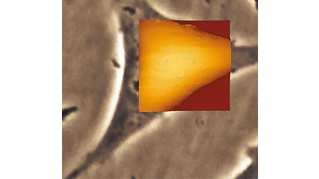
Atomic force microscopy (AFM) is extensively applied to measure the nanomechanical properties of living cells. Despite its popularity, some applications on mechanobiology are limited by the low throughput of the technique. Currently, the analysis of AFM-nanoindentation data is performed by model fitting. Model fitting is slow, data intensive, and prone to error. Herein, a supervised machine learning regressor has been developed for transforming AFM force–distance curves into nanorheological behavior.
The method reduces the computational time required to process the force-volume of a cell, made up of approx. 250,000 curves, from several hours to minutes. In fact, the regressor increases the throughput by 50-fold. The training and the validation of the regressor are performed by using theoretical curves derived from a contact mechanics model that combined power–law rheology with bottom effect corrections and functional data analysis. The regressor predicts the modulus and fluidity coefficient of mammalian cells with a relative error below 4%.
SUMMARY
ViscoDirect Software Module Introduction and Demonstration
The ViscoDirect session introduces and demonstrates how this software module enables the automated, AI-assisted viscoelastic analysis of living cells, tissues, and soft matter, significantly improving the speed and ease of atomic force microscopy (AFM) experiments. Key topics covered include:
- Automated preprocessing of force curves, including contact point detection and correction steps.
- Rapid extraction of the scaling modulus and fluidity coefficient with a 3D power-law rheology model.
- Real-time and post-processing workflows for force-mapping datasets.
- Generation of mechanical-property maps, topography, and model-quality metrics.
- The neural-network approach used to accelerate analysis and reduce user input.
- Practical considerations in the Q&A segment, including licensing, probe selection, calibration, bottom-effect correction, and applications to cells and tissues.
A live demonstration follows the workflow from raw AFM data to viscoelastic property maps, illustrating how ViscoDirect streamlines nanomechanical analysis and reduces processing time for large datasets.
Featured Technologies:
Find out more about the technology featured in this webinar or our other bioafm solutions:
Speakers

Prof. Ricardo Garcia
Advanced Force Microscopy Methods and Optomechanics, ICMM - CSIC, Spain
Prof. Garcia applies a combined theoretical and experimental approach to develop advanced force microscopy techniques for the characterization of materials (biomolecules, cells, polymers, semiconductors) in their native environments (air or liquid). His work includes the pioneering development of 3D-AFM, a high-resolution method that characterizes solid-liquid interfaces, biomolecules, and cells. He has made major contributions to the development of advanced AFM methods, multifrequency and bimodal AFM, and tip-based nanolithography. His work has led to valuable scientific insights into the nanomechanical properties of proteins, cells and polymers. He has published over 200 papers in peer reviewed journals, has had numerous patents granted, and received multiple prizes and awards.

Joerg Barner
Senior Applications Scientist, Bruker BioAFM
Joerg Barner, a Senior Application Scientist at Bruker BioAFM, studied physics at Humboldt University in Berlin, Germany. He is responsible for customer training and instrument installations worldwide. With more than 20 years of AFM experience, his work focuses on the physical and biophysical applications of AFM, from advanced electrical and electrochemical surface characterization to the study of cells, biomolecules, and other biological systems. His expertise includes nanomechanical characterization using force spectroscopy, indentation, and microrheology, as well as the investigation of dynamic mechanisms using high-speed AFM imaging. Joerg works closely with researchers around the world to develop and implement innovative AFM methodologies for cutting-edge scientific applications.