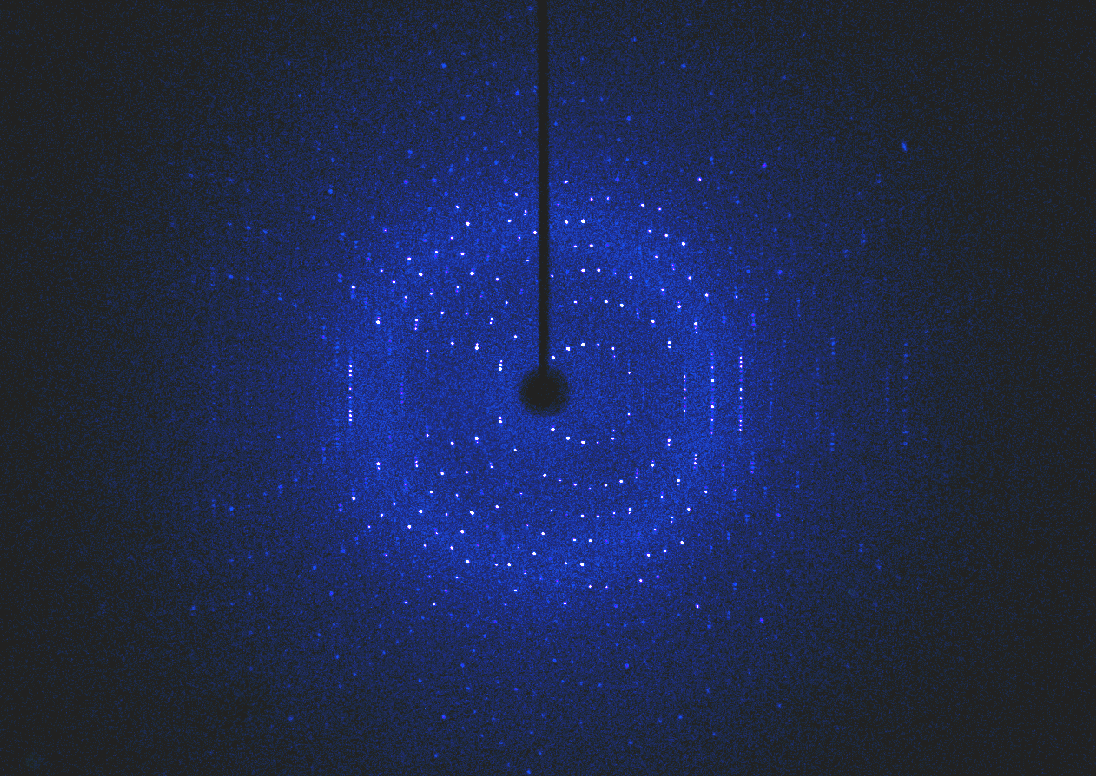
Count Every Photon
Every photon matters when your data needs to be accurate.
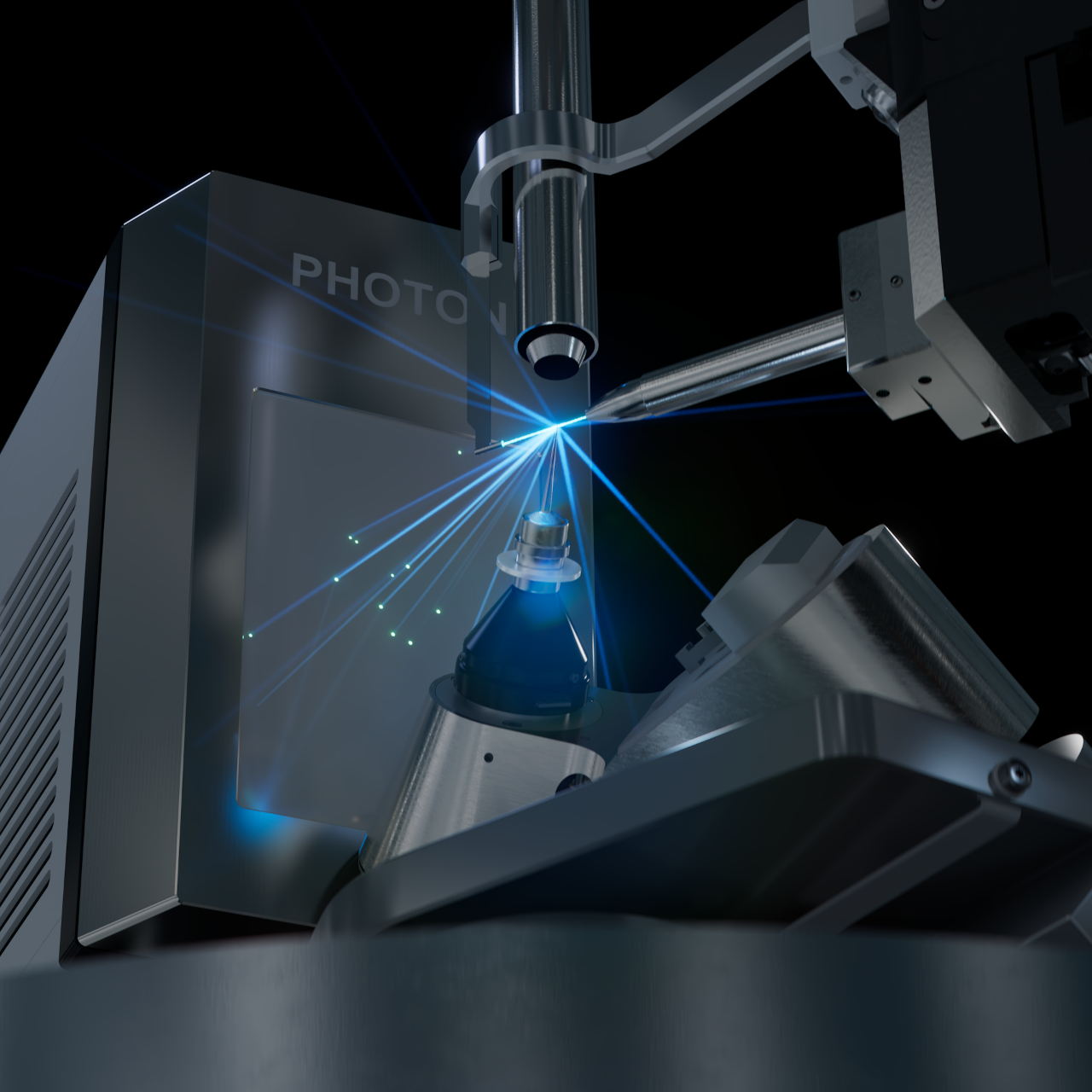
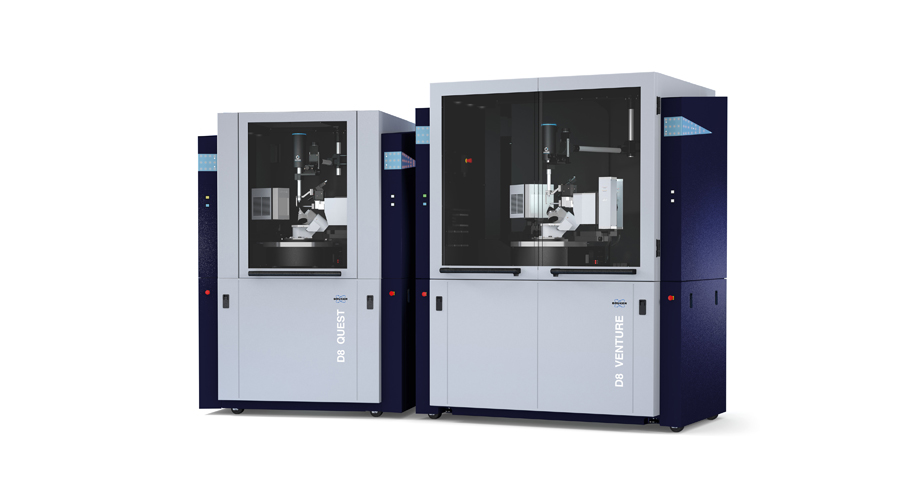
PHOTON IV - built into every Bruker D8 QUEST and D8 VENTURE - delivers a quantum efficiency that outperforms silicon-based HPAD detectors.
Powered by advanced indirect detection, PHOTON IV captures what other detectors miss.
PHOTON IV: CPAD Detector with an Industry-Leading Quantum Efficiency
PHOTON IV is Bruker's advanced Charge-Integrating Pixel Array Detector (CPAD) for crystallography, engineered to deliver data of outstanding quality to the home lab.
PHOTON IV uses indirect detection with a rare-earth scintillator and state-of-the-art monolithic CMOS sensor to deliver an industry-leading quantum efficiency across all home X-ray source wavelengths.
The result is an enhanced signal, less noise, and clearer data for confident structure determination, even when working with challenging crystals.
Count on Your Detector with PHOTON IV:
PHOTON IV is a detector that you can count on:
- Unmatched efficiency for all wavelengths: Collect better data faster, regardless of your X-ray source.
- Not a single photon lost: Ensure data collection without blind gaps using the large continuous active area of the CMOS sensor.
- Excellent spatial resolution: Minimize parallax and collect sharp, undistorted reflections thanks to an ultra-thin rare-earth absorption layer.
- Zero readout noise: Capture intensities of even weak reflections using real-time, event-based photon counting.
- No charge sharing noise: Off-pixel photon counting exactly recombines fractional charges from adjacent pixels.
- 32-bit image depth: Simultaneous measurement of strong and weak reflections in a single frame.
- Maintenance-free reliability: Maximize uptime with high reliability and an air‑cooled design with no chiller required.
- Built to last: Backed by a 3‑year warranty.

One Monolithic CMOS Sensor, Two Sizes

PHOTON IV is available in two active area configurations, both with a single monolithic sensor. Choose the size that best matches your application needs.
PHOTON IV 8: Monolithic CMOS sensor with 8,000 mm2 active area
Optimized for small molecule crystallography, the PHOTON IV 8 maximizes 2-theta coverage in the vertical plane.
PHOTON IV 16: Monolithic CMOS sensor with 16,000 mm2 active area
Our largest detector available for home-laboratory crystallography. The PHOTON IV 16 is ideal for large unit cell structures, twinned and modulated crystals, and powder diffraction experiments.
Superior Quantum Efficiency For All Wavelengths - From Copper to Silver
PHOTON IV's CPAD detector delivers a high absorption efficiency across the full range of home-lab X-ray source wavelengths - from Cu through to Ag.
The detector's high absorption efficiency over a wide range of X-ray energies gives you the freedom to choose the wavelengths best matching your applications, without being restricted by detector sensitivity constraints.
In contrast, silicon-based HPC detectors suffer from a severe drop in efficiency at higher energies. For researchers depending on short wavelength data, that signal loss leads to a significant, but avoidable, loss of data quality

Comparison of the absorption efficiency of a PHOTON IV CPAD detector against a standard Silicon HPC detector.
PHOTON IV is substantially more efficient at absorbing X-rays of higher energies, such as Mo and Ag, when compared to silicon-based direct detectors.
Minimizing Parallax via Indirect Detection for Sharp, Undistorted Reflections
Parallax degrades spatial resolution and when using conventional silicon-based detectors its effects can become increasingly severe at higher X-ray energies, with deeper photon penetration causing signal spread across adjacent pixels.
PHOTON IV's indirect detection design addresses this directly. An ultra-thin rare-earth scintillator layer ensures X-ray conversion occurs within a tightly confined region at the detector surface, preserving the positional accuracy of every recorded photon.
The result is sharp, well-defined reflection profiles with minimal distortion - delivering the spatial resolution needed for unambiguous data and confident structure determination.

PHOTON IV: Trusted by Researchers Worldwide
Researchers at leading institutions around the world rely on PHOTON IV to deliver the data quality their work demands. Here is what some of them have to say:

"We are impressed by the large area PHOTON IV detector, which perfectly matches the high intensity X-ray source. Even for our typically thin micro-crystals, we obtain high-quality datasets in just 15–20 minutes."
Dr. Fengxia Wei, Dr. Mohan Bhadbhade, Dr. Ruoming Tian - The University of New South Wales - Sydney, Australia

"Within all measurements, but with Cu-radiation in particular, we take advantage of the large 140 cm² active area of the PHOTON IV detector."
Prof. Ganesan Prabusankar (left) - IIT (Indian Institute of Technology) - Hyderabad, India
Learn More about Bruker's Detectors for Crystallography
Resources
Brochures & Product Sheets
White Papers
Scientific Papers
Technical & Application notes
- X-ray Detectors for Home Laboratory Macromolecular Crystallography: Does Size Matter?
- Good, Better, Best: Photon Counting, Integration and Mixed-mode Detection
- Advanced Large Area Indirect X-ray Detectors
- Charge Sharing in Pixel Array Detectors: Origins, Impact on Data Quality and Solutions
- New Developments in Pixel Arrays: Hybrid Photon Counting and Charge-Integrating Pixel Detectors
- Improved data quality for high-energy measurements with the PHOTON IV HE detector
- When One Crystal Is Not Enough: Better Completeness with Multiple-Crystal High-Pressure Experiments
- D8 VENTURE METALJET - GPCR Crystallography Moves In-House: Structure of the Human Orexin-1 StaR® to 2.77 Å