
The Acquifer HIVE
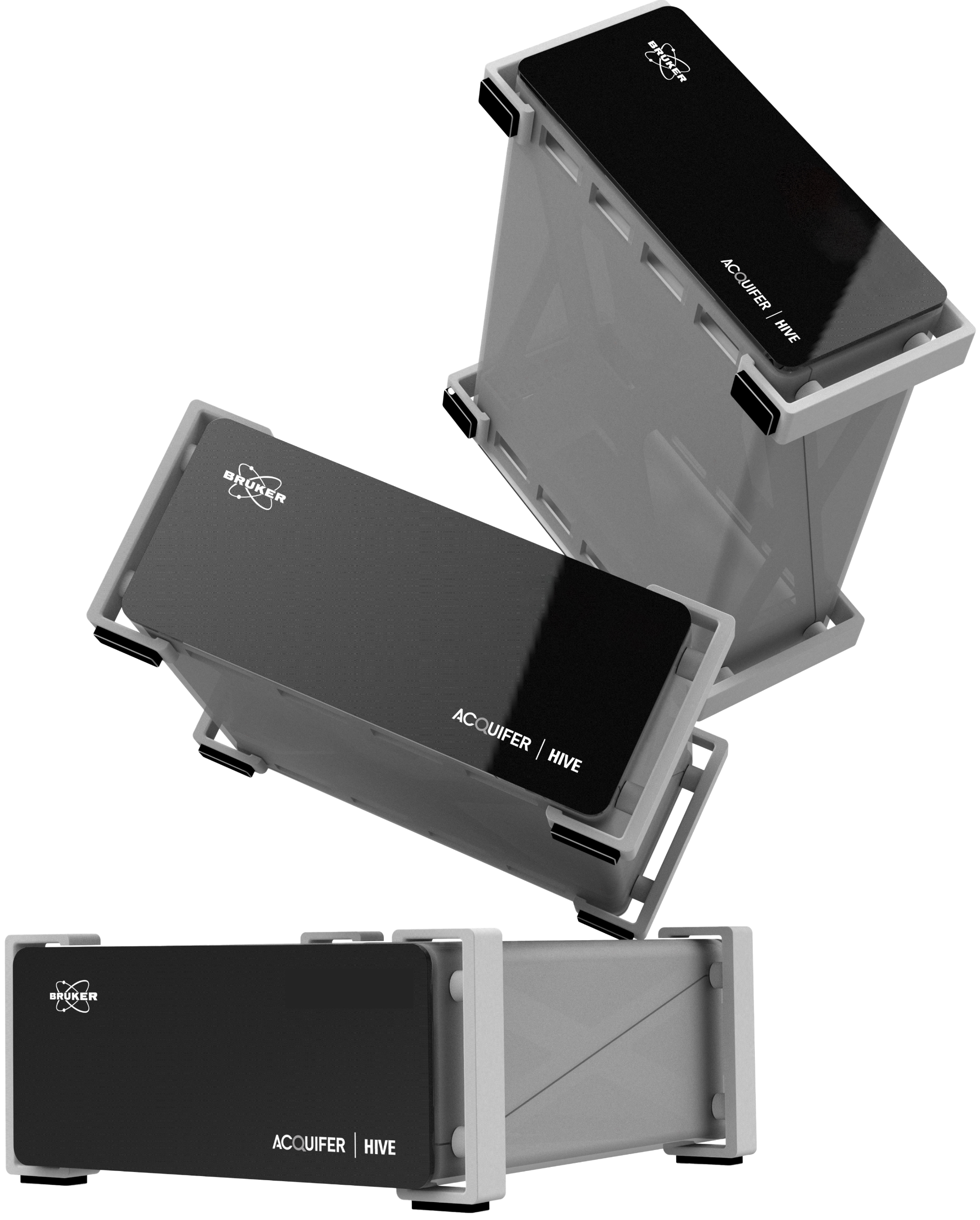
Specialized Big Data Management with Acquifer HIVE
Bruker’s Acquifer HIVE is engineered to deliver high‑speed, integrated data processing and storage, combining powerful CPU/GPU computing with a unified on-premises architecture, eliminating transfer delays and accelerating analysis. At the same time, it provides a centralized, secure, and scalable data infrastructure for large scientific datasets, ensuring researchers can access, manage, and process microscopy data from anywhere while keeping sensitive information safely onsite. Designed with robust redundancy and system reliability, the Acquifer HIVE safeguards data integrity and maintains continuous operation even in the event of component failure.
Ideal for research groups, facilities and institutes working with high‑content imaging, multi-omics, and other data-intensive applications, Acquifer HIVE supports a wide range of instruments and seamlessly integrates with major image‑processing software.
To learn more, continue reading, download the brochure, see FAQs about this platform, or watch an in‑depth overview of this platform's capabilities and use cases in our Acquifer HIVE webinar.
A Unified Platform for Microscopy Data: Store, Process, Access
Acquifer HIVE combines processing, storage, networking, and protection in one system for high‑volume microscopy. Acquifer HIVE uniquely provides:
Data storage and processing in the same place, enabling immediate analysis without transfers or duplication.
Centralized access for every microscope for a secure, vendor‑agnostic environment for multi‑user, multi‑instrument workflows.
Resilient storage for critical experiments, protecting long‑running acquisitions with a no‑single‑point‑of‑failure design.
Modules that scale with research needs, allowing storage, compute, networking, and GPU resources to grow as facilities evolve.
Data Storage and Processing in the Same Place
The Acquifer HIVE brings computation and storage together in a single, integrated system, designed by microscopists who understand the bottlenecks of 3D, 4D, and high-volume imaging workflows. Researchers can now process data directly where it is acquired, instead of waiting on read/write delays or duplicating terabytes between instruments and workstations.
With the latest‑generation AMD Threadripper PRO and AMD EPYC CPUs, up to 2 TB DDR5 RAM, and NVIDIA Blackwell series GPUs, Acquifer HIVE delivers up to 3x faster performance than previous models, giving scientists immediate access to analysis tools. This integrated architecture removes unnecessary transfer steps, accelerates processing pipelines, and ensures stable, high-bandwidth performance even during multi-user, parallel workloads.
Centralized Access for Every Microscope
The Acquifer HIVE serves as a centralized, on-premises data environment purpose-built for microscopy and other data-intensive research. It provides secure, unified storage for all image datasets, no matter the microscope vendor, modality, or analysis software, commercial or open source. Researchers benefit from fast, reliable access from anywhere in the world via VPN and Windows Remote Desktop protocol, supporting both local and international collaboration.
The Acquifer HIVE was designed by microscopists for scientists, resulting in an interface and data organization that are intuitive for scientific users, avoiding the need for IT expertise while still meeting institutional security requirements. The Acquifer HIVE can be fully integrated and connected to the existing network infrastructure. Uniquely, it is tailor-made for different applications and is scalable through modular storage and GPU expansions. The Acquifer HIVE evolves alongside growing labs and new high-throughput instruments.
Resilient Storage for Critical Experiments
Long-running microscopy experiments, multi system data acquisition, and sensitive datasets require a system that does not fail, especially at high workload. The Acquifer HIVE is engineered with a redundant design, allowing mirrored components to take over automatically if a hardware element fails, protecting both data integrity and experimental continuity. RAID-based storage, enterprise-grade firewalls, and an integrated uninterruptible power supply ensure that even in the face of interruptions, data remains secure and accessible.
In addition to hardware, Acquifer HIVE comes with personalized support from scientists and IT experts who understand scientific workflows and large data processing requirements. A combination of robust engineering, deep knowledge of microscopy and other scientific workflows, expertise in commercial and open-source data processing software and a long track record supporting more than 150 installed systems gives researchers confidence that their data and their experiments are protected from acquisition through analysis to publication.
Modules Built to Grow with Research Needs
The Acquifer HIVE’s modular design ensures that capacity and performance scale with the project requirements. The ability to add storage, GPU acceleration, or faster networking results in improved operations and fewer IT hurdles, enabling teams to stay focused on acquisition, analysis, and results as facilities evolve over time.
Central to the Acquifer HIVE is the CORE, the data processing unit.
The three available standard modules include:
- DATA for fast and secure storage
- NET for communication, 10 Gbit/s connection to all your microscopes
- GPU for visualization, GPU processing and machine learning
Two extension to the Acquifer HIVE ecosystem, are the:
- SAT for encapsulated computation and hardware control
- BACKUP for data safety
The Acquifer HIVE is a modular system, and its core modules are suited for computation, storage, and networking.

HIVE CORE - Data Processing

The Acquifer HIVE combines processing computing power and storage, eliminating the need for data transfers and copying. This streamlined approach is supported by a dedicated high-bandwidth network with up to 100 Gbit/s speed, ensuring uninterrupted network traffic.
The Acquifer HIVE works with virtually all supplier's microscopy instruments and processing software solutions, including Windows, Fiji, Knime, OMERO, Arivis Vision4D, Imaris, ZEN, LAS X, Nikon Elements, Huygens, Python, and CellProfiler.
This compatibility with systems and solutions guarantees wide usability across laboratory setups and research environments.
Developed by microscopists, Acquifer HIVE is built around a deep understanding of the data challenges faced by high‑volume imaging and other data‑intensive research fields. As experiments generate hundreds of gigabytes to terabytes of data, Acquifer HIVE addresses common pain points such as fragmented storage, slow data movement, and unmanaged copying across systems. The platform continues to evolve through a modular architecture that improves performance, scalability, and usability while remaining locally deployed and researcher‑controlled.
HIVE Pro, the next generation of the HIVE CORE, extends performance and modular capabilities to support increasingly data‑intensive research workflows.
Watch the webinar to learn about the future of Acquifer HIVE, including next‑generation HIVE Pro and its approach to big‑data management.
HIVE DATA - Storage
The HIVE DATA offers a range of highly scalable storage solutions designed for both speed and data safety. With storage units available from 52 to 364 TB, users can choose the configuration that best suits their data needs. The data transfer rate of 3 GB/s for internal input/output to the HIVE CORE ensures swift access and efficient data handling.
HIVE NET - Communication
Acquifer HIVE ensures the utmost security of your data with several robust measures. RAID systems establish data protection by being distributed across multiple drives, reducing the risk of data loss in case of drive failures. A security firewall prevents unauthorized access by controlling network traffic. The Uninterruptible Power Supply (UPS) provides a continuous and stable power source that safeguards against power outages and potential data corruption.
The Acquifer HIVE can be accessed from wherever you are with a secure connection using Remote Desktop Protocol. The implementation of multi-user login allows for simultaneous collaborative work, which promotes efficiency and flexibility in data management and analysis.

HIVE GPU - Computation and AI
The HIVE GPU proivdes unparalleled processing power for demanding applications. It uses NVIDIA's professional CUDA-capable boards for GPU-processing capabilities. Each HIVE GPU unit can accommodate up to 4 dual-slot GPUs, including the high-performance NVIDIA RTX Blackwell series.
HIVE CORE stands out as a computing powerhouse, offering both flexibility and high-performance capabilities. It is an ideal solution for a wide range of applications in research, data analysis, and other compute-intensive tasks.


HIVE at Trends in Microscopy 2025 in Germany
At Trends in Microscopy 2025 (organized by German BioImaging, GerBI-GMB) in Münsingen, Germany, in March 2025, three Bruker Acquifer HIVEs were used across three campus buildings. The buildings were connected by nearly 2 km of internal cabling and an efficient 10 Gbit fibre network across campus. Over five days, up to 80 users accessed the HIVE simultaneously during software workshops.
- Before the event: To ensure smooth data storage and processing during the event, the HIVE team preconfigured about 100 desktops with relevant software, licences, and datasets.
- During the event: The HIVE infrastructure enabled fast data storage of data from over 20 microscopy systems and workshops, with data flows supported by OMERO data stewards. In addition to centralized data storage, the HIVE was used as a platform for image data processing and analysis workshops, hosting specialized Virtual Machines for OMERO, Jupyter, and SeaTable.
- After the event: All data were transferred to a public OMERO instance (https://omero-tim.gerbi-gmb.de/webclient/), ensuring long-term, open access to the datasets, maintained by GerBI-GMB. The setup demonstrated HIVE’s power as a scalable, event-ready solution for collaborative scientific imaging.
HIVE bridged the gap between acquisition, long-term storage, and a high-performance, shared workspace tailored for these workflows.

For TiM 2025, HIVEs were preconfigured with relevant software, licences, and datasets before the event.

Case Study 2: HIVE at the EMBO Light-Sheet Course 2025 in Germany
The EMBO light-sheet course is a pillar event for the light-sheet community, bringing together microscopists, physicists, image analysts, and experienced light-sheet instructors. In August 2025, the event was held in Dresden over 12 days.
The HIVE infrastructure for the event comprised four HIVEs across two buildings, which integrated data from 12 light-sheet fluorescence microscopy (LSFM) systems within the MPI-CBG network through a dedicated 10 Gbit network. With 400 TB storage capacity and a multi-GPU server supporting dynamically configured virtual machines, the setup enabled centralized data storage, processing, and analysis for a wide range of light-sheet imaging workflows.
HIVE at the EMBO LSFM course 2025 during course setup:
In preparation for the event, 45 user accounts were set up, of which up to 20 were used simultaneously during workshops. Software and respective licenses were pre-installed, and demo datasets were made available for teaching.
During the twelve-day event, the system handled 80 TB of original data.
Widely used tools and languages included Fiji8 (e.g., BigStitcher, Mastodon), Napari, Stardist, Blender, Imaris, ZEN, and others. In addition, specialized virtual machines for software applications such as Aivia and Cellpose were used.
Together, the HIVEs provided robust, scalable, and high-performance data management and analysis for microscopy, proving to be an essential solution for managing, processing, and securing large-scale scientific data at the event.


The HIVE infrastructure for EMBO 2025 comprised four HIVEs across two buildings.

Acquifer HIVE Select Specifications
| Data Processing |
|
|---|---|
| Scalable High-Speed Storage |
|
| GPU Processing |
|
| Ease-of-Use |
|
| System Compatibility |
|
* Acquifer HIVE is made to order based on your requirements. Later extensions and upgrades are easily implemented.
| |
HIVE Dashboard
Acquifer HIVE setup and maintenance is designed with end users in mind, meaning that users need no special expertise in software or hardware. This ease-of-use is maintained all while retaining secure project management.




Frequently Asked Questions
Operating System, Network, and Data Processing
The Acquifer HIVE seamlessly integrates with existing image-processing computers. You can connect your workstations to the Acquifer HIVE’s NET module, using up to 100 Gbit/s per workstation, depending on your configuration.
In most cases, you can work with the data on the Acquifer HIVE without copying them to the workstation. Sometimes, transferring the data to your workstation is preferrable.
The DATA module has 15 HDDs; 13 are used for net storage whereas two are used for data safety on RAID6 level. We use data center-grade SATA HDDs of 4 to 18 TB capacity, so the storage range is from 13 x 4 TB = 52 TB to 13 x 18 TB = 234 TB.
Further DATA modules can be easily added if you require more storage.
If your Acquifer HIVE has an old operating system (OS), such as Server 2012R2 and Server 2016, updating to Server 2022 will ensure you get security updates or bug fixes. Also, the newest Server 2022 is based on Windows 10 OS, so the application support is better.
If you decide to update, please contact us at support.acquifer@bruker.com, and you will receive the needed instructions, license guidance, and hardware from our team.
Yes, you can place the NAS on the same network as the Acquifer HIVE. The NAS can also be used for additional data storage, such as temporary storage or long-term backup. To connect the NAS to the Acquifer HIVE’s NET module with an ethernet cable, you need to ensure that both devices are on the same subnet and have compatible network settings. This will allow you to achieve at least 10 Gbit/s network speed.
Although some compatibility issues were observed between Windows Server 2019 (the operating system of the Acquifer HIVE) and OpenCL-based Fiji plugins (CLIJ, 3D script…, etc.) with the default configuration of Fiji, it is still possible to run CLIJ on an Acquifer HIVE. The solution consists of replacing the default Java Runtime Environment (JRE) shipped with Fiji with a custom version (see the detailed instructions here).
We can provide various declinations of the Acquifer HIVE; below is some reference information, but feel free to contact us for a custom configuration.
The CORE module typically has one dual-slot GPU (such as an RTX 5000 or 6000 Ada). Exceptionally, the CORE can also be equipped with two double-slot GPUs.
The GPU module, available as an additional stackable unit for the HIVE, similar to the DATA module, is equipped with up to 8 single-slot or 4 double-slot GPUs. More than one GPU module can be added to the Acquifer HIVE.
You can also “mix and match” with a double-slot GPU in the CORE and single-slot GPUs in the GPU module or vice versa.
Sharing a single GPU between host system and a virtual machine (VM) is not possible but you can pass through a whole PCIe device to a VM. Therefore, if you aim to run VMs on the Acquifer HIVE, you should have at least two GPUs. The HIVE GPU module is the ideal solution for a multi-VM scenario. To pass through the GPUs to a VM, Nvidia requires professional GPUs from the Quadro series or higher.
Yes, on Linux, you can use Remmina, and on Mac, you can download the Windows app from the App Store for a remote desktop connection. There are also various non-freeware tools available.
Physical Acquifer Hive Attributes
Each Acquifer HIVE module has the following dimensions: 63 cm depth, 61 cm width and 26 cm height. The individual modules can be stacked on top of each other.
Yes, the Acquifer HIVE is exceptionally quiet and produces minimal excess heat, so that you can install it directly in an office environment.
The Acquifer HIVE can be plugged into a standard power socket. To secure uninterruptible power, we provide a battery-based uninterruptible power supply (UPS) as part of the NET module.
By default, the Acquifer HIVE is mounted in its own housing. Alternatively, the Acquifer HIVE can be provided without this housing to mount in a standard 19” server rack.
Your Acquifer HIVE comes with one year warranty and one year technical support. For longer-term technical support, you can also purchase a range of service packages for your Acquifer HIVE. Feel free to reach out to our sales team (sales.heidelberg@bruker.com).
It is straightforward to upgrade the Acquifer HIVE thanks to its modular design. Adding more storage, such as a second DATA module, or more GPUs, with an additional GPU module, is especially easy and frequently done. Other upgrades, such as adding more RAM, are possible, too.
Project Management and User Control
Yes, you can use the Windows Quota tool to achieve this. Future updates will allow you to manage this via our Acquifer HIVE Dashboard.
This can be done as a global group policy setting configured for all users connecting via remote desktop. We offer help configuring it.
As the Acquifer HIVE administrator, you can log users off through the Windows Task Manager. Through the Task Manager, you can also terminate processes of other users (e.g. image processing in Imaris).
General Acquifer Hive FAQ
RAID systems, such as the ones in the HIVE CORE and HIVE DATA modules of the Acquifer HIVE, have two main advantages:
- Data safety: RAID systems introduce HDD redundancy. If a disk starts malfunctioning or stops working, your data is safe also during replacement of the faulty disk.
- Faster data access: The multiple hard drives in the RAID system share the load for the read and write operations. This parallelization allows faster data access compared to a single disk drive.
OMERO server run on Linux OS only. It can be hosted on the Acquifer HIVE in a virtual machine with a Linux OS. Alternatively, a HIVE can be connected to a separate OMERO server by means of a fast network connection, i.e., at 100 Gbit/s.
For more information, please contact us at sales.heidelberg@bruker.com.
A software firewall is part of the Windows Server operating system (Windows Defender). Additionally, when you purchase the NET module, the Draytek router provides a hardware firewall, which, by default, blocks all incoming data unless specified otherwise.
Please contact us at sales.acquifer@bruker.com.
A backup is an independent copy of your data on a safe separate device.
As a centralised storage and computing solution, the Acquifer HIVE is not a backup device per se. However, we also provide a backup solution that is optimized to work with the HIVE. Please contact us at sales.acquifer@bruker.com for a customized solution.
Published Application Research
| Year | Journal | Title | Author(s) | Subject |
|---|---|---|---|---|
| 2025 | Heidelberg Thesis | Design and implementation of workflow tools for multiplexed time-lapse imaging experiments in zebrafish screening | Satheesan Sankeert | zebrafish-based screening, multiplexed time-lapse imaging |
| 2024 | Wiley - Light Sheet Fluorescence Microscopy | Light Sheet Fluorescence Microscopy | Emmanuel G. Reynaud, Pavel Tomančák | light-sheet book |
| 2024 | Toxicological Sciences | Corticosteroids alter kidney development and increase glomerular filtration rate in larval zebrafish (Danio rerio) | Jana Heigwer, Petrus J Steenbergen, Jochen Gehrig, Jens H Westhoff | zebrafish, corticosteroid, kidney, development, toxicology |
| 2024 | PhD Thesis Åbo Akademi University | Bioimage Analysis for Life Scientists: Tools for Live Cell Imaging | Joanna Pylvänäinen | image analysis, live cell imaging, experimental design, image processing, deep learning |
| 2023 | Journal of the American Society of Nephrology | A Novel High-Content Screening Assay Identified Belinostat as Protective in a FSGS—Like Zebrafish Model | Schindler Maximilian, Siegerist Florian, Lange Tim, Simm Stefan, Bach Sophia-Marie, Klawitter Marianne, Gehrig Jochen, Gul Sheraz, Endlich Nicole | zebrafish, screening, kidney, development, toxicology |
| 2023 | American Journal of Respiratory Cell and Molecular Biology | Local, Quantitative Morphometry of Fibroproliferative Lung Injury Using Laminin | Brendan P. Cox , Riley T. Hannan, Noora Batrash, Pearl Raichura, Anne I. Sperling, Yun Michael Shim, and Jeffrey M. Sturek | Fibrosis, histology, histopathology, imaging |
| 2020 | Cells | A multiparametric assay platform for simultaneous in vivo assessment of pronephric morphology, renal function and heart rate in larval zebrafish | Petrus J. Steenbergen, Jana Heigwer, Gunjan Pandey, Burkhard Tönshoff, Jochen Gehrig, and Jens H. Westhoff | screening pipeline, drug screening, experimental design , zebrafish |
| 2020 | Front. Cell Dev. Biol. | In vivo High-Content Screening in Zebrafish for Developmental Nephrotoxicity of Approved Drugs | Jens H. Westhoff, Jens H. Westhoff, Petrus J. Steenbergen, Laurent S. V. Thomas, Jana Heigwer, Bruckner Ledean Cooper, Burkhard Tönshoff, Georg F. Hoffmann, Jochen Gehrig | zebrafish, screening, kidney, pronephros, development, toxicology |
| 2020 | PhD Thesis Medizinischen Fakultät Heidelberg | Laurent Thomas | phenotypic screening, software development, image analysis, object-detection | |
| 2019 | IJMS | A smart imaging workflow for organ-specific screening in a cystic kidney zebrafish disease model | Gunjan Pandey, Jens H. Westhoff, Franz Schaefer, and Jochen Gehrig | kidney disease, intraflagellar transport, zebrafish, phenotypic screening |