Application Brief: Evaluating Cutting Tool Coatings with Scratch Testing
Linking Scratch-Test Signals to Coating Damage and Wear Resistance
Cutting tools are widely used in industry to manufacture parts through drilling, milling, tapping, or lathe cutting. Efficiency of material removal and tool lifetime depend on tool geometry and machining parameters. In addition, coatings deposited over the cutting surface can improve tool durability and efficiency by hardening the surface, increasing abrasion resistance, and reducing frictional heating. Coatings can also provide antiseizure capability that helps protect against galling and built-up edge formation.
This application note shows how scratch testing with the UMT TriboLab assesses key characteristics of coatings used in the cutting tool industry. It also describes how standard parameters derived from a scratch test gauge coating effectiveness and wear resistance.
Readers can expect to find:
- A description of a linear, increasing-load scratch test for coated cutting tools
- Key scratch-test outputs, including coefficient of friction, acoustic emission, and critical load
- A discussion of cohesive versus adhesive coating failure observed during scratching
KEYWORDS: Tribometer; Mechanical Tester; AB1014; Bruker; Application Note; UMT TriboLab; Scratch Testing; Coefficient of Friction; Acoustic Emission; Critical Load; Wear Resistance

Introduction
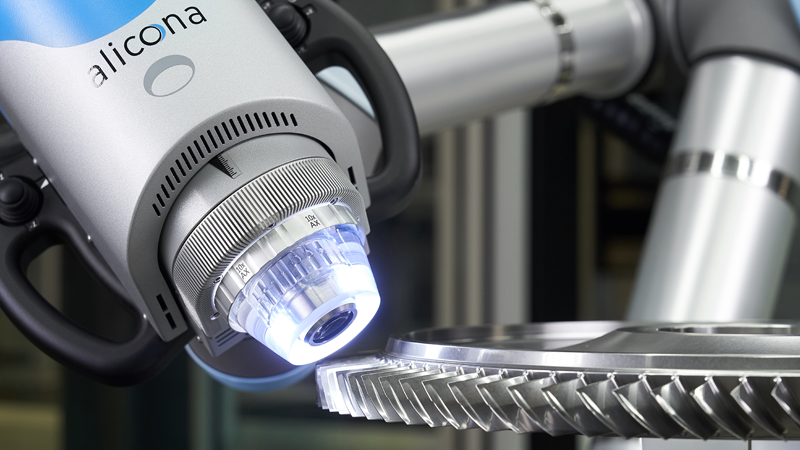
Cutting tools are widely used in industry to manufacture parts through drilling, milling, tapping or lathe cutting. Efficiency of material removal as well as cutting tool life time primarily depends on geometrical factors, such as edge radius, roughness of rake face and flute (e.g., see Bruker Alicona application note, “How to optimize machining results and service life of cutting tools”) as well as proper selection of feed rate, cutting speed, and other machining parameters. In addition to these parameters, major improvement of tool durability and efficiency relies on coatings deposited over the cutting surface.
LEARN MORE ABOUT BRUKER ALICONA:
Coating a tool bit encompasses multiple benefits. It ensures the hardening of the tool surface to sustain local high pressure between the cutting edge and the machined surface. It also provides enhanced abrasion resistance, allowing the chip to slide along the rake face without dissolving the tool material and avoiding crater formation. Finally, it enhances surface lubricity reducing friction between chip and tool surface, thus minimizing the increase of temperature during the cutting process. All these improvements allow an increase of machining throughput. Another aspect of surface lubricity is antiseizure capability, which helps protect against galling of the work material and prevents a built-up edge, where the workpiece material sticks to the cutting edge.


LEARN MORE ABOUT TRIBOLOGY:
This application brief shows how scratch testing with the UMT TriboLab can assess key characteristics of Evaluating Cutting Tool Coatings with Scratch Testing Mechanical Tests Improve Tool Durability and Efficiency Innovation with Integrity coatings used in the cutting tool industry, as well as how standard parameters derived from a scratch test can gauge coating effectiveness and wear resistance.
The tribology experiment is based on a linear scratch test consisting of a linear increasing load between Rockwell indenter while dragging it along a straight path. Normal and lateral forces are simultaneously recorded together with acoustic emissions during the test. The coefficient of friction (COF) can be calculated, and initial crack failure can be identified. One specific example of this scratch test is shown in Figure 2. TriboLab also provides an automatic recording of the optical view from the scratch after the test for further correlation between tribological signals and optical appearance.
From the acquired data, the user can conveniently extract the coefficient of friction (COF) for the coating in the early stages of a scratch test. This is important data as it directly links with the surface lubricity and ability of the coating to sustain the friction of the removed chip. Ramping to higher load allows the user to measure the wear resistance and critical load (Lc1) where failure of the coating occurs and is detected through its signature on the acoustic emission signal (AE). Scratch testing also provides an answer on failure mode, which can be either cohesive via crack propagation inside the coating thickness, or adhesive via delamination of the coating causing buckling and even chipping. While the former brings the maximum load that coating can sustain and beyond which its life time is dramatically reduced, the latter defines the breakage point of the cutting tool, beyond which regular operation should be avoided.
LEARN MORE:

To further illustrate this capability, several standard physical coatings (Physical Vapor Deposition PVD) on high-speed steel (HSS) drill mills were screened through systematic linear scratching test (see Figure 3). Load was applied through a standard Rockwell diamond indenter with 200 µm radius and ramps from 2 N to 80 N along 10 mm length travel. Results presented in Figure 3 show that the most common coatings of TiN/ TiCN exhibit slightly higher COF versus diamond, compared to more elaborate aluminum-based coatings. Hardness plays a significant role here, allowing the diamond indenter to smoothly slide and avoid plastic deformation. Critical load, deduced from the scratch test, also helps in the estimation on how resistant the coating is. Here, the composite coating TiN/TiAlN outperforms all other coatings by almost 50%.
Finally, post-mortem analysis of the scratch by a 3D optical profiler can reveal earlier coating fatigue through the presence of fine cracks or surface deformation in the scratch vicinity. For example, a scratch on a TiAlN coating exhibited cavities outside the main groove around the region of Lc1, indicating that coating is failing through lack of adhesion between the coating and the mill bit metal surface. Adhesive failure is even more obvious at the point of coating breakage as the surface buckles. Optical profilometry also provides accurate measurement of the coating thickness, which here was 2.12 µm for TiAlN, in agreement with the thin film coating. Further correlation can be established between 3D topography and the AE signal to associate the signature from AE with a specific damage level.
More experiments can be carried out through replacement of the diamond Rockwell indenter by metallic or ceramic small-radius balls to gather more accurate COF and simulate in a finer way real metal or ceramic chip sliding on a cutting tool. Ball and indenter can also conveniently be replaced by a cutting insert while the bottom stage is swapped with a rotary drive to mimic a CNC turning machining.

Conclusions
Bruker’s UMT TriboLab scratch tester conveniently allows direct and complete characterization of coatings for cutting tools. This characterization is the premise for future improvements, as well as for the development of new methods and/or coating materials in the cutting tool field.
Authors
- Steve Shaffer
- Samuel Lesko