PDF Analysis of a Glassy ZIF-62 Metal-Organic Framework
Pair Distribution Function (PDF) Analysis of Non-Crystalline Materials
Pair distribution function (PDF) analysis is a powerful technique for probing short-range atomic order in non-crystalline materials such as glasses.
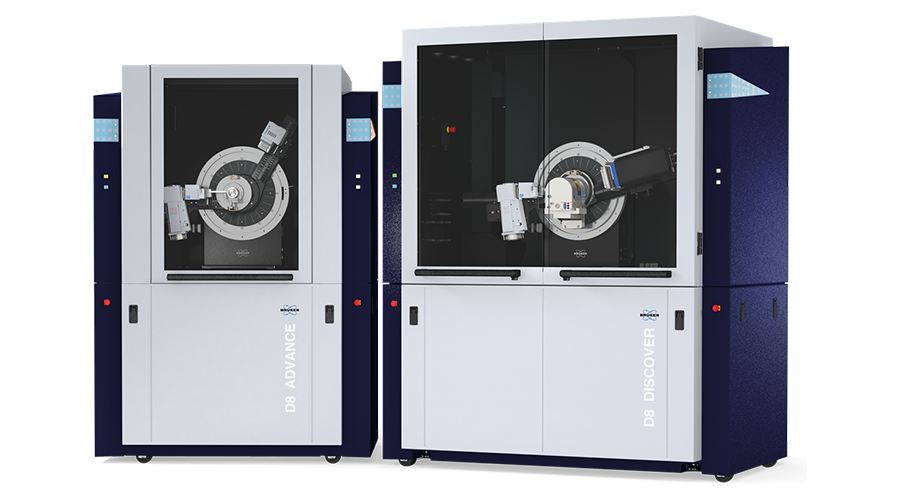
The D8 ADVANCE HE, equipped with a high-energy Mo X-ray source and the LYNXEYE HE detector, provides an optimal platform for local structure investigations using PDF analysis. The short Mo wavelength (0.71 Å) enables data collection to high momentum transfer values (Q up to ~17 Å⁻¹), which is essential for high quality PDFs.
Investigating a Glassy Metal-Organic Framework, ZIF-62, using an Mo X-ray Source
ZIF-62 is a mixed ligand metal–organic framework (MOF) with the general composition [Zn(im)1.75(bim)0.25] (im = imidazolate,bim = benzimidazolate). Unlike most MOFs, which decompose upon heating, ZIF-62 undergoes a melting transition at around 400 °C (depending on ligand ratio), followed by thermal decomposition only at higher temperatures (~550 °C). Upon cooling, the melt solidifies into a glass consisting of a disordered network of tetrahedrally coordinated Zn cations linked by imidazolate anions.
MOF glasses are of growing interest thanks to their inherent microporosity – which differs significantly from the crystalline parent material – and suggests applications in gas separation. Understanding both the crystalline and glassy structures is therefore critical for linking structure to performance.
Method, Results & Discussion
Powder samples of crystalline and glassy ZIF-62 were loaded into 1.0 mm diameter glass capillaries. Data suitable for PDF analysis were collected on a D8 ADVANCE HE diffractometer configured with a Mo sealed X-ray tube, focusing Göbel mirror optic, capillary stage, and LYNXEYE HE detector. The detector features a CdTe sensor with unrivaled efficiency for hard radiation, enabling acquisition of high-quality, low noise datasets in 18 hours.
PDFs were generated using the PDF processing tool in DIFFRAC.EVA, which applies semi-empirical and semi-physical corrections to obtain the coherent scattering contribution from the sample. The intuitive workflow and visual feedback allow the rapid generation of physically meaningful PDFs with minimal user input.
Figure 2 shows overlaid PDFs of crystalline and glassy ZIF-62. At interatomic distances below ~8 Å, the two curves are nearly identical, indicating that thelocal tetrahedral Zn coordination is preserved in the glass. At larger distances (>10 Å), the PDF of the glass decays to zero, reflecting the loss of long-range order.
Figure 3 illustrates the use of the Atom Pair Histogram tool in DIFFRAC.EVA, which displays element specific pair distance distributions calculated from all structures in a database, and can be helpful in peak assignment. For example, the Zn–Nhistogram (green curve) shows a maximum near 2.1 Å, indicating this is a common Zn-N bond distance found in numerous other structures. This maximum overlaps with the peak around 2.1 Å in the experimental PDF, corresponding to Zn–N correlations within the ZIF 62 framework.


Further Information
References
- K. Momma and F. Izumi, “VESTA 3 for three-dimensional visualization of crystal, volumetric and morphology data” J. Appl. Crystallogr., 44, 1272–1276 (2011).
Acknowledgments
N. Krittametaporn and Prof. S. Henke, TU-Dortmund are thanked for providing the crystalline and glassy ZIF-62 samples.
Learn More About Bruker's XRD Solutions: