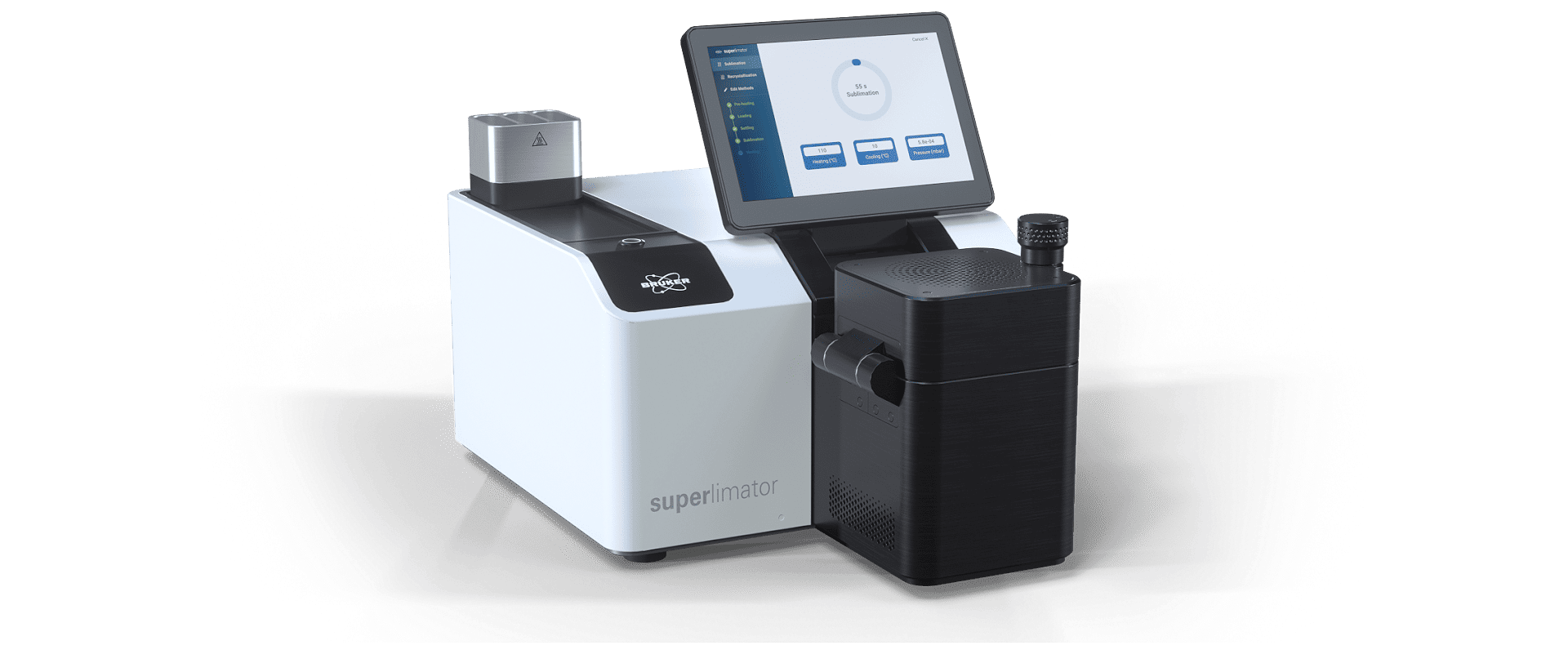
superlimator™
Streamline Imaging with Push-Button Sample Preparation
Your Mass Spec Is Reproducible. Is Your Matrix Coating?
Many spatial techniques face challenges with method transfer and reproducibility across laboratories. MALDI Imaging doesn’t have to. superlimator™’s automated workflow ensures highly reproducible sample preparation independent of device, site, or user.
In tests across three superlimator™ units and three widely used matrices (DHAP, DHB, CHCA), matrix transfer consistently reached 75 ± 5%.
This reliability enables truly consistent and comparable MALDI Imaging results, whether the data comes from your own instrument, a collaborator’s lab, an experienced operator, or someone new to the workflow.

Reproducibility When You Need It. Flexibility When You Want It.

superlimator™ is built for both routine operation and discovery driven research. Validated, ready to use protocols for common MALDI matrices ensure reproducible results from day one, while customizable parameters give experienced users the freedom to optimize conditions, explore new matrices, and adapt workflows for novel applications. All within one intuitive platform.
Validated protocols also hold up over time, so results you generate today remain comparable months later which is critical for longitudinal studies and multi-site collaborations.
2-in-1 Solution: Sublimation and Recrystallization Workflows Combined into One Device
If you already use a Bruker mass spectrometer and SCiLS™ software, superlimator™ completes the picture. Purpose-built for Bruker's MALDI Imaging ecosystem and optimized for IntelliSlides® and fleXmatrix® kits, it slots directly into your validated workflow with no method development required and no third-party integration headaches.
By combining matrix sublimation and controlled recrystallization in one automated device, it also eliminates the need for separate tools and manual handling. One platform. One validated workflow. From slide to image to insight.

Enabling High‑Confidence Biology at Cellular Resolution

Single cell MALDI Imaging requires matrix layers that preserve the molecular integrity of individual cells.
For biologists studying cell heterogeneity, tumor microenvironments, organoids, or rare cell populations, even slight analyte delocalization can blur biologically meaningful differences.
superlimator™ supports these applications by producing ultra thin, uniform matrix coatings that maintain cellular detail and enable reliable detection of metabolites and lipids at single cell scale. Its automated sublimation workflow ensures consistent sample preparation across slides, helping researchers generate reproducible data and focus on the biology rather than the preparation steps.
Fast, Efficient, and Designed for Seamless Lab Integration

superlimator™ combines fast performance with a lab ready design. Common MALDI matrices typically sublimate within just 5–10 minutes, enabling quick turnaround and supporting high throughput workflows.
Its compact footprint fits seamlessly into standard laboratory environments, requiring minimal bench space while integrating smoothly into existing setups.
The device is also highly efficient, using only very small amounts of matrix for reducing waste and lowering the cost per slide.
Technical Features
| Fast | 5 - 10 minutes for standard matrices |
| Easy | Validated workflows available |
| Reproducible | < 5% standard deviation of matrix transfer between different matrices and instruments |
| Efficient | Reliable / reproducible matrix transfer of 75%
|

"I never expected mass‑spec sample prep to be this simple. Thanks to the superlimator’s intuitive and reproducible workflow, achieving 5 µm spatial resolution in our MALDI Imaging experiments has complemented our spatial proteomics and multimodal research in an impressive way."
Prof. Dr. Rajkumar Savai, Chair of Lung Microenvironmental Niche in Carcinogenesis, Institute for Lung Health (ILH), Justus Liebig University Giessen, Germany

"The superlimator enables the quick and easy, yet very reproducible coating of samples for MALDI Imaging, even for matrices notoriously difficult to sublimate. It is intuitive to operate, easy to clean and consumes very small amounts of matrix. It has become our go-to technology for sample preparation, especially for applications with high spatial resolution."
Dr. Jens Soltwisch, Group leader Biomedical Mass Spectrometry, University of Münster, Münster, Germany