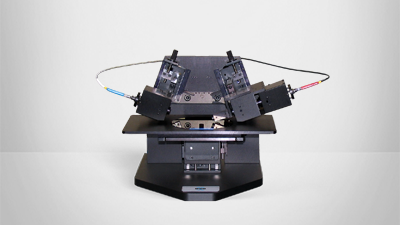
エリプソメトリーチュートリアル
エリプソメトリーとは?
分光エリプソメトリーは、薄膜の膜厚や光学特性をはじめとする関連特性を測定するための、光の偏光情報を利用した強力な光学計測技術です。この技術は、膜厚および膜の均一性に対して非常に高い感度を持ち、一般的な反射率測定では得られない情報を容易に取得できます。また、適切な測定条件およびプロセス条件下では、既知のいずれの手法よりもより薄い薄膜に対して高精度な膜厚測定を実現できる点が大きな特長です。
当社の分光エリプソメトリーシステムは、最高水準の技術設計に基づき、先進的な特許取得済のFilmTekテクノロジーを搭載しています。一般的な分光反射率計の測定可能な膜厚範囲が数十~数百nm程度であるのに対し、FilmTek分光エリプソメトリーシステムは、測定精度や再現性を損なうことなく、1オングストローム未満の超薄膜層まで測定することが可能です。
ご相談・資料請求:
当社のエリプソメーターやその他の薄膜測定装置に関する詳しい試料の請求、またはお客様の独自の測定ニーズについてご相談ください。
Frequently Asked Questions
Ellipsometry is a non-destructive model-based metrology technique used to measure the optical properties and thicknesses of single-layer and multilayer thin films.
Ellipsometry measures the change in reflectance as a function of the polarization states s and p, which can be used to determine the optical properties and thickness of various films. The data collected consists of Ψ (the tangent of the amplitude differences of Rs and Rp) and Δ (the phase shift of Rs and Rp).
- Single-wavelength ellipsometry
This technique uses a monochromatic light source of a given wavelength, typically 632.8 nm, which allows for a smaller spot and higher intensity, but only collects Ψ and Δ for that specific wavelength, which limits measurement capability. - Spectroscopic ellipsometry
This technique utilizes a broad band light source, i.e. 220 - 950 nm, and can measure Ψ and Δ throughout the entire spectrum, allowing for a greater measurement capability. - Single-angle ellipsometry
This technique uses a set angle, typically close to the Brewster angle of the sample (~70° for Silicon) to collect measurements. This method is sufficient in most cases. - Variable-angle spectroscopic ellipsometry
This technique takes measurements at various angles (typically 2 or 3). - Imaging ellipsometry
This technique combines ellipsometry and optical microscopy, allowing for images/maps of measured values like thickness.
Both techniques are similar, however reflectometry measures an intensity ratio of reflected light, whereas ellipsometry measures polarization changes of the reflected/transmitted light.
Both methods can measure the refractive index, however the most accurate method utilizes multi-angle reflectometry with Bruker’s Differential Power Spectral Density (DPSD) technology, which allows Refractive Index resolution down to 2 x 10⁻⁵.
Ellipsometry excels at the measurement of very thin films. Reflectometry is better suited to measure thicker films.
An ellipsometer is used to perform ellipsometry measurements.
When using a FilmTek ellipsometry and reflectometry system:
- A recipe is selected, featuring a map of measurement locations and the type/range of spectra to collect (i.e. ellipsometry only, ellipsometry and multi-angle reflectometry.)
- After each point is measured, the software will use the film model within the recipe to fit the spectra and provide measurement results.
Typical length of time per point is <4s.
Spot size varies by tool, but FilmTek ellipsometry and reflectometry systems can fit within a 50 x 50 µm2 test pad, with 0° reflectance spot going down to ~2 µm on the 2000M TSV.
Using a FilmTek ellipsometry and reflectometry system: Acquisition time is approximately 1s per point, with analysis taking up to 3s.
Using a FilmTek ellipsometry and reflectometry system: Typical spectral range for ellipsometry is 400 - 950 nm. The 0° reflectometry component benefits more from DUV and NIR, with a typical range of 220 - 950 nm and an optional NIR source extending the range to 1690 nm.
Using a FilmTek ellipsometry and reflectometry system: Spatial resolution of thickness is sub-Angstrom, while the spatial resolution of the refractive index is down to 2 x 10⁻⁵.
Due to the incident angle of ellipsometry and the focus point of the beam, thicker films can be difficult to measure due to incoherence and refraction. Transparent substrates can also result in backside reflectance and/or in birefringence. The additional reflectometry component allows FilmTek products to overcome a lot of these limitations.
Any type of solid/semi-solid sample can be used with FilmTek tools, and the thickness ranges will change by sample due to differences in optical properties of various materials (i.e. pure metals like copper will become opaque at smaller thicknesses than materials like SiO2.)
Yes, ellipsometry measurements can be collected on metal samples.
Yes, ellipsometry measurements can be collected on organic film and polymer samples.
Yes, ellipsometry measurements can be collected on transparent and/or absorbing materials using FilmTek ellipsometry and reflectometry systems.
While typical ellipsometry has a limited amount of data to use for modeling, which can often result in multiple solutions, FilmTek tools combine ellipsometry with mutliangle reflectometry, which allows for a unique solution. This allows for Film Thickness accuracy to the sub-Angstrom level, and Refractive Index accuracy down to 2 x 10⁻⁵.