
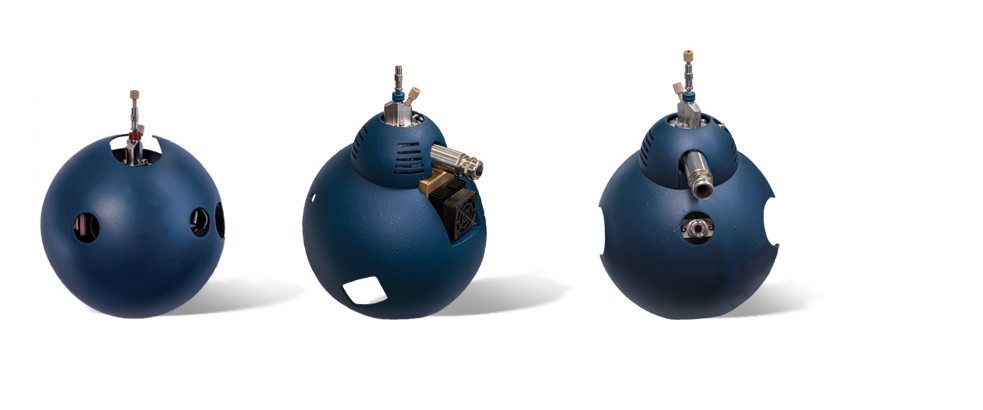
Ion Sources
Enhance Mass Spectrometry Results with Powerful Ion Sources
Achieving optimal results in mass spectrometry, including high mass resolution, accuracy, and sensitivity, heavily relies on employing a powerful ion source that efficiently delivers a higher number of ions to the mass analyzer. This capability allows for the analysis of a diverse range of analytes.
As a leading provider of mass spectrometry solutions, Bruker offers a selection of robust and durable ion sources that deliver exceptional performance and flexibility. We understand that there is no one-size-fits-all ion source for every application. That's why our Bruker ion sources are specifically designed to seamlessly integrate with your LC-MS system. Each ion source is equipped with unique features, providing a wide variety of options to meet specific requirements.
Our extensive selection of ion sources caters to various applications and flow rates, accommodating both polar and non-polar compounds. They are also suitable for analyzing small and large molecules requiring specific ionization techniques.
Discover the extensive range of ion sources available from Bruker and leverage their distinctive capabilities to enhance your mass spectrometry workflow. Achieve accurate and reliable results with our advanced ion source technology.
NEOS-Source: The Ultimate Nano ESI Offline Sprayer
Introducing the NEOS-Source, the latest innovation in our ion sources family. Designed to enhance your offline nanoESI experiments, the NEOS-Source offers unparalleled performance for top-down experiments.
Key Features:
- Seamless Experience: The NEOS-Source ensures a smooth and efficient workflow for offline nanoESI experiments.
- Integrated Dual Cameras: Optimal emitter positioning for highest spray stability.
- Versatile Compatibility: Supports all types of emitters, whether coated or non-coated, open or closed.

CaptiveSpray 2 and CaptiveSpray Ultra 2
Unleash the power within your experiments and immerse yourself in a world of better performance and enhanced precision. The CaptiveSpray 2 and CaptiveSpray Ultra 2 - the gateways to a new era in ion mobility spectrometry. Brace yourself for the ultimate transformation and be captivated by the extraordinary possibilities that lie ahead. Step into the future and witness the revolution in trapped ion mobility spectrometry (TIMS). The time is now to redefine what's possible. Are you ready to experience the difference?

VIP-HESI
VIP-HESI (Vacuum Insulated Probe Heated Electrospray Ionization) is a cutting-edge ion source designed to enhance sensitivity and optimize mass spectrometry (MS) analytical tasks. With its heated electrospray technology, VIP-HESI significantly increases ion yield, surpassing the capabilities of standard electrospray. This leads to a substantial gain in sensitivity for a wide range of compounds, making it an invaluable tool in metabolomics and pharmaceutical analysis, environmental analysis, food testing, and forensic drug investigations. With a proven track record as a robust workhorse ion source on Bruker Triple Quad mass spectrometers for nearly a decade, VIP-HESI has become an industry favorite.
One of the significant advantages of VIP-HESI is its compatibility with a wide range of instruments. The latest version can be used with all timsTOF and QTOF (Quadrupole Time of Flight) series instruments and can be quickly and easily installed. Leveraging its advanced features, VIP-HESI achieves sensitivities comparable to those of leading Triple Quad MS for diverse compounds. Furthermore, it retains the advantages of accurate mass values with TIP (True Isotopic Pattern). Operating the VIP-HESI is straightforward, thanks to its simple parameters, and it includes an efficient active exhaust system, enabling seamless upgrades from conventional sources.
The enhanced performance, the VIP-HESI system offers the microFlow emitter as an optional addition to its standard ESI sprayer. This simple drop-in replacement boasts an inner diameter of 50 µm, significantly improving peak intensities within the lower flow range limits of the VIP-HESI source (ranging from 1 µL/min to 50 µL/min). The microFlow Emitter's narrow ID is the ideal solution for achieving increased analytical depth while maintaining robustness.
VIP-HESI is a dual-source system that combines VIP Heated Electrospray with Atmospheric Pressure Chemical Ionization (APCI) probes as standard. This powerful combination ensures versatile capabilities and allows researchers to explore a wider range of applications. By incorporating VIP-HESI into their analytical workflows, scientists can unlock new possibilities and achieve remarkable results.

Technical Details
The ion source significantly improves sensitivity and reduces detection limits by enhancing ionization efficiency across a wide range of applications. In the VIP-HESI system, an electrospray is maintained at a precisely controlled vaporizing temperature. This enables the analyte ions to undergo enhanced desolvation, even at high eluent flow rates during UHPLC separations, resulting in sharp chromatographic peaks.
Within the Vacuum Insulated Probe (VIP), the eluent stream containing the compounds of interest is effectively shielded against heat by a vacuum barrier, similar to a dewar. This combination of heating and integrating the eluent stream into the probe results in a simple and easy-to-maintain design. Additionally, the implementation of a powerful active exhaust, utilizing the Venturi effect, effectively prevents re-circulation. This demonstrates a smart application of well-established physical principles in modern instrumentation.
Applications
VIP-HESI in Forensics
Ethyl-Glucuronids (EtG and EtS) are markers for alcohol misuse. The VIP-HESI source yields great sensitivity for determination of EtG from blood. For details, please refer to application note LCMS-122.
VIP-HESI in Food Safety
Extremely sensitive analytical methods are required for accurate low-level identification, and quantitation of zero-tolerance compounds in food.
Bruker’s TargetScreener application is boosted more than 10-fold for a representative subset of analytes when used with VIP-HESI instead of regular ESI source.
The VIP-HESI achieves a Limit of Quantitation (LOQ) more than 100 times lower than the minimum required performance level (MRPL).
VIP HESI in Glycopeptide Determination
Glycosylation is a common critical quality attribute (CQA) of therapeutic proteins and needs to be characterized during product development. Typically, this analysis is conducted after enzymatic release and tagging of the glycans followed by fluorescence and MS detection. A more modern workflow is to identify glycan compositions directly from tryptic peptide maps acquired with the timsTOF Pro and PASEF® in combination with analytical LC and the new VIP-HESI ion source. It employs a glycan search method from peptide mapping data and uses previously identified aglycons as mass tags.
APCI II
Atmospheric pressure chemical ionization (APCI) is used for less polar molecules where ESI fails to deliver reasonable quantities of ions. In contrast to ESI, it produces mainly singly-charged ions even for larger molecules.
APCI is only limited in the case of thermally unstable compounds, since evaporation of the solvent is done by heating the sample in the nebulizer needle. APCI is often used for metabolomics as well as for drug or pesticide screening.
The new Bruker APCI II source is of course compatible to Bruker's unique DirectProbe option DIP. The direct injection probe is a novel smart solid sample introduction technique allowing a rapid analysis of solids. Sample preparation is as simple as dipping a disposable glass capillary into the solid sample.

APPI II
Atmospheric pressure photo ionization (APPI) is used for less polar or non-polar molecules that can not be ionized in either ESI or APCI.
APPI delivers a wide dynamic range and low chemical noise. With an operational flow range of 2 µl/min – 1500 µL/min it is compatible with cap- to analytical chromatography.
APPI II by Bruker Daltonics is the only APPI source with DirectProbe option for direct analysis of solid samples. The direct injection probe is a novel smart solid sample introduction technique allowing a rapid analysis of solids.
Sample preparation is as simple as dipping a disposable glass capillary into the solid sample.

Direct Insertion Probe
- Extremely sensitive down to the sub-ng range of pure substance - amount not visible at all!
- Minimum sample preparation
- Direct analysis of liquid & solid samples
- Short analysis time
- No memory due to single-use glass tubes

Applications
Fields of applications are
- General Chemistry → Synthesis control
- Manual quality control of solids (Pharma, oil, explosives)
- Customs → Drugs of abuse, explosives
- Homeland security
- Environmental
- Thermal degradation processes (plastic production)
- Classical routine analysis (e.g. confirmation of sum formula)
GC-APCI II
GC-APCI II Source Ultra-High Resolution TOF-MS on GC
Todays analytical chemistry often presents complex mixtures of compounds which are not available in libraries and data bases. Identification of such components can be easily performed with Bruker's ultra-high resolution TOF systems designed for LC or GC use.
With its second generation GC-APCI source, Bruker offers the greatest flexibility and highest performance with a combined GC frontend and high-resolution MS system for confident ID of unknown compounds using complementary MS technology. The GC-APCI II interface can be coupled to any Bruker MS system with the common Apollo II source design.
