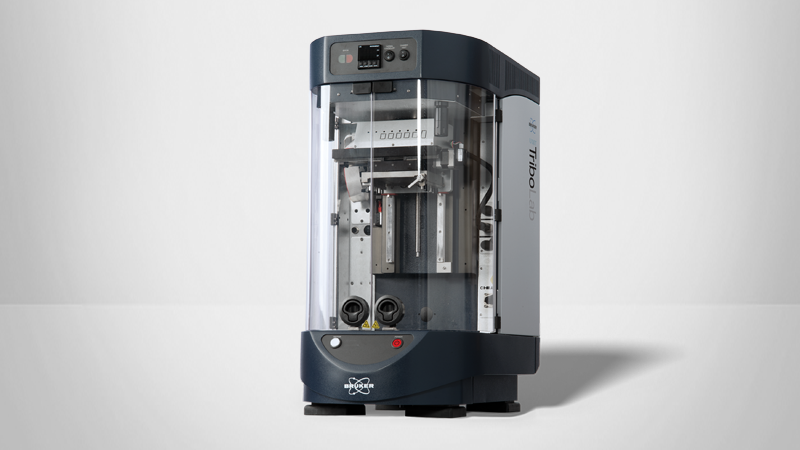
Tribotest Protocols and Standards
The UMT TriboLab platform supports a wide range of ASTM tribology and mechanical testing methods. Supported methods span lubricants, fuels, coatings, polymers, metals, biomedical materials, and engineered surfaces. Depending on the test configuration, users can measure friction, wear, wear volume, torque, hardness, critical load, corrosion response, and other key performance indicators.
This page provides access to tribotesting protocols, ASTM standards coverage information, and a reference library of ASTM test methods supported by UMT TriboLab systems.
Available Protocols
| Download PDF | Protocol (click to download) | ASTM Standard | Test Configuration | Description | ASTM.ORG INFO |
|---|---|---|---|---|---|
| Thrust Washer Wear Rate and Coefficient of Friction | ASTM D3702 | Thrust Washer | Standard procedure for measuring wear rate and friction performance of self-lubricating materials using a thrust washer configuration on the UMT TriboLab system. Covers test setup, operating parameters, data collection, and wear analysis. | Go to astm.org |
UMT TriboLab Testing Modes and Corresponding ASTM Coverage
The following table shows common UMT TriboLab testing modes and the ASTM standards frequently associated with each application. See the ASTM Standards Reference at the bottom of this page for more details about each standard.
| Testing Mode | Typical Applications | Key Measurements | Representative ASTM Standards |
|---|---|---|---|
| Block-on-Ring Drive — Block-on-Ring | Grease load-carrying capacity; friction and wear; solid-film lubricant wear life; material and plastic sliding-wear resistance | COF, friction force, wear scar | D2509, D2714, D2981, D3704, G77, G176 |
| Block-on-Ring Drive — Pin & Vee | Extreme-pressure and wear testing of lubricants and solid-film lubricants | COF, torque, load, wear scar | D2625, D2670, D3233 |
| Block-on-Ring Drive — Web/Roller | Friction evaluation of flexible web and roller combinations | Static COF, kinetic COF | G143 |
| Linear-Reciprocating — Fretting | Evaluation of surface damage under controlled fretting conditions | Friction, wear volume, surface damage | G204 |
| Linear-Reciprocating — HFRR | Diesel-fuel lubricity testing | COF, wear scar diameter | D6079, D7688 |
| Linear-Reciprocating — Joint-Prosthesis Wear | Wear evaluation of polymeric materials used in total-joint bearing surfaces | Wear volume, wear rate | F732 |
| Linear-Reciprocating — Pin/Ball-on-Plate | Reciprocating sliding wear; friction-energy analysis; piston-ring wear-volume analysis | COF, wear scar, wear volume | G133, G203, G206 |
| Linear-Reciprocating — Piston Ring / Cylinder Liner | Piston-ring and cylinder-liner friction testing under lubricated conditions | Friction, load response | G181 |
| Linear-Reciprocating — SRV / Linear Oscillation | Grease and oil EP testing; friction and wear; fretting resistance; SRV wear-volume determination | COF, wear scar, wear volume | D5706, D5707, D6425, D7594, D7755 |
| Linear-Reciprocating — Tribocorrosion | Evaluation of combined wear and corrosion effects | Friction, corrosion response, wear | G119 |
| Micro-Head — Instrumented Indentation | Instrumented indentation characterization of coatings and small material volumes | Force, displacement, hardness | E2546 |
| Micro-Head — Quantitative Single-Point Scratch | Adhesion, damage resistance, and failure-mode evaluation of hard ceramic coatings | Critical load, scratch damage/failure modes | C1624 |
| Rotary Drive — Ball-on-Cylinder | Aviation turbine-fuel lubricity evaluation | COF, wear scar | D5001 |
| Rotary Drive — Four-Ball | Grease and lubricant wear, friction, and extreme-pressure performance | COF, wear scar diameter, weld load | D2266, D2596, D4172, D5183 |
| Rotary Drive — Low-Temperature Ball-Bearing Torque | Low-temperature evaluation of lubricating grease in slow-speed ball bearings | Starting torque, running torque | D1478 |
| Rotary Drive — Pin/Ball-on-Disc | Material friction and sliding-wear evaluation | COF, wear volume, wear rate | G99 |
| Rotary Drive — Tapping Torque | Metalworking-fluid performance evaluation | Torque, friction | D8288 |
| Rotary Drive — Thrust Washer | Wear and friction evaluation of self-lubricated materials in thrust-washer contact | Torque, COF, wear | D3702 |
| Rotary Drive + X-Slider — Pin Abrasion | Abrasion-resistance testing using a pin against an abrasive surface | Material loss, abrasion resistance | G132 |
Looking for a specific test method?
Bruker application experts can help determine the appropriate UMT TriboLab configuration, fixture, and testing protocol for your ASTM-standard tribology or mechanical testing requirements.
Appendix: ASTM Standards Reference (from astm.org)
| ASTM Standard | Official ASTM Title | Description | ASTM Link |
|---|---|---|---|
| D1478-20 | Standard Test Method for Low-Temperature Torque of Ball Bearing Grease | Measures the starting and running torque produced by grease in a slow-speed ball bearing at low temperature. | Read more |
| D2266-23 | Standard Test Method for Wear Preventive Characteristics of Lubricating Grease (Four-Ball Method) | Determines the relative wear-preventive properties of greases in sliding steel-on-steel contact using a four-ball machine. | Read more |
| D2509-26 | Standard Test Method for Measurement of Load-Carrying Capacity of Lubricating Grease (Timken Method) | Determines lubricating-grease load-carrying capacity with the Timken Extreme Pressure Tester. | Read more |
| D2596-26 | Standard Test Method for Measurement of Extreme-Pressure Properties of Lubricating Grease (Four-Ball Method) | Determines load-wear index, weld point, and last nonseizure load for lubricating grease using a four-ball EP tester. | Read more |
| D2625-26 | Standard Test Method for Endurance (Wear) Life and Load-Carrying Capacity of Solid Film Lubricants (Falex Pin and Vee Method) | Determines wear life and load-carrying capacity of dry solid-film lubricants in sliding steel-on-steel contact. | Read more |
| D2670-25 | Standard Test Method for Measuring Wear Properties of Fluid Lubricants (Falex Pin and Vee Block Method) | Provides a preliminary evaluation of fluid-lubricant wear properties using a Falex pin-and-vee-block machine. | Read more |
| D2714-24 | Standard Test Method for Calibration and Operation of the Falex Block-on-Ring Friction and Wear Testing Machine | Covers calibration and operation of a block-on-ring machine using the friction and wear response of a calibration fluid. | Read more |
| D2981-24 | Standard Test Method for Wear Life of Solid Film Lubricants in Oscillating Motion | Evaluates bonded solid-film lubricant wear life under oscillating motion using a block-on-ring machine. | Read more |
| D3233-24 | Standard Test Methods for Measurement of Extreme Pressure Properties of Fluid Lubricants (Falex Pin and Vee Block Methods) | Provides two Falex procedures for preliminary evaluation of the load-carrying and EP properties of fluid lubricants. | Read more |
| D3702-24 | Standard Test Method for Wear Rate and Coefficient of Friction of Materials in Self-Lubricated Rubbing Contact Using a Thrust Washer Testing Machine | Determines equilibrium wear rate and coefficient of friction for self-lubricated materials in a thrust-washer configuration. | Read more |
| D3704-24 | Standard Test Method for Wear Preventive Properties of Lubricating Greases Using the (Falex) Block on Ring Test Machine in Oscillating Motion | Differentiates lubricating greases by wear-preventive performance in oscillating block-on-ring contact. | Read more |
| D4172-25 | Standard Test Method for Wear Preventive Characteristics of Lubricating Fluid (Four-Ball Method) | Provides a preliminary evaluation of fluid-lubricant antiwear properties in sliding contact using a four-ball machine. | Read more |
| D5001-26 | Standard Test Method for Measurement of Lubricity of Aviation Turbine Fuels by the Ball-on-Cylinder Lubricity Evaluator (BOCLE) | Assesses the boundary-lubrication wear properties of aviation turbine fuel on rubbing steel surfaces using BOCLE. | Read more |
| D5183-25 | Standard Test Method for Determination of the Coefficient of Friction of Lubricants Using the Four-Ball Wear Test Machine | Determines the coefficient of friction of lubricating fluids using a four-ball wear machine. | Read more |
| D5706-23 | Standard Test Method for Determining Extreme Pressure Properties of Lubricating Greases Using a High-Frequency, Linear-Oscillation (SRV) Test Machine | Determines grease EP properties under high-frequency linear oscillation using an SRV machine. | Read more |
| D5707-25 | Standard Test Method for Measuring Friction and Wear Properties of Lubricating Grease Using a High-Frequency, Linear-Oscillation (SRV) Test Machine | Determines grease coefficient of friction and wear protection under high-frequency linear-oscillation conditions. | Read more |
| D6079-26 | Standard Test Method for Evaluating Lubricity of Diesel Fuels by the High-Frequency Reciprocating Rig (HFRR) | Evaluates diesel-fuel lubricity by measuring wear generated in a high-frequency reciprocating rig. | Read more |
| D6425-23 | Standard Test Method for Measuring Friction and Wear Properties of Extreme Pressure (EP) Lubricating Oils Using SRV Test Machine | Determines friction and antiwear performance of EP and non-EP lubricating oils under high-frequency linear oscillation. | Read more |
| D7688-24 | Standard Test Method for Evaluating Lubricity of Diesel Fuels by the High-Frequency Reciprocating Rig (HFRR) by Visual Observation | Evaluates diesel-fuel lubricity with an HFRR using visual observation of the resulting wear scar. | Read more |
| D7594-24e1 | Standard Test Method for Determining Fretting Wear Resistance of Lubricating Greases Under High Hertzian Contact Pressures Using a High-Frequency, Linear-Oscillation (SRV) Test Machine | Determines the ability of grease to prevent fretting wear under short-stroke linear oscillation and high Hertzian contact pressure. | Read more |
| D7755-11 (2022) | Standard Practice for Determining the Wear Volume on Standard Test Pieces Used by High-Frequency, Linear-Oscillation (SRV) Test Machine | Determines wear-scar and wear-track volume on SRV test pieces using stylus-tip profilometry. | Read more |
| D8288-25 | Standard Test Method for Comparison of Metalworking Fluids Using a Tapping Torque Test Machine | Compares metalworking-fluid performance using measured tapping torque or calculated efficiency from an instrumented tapping machine. | Read more |
| F732-17 (2025) | Standard Test Method for Wear Testing of Polymeric Materials Used in Total Joint Prostheses | Evaluates and ranks material combinations by polymer wear for prospective total-joint bearing surfaces under simplified laboratory conditions. | Read more |
| G77-17 (2022) | Standard Test Method for Ranking Resistance of Materials to Sliding Wear Using Block-on-Ring Wear Test | Ranks material pairs by sliding-wear resistance using a flexible block-on-ring test configuration. | Read more |
| G99-23 | Standard Test Method for Wear and Friction Testing with a Pin-on-Disk or Ball-on-Disk Apparatus | Determines sliding wear and friction of material pairs under nominally non-abrasive pin-on-disk or ball-on-disk conditions. | Read more |
| G119-09 (2021) | Standard Guide for Determining Synergism Between Wear and Corrosion | Provides calculations for increased material loss caused by interaction between wear and corrosion in liquid solutions or slurries. | Read more |
| G132-24 | Standard Test Method for Pin Abrasion Testing | Ranks two-body abrasive-wear resistance using a material pin sliding against abrasive cloth, paper, or plastic film. | Read more |
| G133-22 | Standard Test Method for Linearly Reciprocating Ball-on-Flat Sliding Wear | Determines wear volume—and optionally kinetic friction—for materials in lubricated or unlubricated reciprocating ball-on-flat sliding. | Read more |
| G143-23 | Standard Test Method for Measurement of Web/Roller Friction Characteristics | Measures static and kinetic friction of a flexible web/roller couple during simulated transport and slip. | Read more |
| G176-03 (2024) | Standard Test Method for Ranking Resistance of Plastics to Sliding Wear Using Block-on-Ring Wear Test—Cumulative Wear Method | Coarsely screens plastics by cumulative sliding-wear volume in a block-on-ring configuration. | Read more |
| G181-26 | Standard Test Method for Conducting Friction Tests of Piston Ring and Cylinder Liner Materials Under Lubricated Conditions | Bench-screens frictional behavior of candidate piston-ring and cylinder-liner materials under lubricated reciprocating contact. | Read more |
| G203-10 (2026) | Standard Guide for Determining Friction Energy Dissipation in Reciprocating Tribosystems | Guides calculation and interpretation of friction-energy dissipation from recorded forces in reciprocating tribosystems. | Read more |
| G204-21 | Standard Test Method for Damage to Contacting Solid Surfaces under Fretting Conditions | Ranks material couples and quantifies volume loss on contacting solid surfaces subjected to controlled fretting. | Read more |
| G206-17 (2021)e1 | Standard Guide for Measuring the Wear Volumes of Piston Ring Segments Run against Flat Coupons in Reciprocating Wear Tests | Provides a profiling method for accurately measuring wear volume on curved piston-ring segments tested against flat coupons. | Read more |
| C1624-22 | Standard Test Method for Adhesion Strength and Mechanical Failure Modes of Ceramic Coatings by Quantitative Single Point Scratch Testing | Assesses practical adhesion strength, damage resistance, and failure modes of hard thin ceramic coatings by controlled single-point scratching. | Read more |
| E2546-15 (2023) | Standard Practice for Instrumented Indentation Testing | Defines IIT procedures and instrument requirements for collecting force–displacement data used to determine indentation hardness and other material characteristics. | Read more |