USI Universal Adaptive Profiling Measurement Mode for Superior Surface Texture Characterization
Bruker has recently released the Universal Scanning Interferometry (USI) measurement mode to enable universal measurement results on wide-ranging surfaces for ContourX white light interferometry (WLI) profilometers. USI provides fully automated, self-sensing surface texture optimized signal processing while delivering the most accurate and realistic computation of the surface topography being analyzed.
This application note explains how USI technology covers a broad range of applications, from semiconductor manufacturing metrology to medical component inspection and advanced research.

Technology Overview
The USI technique requires no operator input to automatically adjust algorithm parameters for optimum results on different surface textures in the same field of view, even on surfaces with differing contrast, intensity, and heights. USI is unique in that it can be set up to automatically sense the type of surface and provide the most accurate areal metrology representation of that surface. Being one of the most robust measurement techniques within optical-based profilometry, USI provides a single-measurement mode that combines subnanometer vertical resolution metrology on almost any surface, transparent to opaque, with a vertical range up to 120 microns. This mode also captures multiscale information by preserving subnanometer vertical resolution across the full vertical measurement range. For example, Figure 1 shows a measurement of a cell phone camera lens after being mounted into the assembly. The large scanning range allows measurement down the sides of the lens, and once the sphere shape is automatically removed, USI’s automatic surface sensing clearly reveals the mold pin cylindrical grinding marks in the final image.

Flexibility for Broad Range of Applications
In the case of multiple users or when characterizing a broad variety of samples, USI incorporates all of Bruker’s easeof- use features while preserving accuracy and precision for any surface under test through auto selection. On the other hand, to preserve flexibility and testing in advanced research or to set a constant response in industrial inspection, USI provides users the ability to select from four operational resolution modes: Auto, Standard, High Fidelity, or High Speed.
This user-selectable choice of process resolution for different scenarios is available from a simple pull-down menu (see Figure 2).

The definitions of the four primary resolution settings are:
- Auto — The 3D WLI metrology profiler will automatically sense the surface texture properties and adjust the resolution setting to one of the three other modes based on amplitude/frequency of spatial topography. For relatively smooth surfaces, this setting will default to High Fidelity. If the surface is less smooth, Standard resolution will be applied to process the surface signal data into a topography map with a balance between resolution and High Speed mode. For rough surfaces with sudden large topology fluctuations, the system will select High Speed mode.
- Standard — This is a phase-based processing of the surface measurement signal with a speed-enhanced algorithm, primarily useful for smooth surfaces with subnanometer vertical resolution.
- High Fidelity — This is another phase-based algorithm, useful when the application requires the absolute best vertical resolution (<0.1 nanometer) even on rough or diffuse surfaces, as it will process the scan multiple times to achieve the best and most accurate data.
- High Speed — This is a center of mass (COM) enhanced algorithm with improvement in accuracy over previous vertical scanning algorithms. This setting will achieve the fastest USI measurement results with nanometer precision and is primarily useful when surfaces are relatively rough with large steps.
All magnifications, including lower ones, benefit from these settings to achieve angstrom surface resolution on large height features. This makes USI suitable for large fields of view (wide) as well as for high submicron lateral resolution (high).
Automatic sensing has been designed to balance the optimum quality of the data with speed of acquisition and processing in respect to a given surface or magnification. Users can then fully focus on research or data generation with the peace of mind of achieving the best results every time. In cases where the nature of the surface is well characterized, then the user is also afforded a selection option for processing the data in the most efficient way, such as the high-speed option to obtain data as fast as possible, with a slight reduction in vertical resolution. In addition to the resolution setting, USI allows for a signal-to-noise ratio (SNR) threshold setting to reject data with low or limited quality to achieve high-fidelity topography. The SNR threshold setting cleverly combines average modulation and phase information into quality ranking in percentage to further extend reliability over all type of samples. Any individual data pixels where the minimum criteria are not met will be rejected as noise and not included in the final image, resulting in a reliable dataset without prior experience from user. Best tested setting is 2, while a 0 setting rejects no data.
USI provides Bruker WLI profilers several large metrology advantages as it has the capability to measure surfaces of semi-transparent materials directly. For example, semiconductor and data storage manufacturers commonly use dielectric or Alumina as an insulating barrier between the conductive materials. Most optical fringe height measurement algorithms are based on the center-of-mass calculations from the camera signal frames returning from the surfaces, meaning when signal are received from the top and bottom surfaces of a transparent film, those heights are averaged somewhere in the middle to report the average height. On a Bruker profilometer though the selection of the correct USI mode allows the user to select the strongest signal of the two surfaces and use that as the measurement surface for height comparison to other non-transparent conductive surfaces (see Figure 3). This direct surface measurement makes USI an ideal non-contact measurement mode of these delicate materials for process control in deposition, etching and lapping processes.


Advanced AcuityXR® measurement methodology can also be used with USI for the absolute highest lateral resolution available for a given magnification and field-of-view combination. AcuityXR enhances edge detection and improves lateral repeatability three to five times over conventional microscope imaging for equivalent measurement parameters, as demonstrated on the 1200 lines per millimeter grating in Figure 4.
Combining Large Step Height with Precision Surface Resolution
USI is ideal for the measurement of any surface, from smooth, rough, steps, or a combination of surfaces in one image. This versatile power of USI is illustrated in the measurement of a chrome-on-glass lateral resolution standard (Siemens Star) in Figure 5. This standard combines the imaging challenges of both reflectivity differences of the two materials and the diffraction limit for a 10x objective. With the ability to achieve the lateral resolution of the standard up to the physical limits, USI accurately measures the hundreds-of-nanometers step height while characterizing the surface finish of the glass substrate down to the angstrom areal Sa level without any filtering applied. The USI capability to produce such a high-fidelity representation of such a dynamic surface structure makes it ideal for all types of applications.

MEMS and Microfluidics Applications
The quality of data obtained with Bruker’s USI technology is readily seen in a closer look at a 3D interactive view of a microfluidic device (see Figure 6). These microfluidic devices are typically used to deliver a very small amount of precise liquids, so the depth and width characterization of these channels is extremely critical. USI allows diffractionfree images without the effects seen in other optical measurement systems when measuring high-sloped, sharp-edged stepped structures with micron-deep smooth surfaces. USI easily handles this surface topography and provides accurate, high-quality data of the surface of interest, which allows easy characterization of the critical depth, surface finish, and volume design function parameters of these devices.

Semiconductor and Wafer Manufacturing
The data storage industry is still heavily reliant on producing conventional hard drives. With cloud storage driving most of this demand, they are pushing the areal density storage limits with new technologies, such as MAMR, HAMR, and EAMR. As these technologies evolve, some historic slider measurements remain critical, such as the characterization of the air bearing surface (ABS). The ABS surface is designed to create an air-bearing layer between the read/write head (slider) and the spinning magnetic media to allow the slider to fly above the surface without touching while creating a suction to keep the slider within a constant nanometer height to maximize track writing and reading capabilities. Figure 7 illustrates the USI measurements of the slider
ABS step features, showing hundreds-of-nanometers feature heights while characterizing the subnanometer surface finish of the upper air bearing feature and the lower etched cavity with angstrom repeatability, all in a single measurement scan.


The semiconductor industry uses a chemical mechanical polishing (CMP) or a planarization process to smooth the wafer surfaces with a combination of chemical and mechanical forces. At various points in the manufacturing process, wafer CMP is performed to remove excess material to expose underlying features or flatten the surface for a flat foundation before adding the next layer of circuit features. The CMP process is done over the whole wafer, which consists of different materials that wear and planarize at different rates. Non-proportional dishing (the curvature of the surface) and erosion (the depth of the feature) are common results during the CMP process, as can be seen in the excessive planarization shown in Figure 8. Not only does this show the softer metal material cupped or curved from the CMP process, but USI also easily characterized the shape and the depth of the larger feature, which is around 10 nanometers deeper than the smaller features.
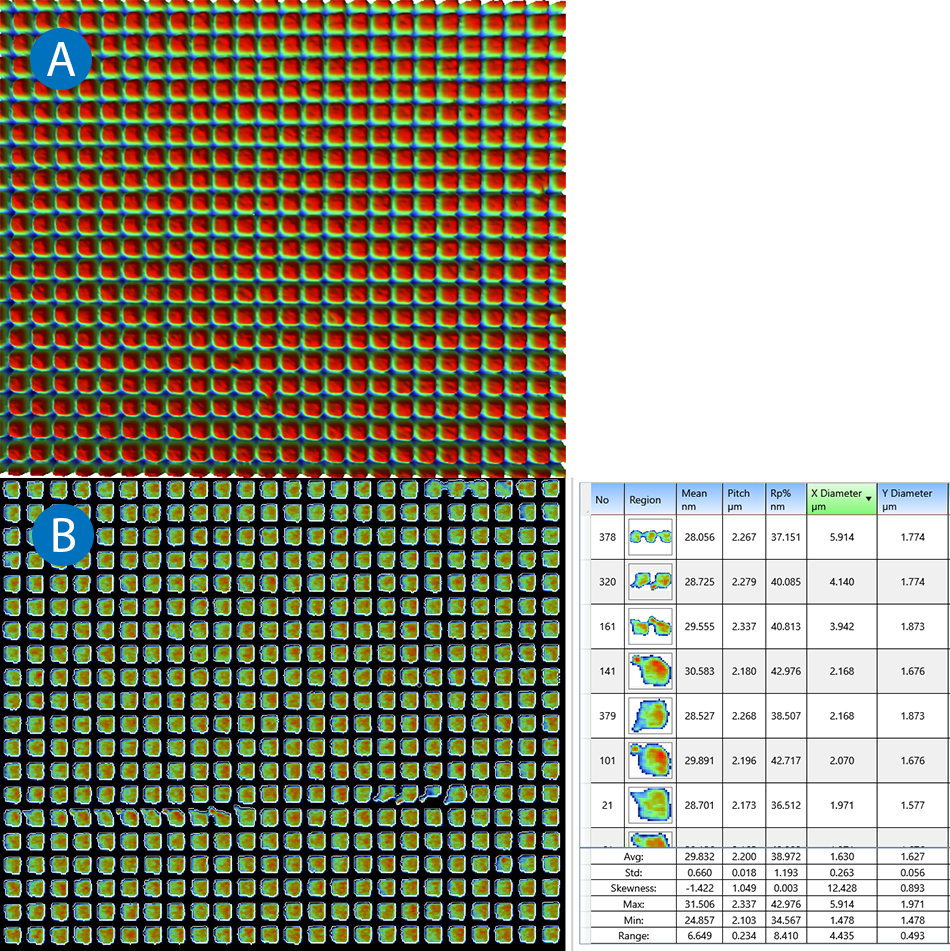
The semiconductor industry also has various inspection steps to verify the proper manufacturing of the wafer features and components. Figure 9a illustrates a repeating wafer die structure requiring inspection, with no outstanding visual defects seen in this measured die. However, Figure 9b shows an adjacent repeating die structure viewed through Bruker’s Vision Multiple Region software, which can automatically detect and inspect these various types of structures. The Multiple Region setting automatically finds these structures and highlights the abnormal ones using pass/fail criteria in the database logging.
If needed, inspection of larger areas can be done by stitching multiple images together into one large image of a whole die. Another method works like stitching, but each individual image is analyzed during image capture for various pass/fail criteria, allowing failed-image binning for further inspection.
Precision Surface Machining and Roughness
Precision machining is the process of manufacturing parts under extremely tight tolerances to ensure that all specifications and technical GDT callouts for fit and finish are met during the manufacturing process. Thanks to its wide field of view and nanometer sensitivity, a WLI profiler with USI measurement mode can yield additional benefits not seen with other measurement techniques to meet these highly specific design specifications. An example of this can be seen in Figure 10 where two surfaces, one manufactured using grinding and the other vertically milled, yielded around 300 nanometers average roughness (Ra) when measured by a stylus profilometer. USI measurement mode correlates to the 2D stylus measurement (ASME B46.1 / ISO 4287) but can also illustrate the clear differences of these surfaces and can quantify the differences using the more modern Internationally recognized areal roughness S-parameters (ISO 25178).


Precision machining is performed on a variety of materials, including steel, bronze, graphite, plastic, and glass, to name just a few. The resulting intricate parts and components are used in areas from medical to automotive and aerospace, across nearly all technologies and industries. Bruker’s WLI with single-measurement USI mode can measure all these materials and surface finishes, as represented in Figure 11 by the images of a precision nanometer Sa lapped-mated sealing surface and a tens of microns Sa milled surface. The successful measurement of these surfaces show that this technology makes possible iterative control along finishing steps.
Conclusion
USI measurement mode on a Bruker optical WLI profiler provides users with significant metrology advantages, including ease of use, flexibility, and a greater range of analyses. This universal self-learning non-contact measurement mode enables the most reliable 3D surface topography metrology possible for the widest range of surfaces. As demonstrated, USI produces fast, accurate results capable of providing striking details for applications ranging from medical and precision machining samples to MEMS, data storage, and semiconductor wafer device measurements. These measurements are accomplished with a single fast measurement or multiple images to cover larger areas. This measurement advancement in 3D metrology produces the most accurate representation of varying technical surfaces available in the market today.
Authors
- Roger Posusta, Senior Marketing Application Specialist, Bruker Nano Surfaces and Metrology Division (roger.posusta@bruker.com)
- Samuel Lesko, Senior Manager for Optical and Tribology, Bruker Nano Surfaces and Metrology Division (samuel.lesko@bruker.com)
© 2020 Bruker Corporation. All rights reserved. AcuityXR, ContourX, Vision64, and VisionXpress are trademarks of Bruker Corporation. All other trademarks are the property of their respective companies. © 2020 Bruker Corporation. All rights reserved. TN5035, Rev. A1