
Ultima Investigator Plus
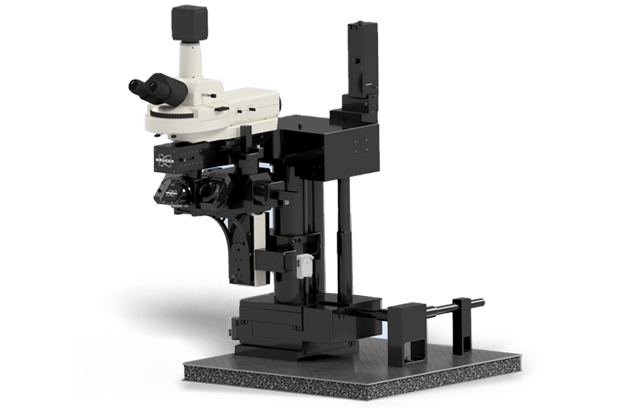
Ultima Investigator Plus
As the most streamlined model of Bruker's Ultima family of multiphoton microscopes, the Ultima Investigator Plus builds upon a platform optimized for live imaging. With an upgraded electronics architecture, expanded field-of-view, an enhanced detection path, and upgrade options to the 2Pplus platform, the Investigator Plus can grow with research demands. A host of add-ons including three-photon imaging, multi-region scanning, and motorized nosepieces integrate seamlessly for a comprehensive imaging experience
Intravital Imaging with Behavioral Paradigms
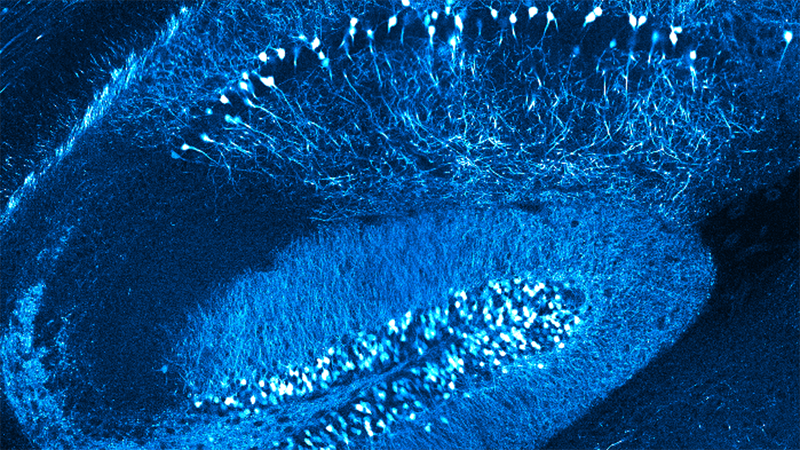
Intravital imaging using functional indicators provides the opportunity to measure neural activity in awake, behaving specimens. Investigator Plus provides the imaging speed to capture activity of neural networks in single or multiple focal planes.
High-Resolution Oncology Imaging

Multiphoton intravital imaging provides a high resolution method for imaging tumor implants. Tumor progression and response to pharmaceuticals as well as immune cell response, can be measured through longitudinal imaging sessions. Ultima Investigator can be configured to image the collagen fibers.
Anatomic Mapping of Neural Networks
The Atlas Imaging module in Bruker's Prairie View software simplifies setup of 2D and 3D automated montages. X,Y boundaries are easily setup through a thumbnail display. Tiles not containing areas of interest can be turned off, and the Z range for 3D montages can be variable, allowing more efficient collection of data.

Combining Advanced Engineering with Continuous Innovation
Ultima multiphoton imaging technology is built on close collaboration and laboratory experience with leading neuroscientists. Ongoing development, informed by this engagement, ensures alignment with evolving experimental needs while supporting advanced and exploratory work in the field. The result is a flexible, future-ready imaging solution that evolves alongside research — enabling users to adopt new capabilities as they emerge while preserving performance and long-term system value.
Recent advancements to the Ultima platform include:
- xCore electronics: Provides unified timing and multi‑device, system-wide synchronization, forming a scalable foundation for modular upgrades and application-focused add-ons.
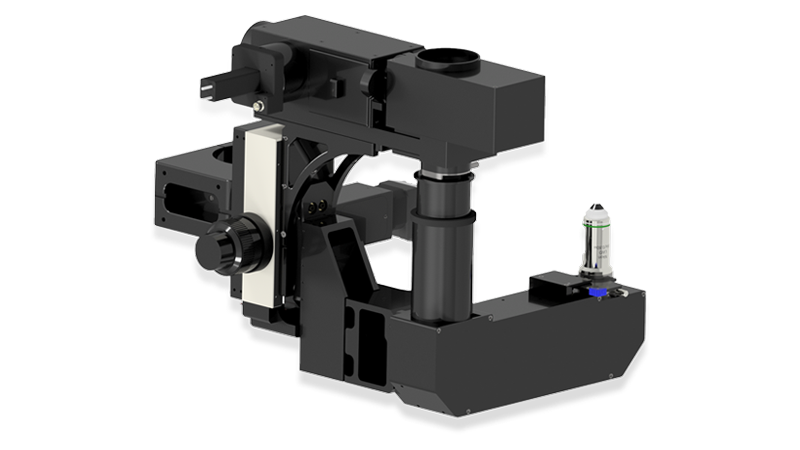
- Inverter Module: Converts Bruker’s upright multiphoton platforms into a flexible inverted configuration while preserving the strengths of the original upright system.
- xView Module: Exchangeable lens set that extends the FOV by > 2.5x the standard area, enabling researchers to visualize neural activity without sacrificing speed or sensitivity.
- OptoVolt Module: Delivers kilohertz imaging rates to enable voltage imaging neural research, capturing electrical dynamics > 1,000 fps and providing software-selectable multiplication modes.
- NeuraLeap Module: Allows for nearly instantaneous switching between optical planes and defining multiple excitation planes to selectively image larger volumes in a single optical plane.
- NeuraLight 3D Ultra: Unlocks access to a larger FOV for more uniform optical manipulation of cells with 2x greater axial precision and 4x faster response times that mimic neuronal firing.
Ultima Investigator Accessories and Options
- Software control of laser power and line blanking
- Provides higher sensitivity in photon-limited studies
- Provides fluorescence illumination
- Provides full field photoactivation
- Provides point and scanning photoactivation
- Provides detection of wide-field epifluorescence
- Provides high-speed Z-series (0.1 µm step size, 150 µm range)
- Provides minimum 0.3 µm increments, 1 µm accuracy, and 6-inch X and 3-inch Y travel
- Provides highest temporal and spatial fluorescence lifetime imaging in cells
Hear What Our Customers Have to Say

We appreciate the modular nature of the Ultima hardware and software. The systems now available range from basic imaging systems to the dual-laser photo-stimulation multi-mode imaging workstation. We have continued updating many of our 14 machines, including our ten year old systems. The Team Viewer connection and support is a huge asset for novice owners and for significant software changes.
David Wokosin, Ph.D., Northwestern University