
timsMRMS
An eXtreme Combination
that delivers greater depth and confidence in the analysis of high complexity samples
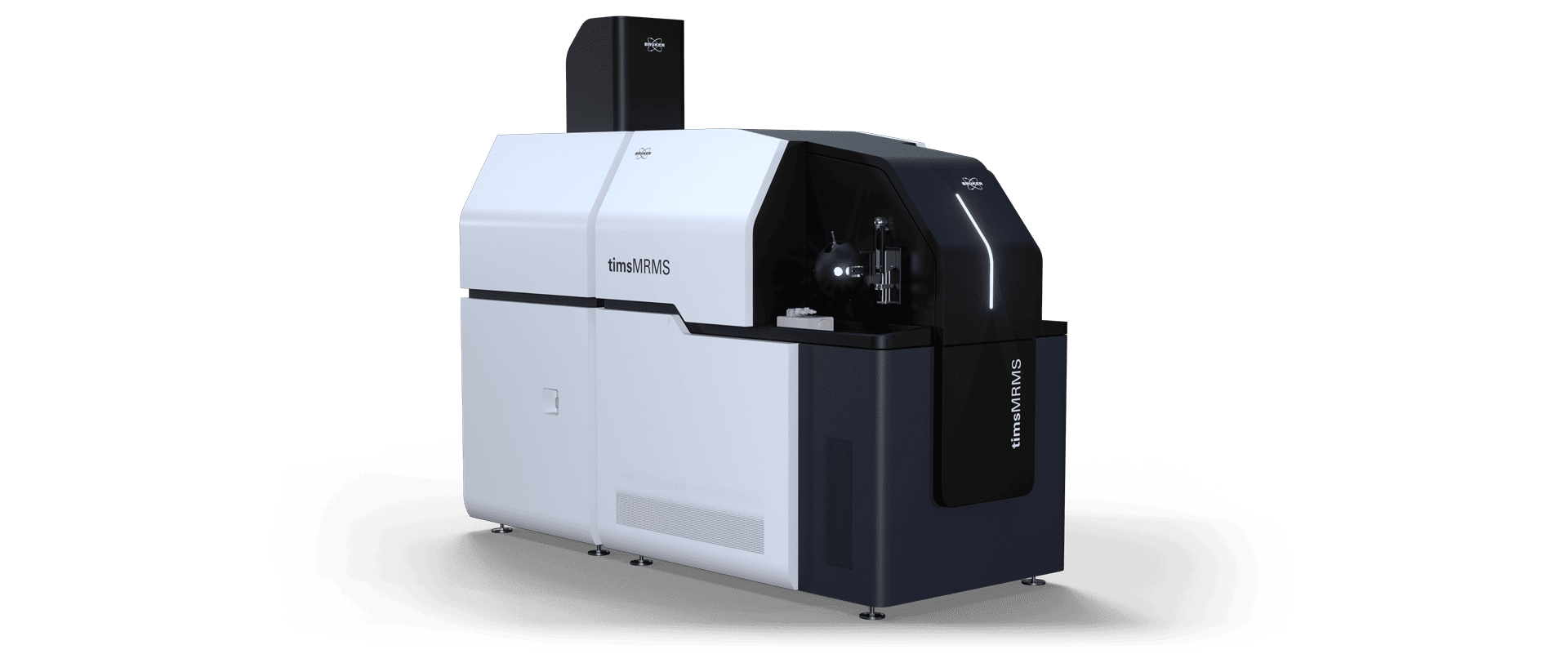
Dive Deeper into Chemical Complexity
The Next Generation in MRMS Technology

Core to the timsMRMS is the integration of trapped ion mobility spectrometry (TIMS) to MRMS - the world’s most powerful mass spectrometer. This combination enables researchers to tackle extreme complexity, adding greater depth and confidence.
- Dual MALDI / ESI source - The timsMRMS features a dual ion source for both MALDI and ESI. The change between ionization modes is fast and effortless.
- Smartbeam 3D and microgrid technology for high spatial resolution imaging. Smartbeam 3D is Bruker’s latest advancement in MALDI based imaging and features the highest spatial resolution to date within the Bruker family of imaging platforms and detection of isomeric diversity.
- Proprietary gated TIMS for accurate CCS val separation (selectivity) with a unique molecular identifier – CCS (specificity).
- High capacity collision cell that enables continuous accumulation of selected ions (CASI) and Q-CAD. The ion capacity of the newly designed collision cell matches that of the MRMS detector cell, maximizing S/N and time efficiency.
- ParaCell with 2xR capability. MRMS is synonymous with ultra-high performance, and this have never been easier to achieve than with the timsMRMS. At its core is the ParaCell detector in combination with the high-fidelity magnetic field of the Maxwell magnet. Ultra-high resolution and accuracy is effortless, making eXtreme performance routine.
- Heated cathode – accessibility to all modes of ExD fragmentation adding to the arsenal of structural tools that are available on the timsMRMS.
No Limits – Seamless Switching Between ESI and MALDI
Researchers can quickly move from a MALDI Imaging campaign to direct infusion or flow injection for ESI of large cohorts of environmental samples, for example.
- The integrated MALDI source is Bruker’s smartbeam 3D with microgrid designed for high spatial resolution MALDI Imaging

MALDI Imaging of rat brain cerebellum. 10 um Spatial imaging. Data provided by Spraggins and Coworkers, Vanderbilt University
- The rugged API source supports ESI as well as Bruker’s optional APCI and APPI sources for addressing both polar and nonpolar species

Gated TIMS – a Force Multiplier
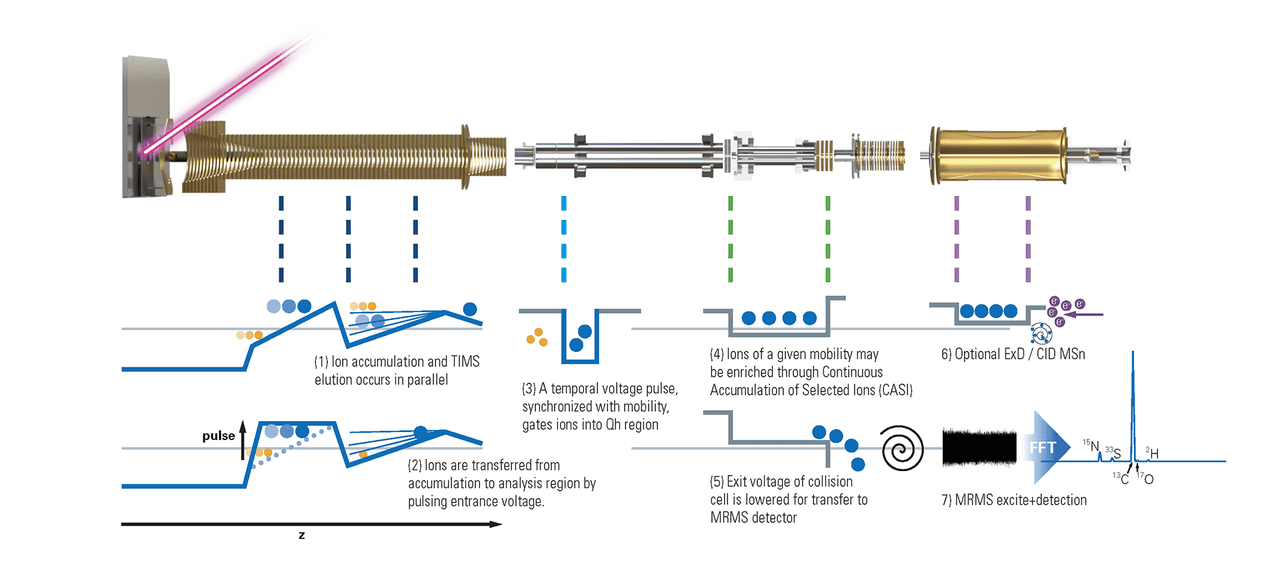
TIMS separation is accomplished with the precise and gated release of ions within a given mobility range. This is most compatible with MRMS detection and enables greater dynamic range and depth of coverage including isomers.
It also provides CCS values translating into greater confidence in identifications. Moreover, gated TIMS can be flexibly tailored and controlled to address specific analytical challenges, providing enrichment and specificity in targeted analyses.
MRMS Redefines the Limits of What’s Achievable
- Ultra-high mass resolving power (>10 M) that helps untangle the complexity. The benefit of high mass resolving power is profound for the analysis of complex mixtures. It increases the 'peak capacity' of your measurement for the detection of more molecular species. Bio-oils, crude oil, dissolved organic matter, and other environmental matrices are all applications that benefit from ultra-high resolving power.
- Ultra-high mass measurement accuracy (< 500 ppb) that provides confidence in mass and molecular assignment. Mass measurement accuracy tracks with mass resolving power. Sub ppm mass measurement accuracy limits the number of molecular formula candidates and adds significant confidence in annotation.
- Isotopic fine structure (IFS) enabled to give added specificity to molecular assignments. Like mass measurement accuracy, IFS brings another dimension of specificity that builds on the power of mass measurement accuracy to refine molecular formula candidates for assignment – like an elemental bar code. Only MRMS can routinely deliver on this level of performance.


- Ease of use with the dynamically harmonized ParaCell and new autoshim software. The timsMRMS has new features that enable users to routinely get the best performance for their analyses, allowing the focus to be on the science and not on instrument optimization or tuning.
Environmental and Energy
Raw environmental samples (e.g. DOM) and energy related samples such as bio-oils, crude oil, and battery material represent extreme levels of chemical diversity. Moreover, these sample types are difficult to separate by chromatography prior to MS detection.
The timsMRMS addresses this by leveraging TIMS for gas-phase fractionation followed by ultra-high mass resolving power and accuracy in the mass domain. This combination enables the detection of greater diversity, even isomeric diversity, with the power of CCS values, high resolution and mass measurement accuracy to make confident annotations of chemical features – see more and identify more.

Figures and analysis provided by: Dr. Christopher Rüger, Research Group Leader, Universität Rostock
MALDI Imaging

MALDI Imaging of animal or human tissues presents a unique challenge that requires the spatial correlation of complex chemical signaturess. timsMRMS MALDI instruments feature Bruker’s smartbeam 3D laser and microgrid stage and allows the researcher to achieve high spatial resolution simultaneously with ultra-high mass resolving power. Researchers are revealing even more molecular specificity and detail at the cellular level.
This combination results in greater depth of detection and higher molecular features detected with high confidence.
Protein Characterization

The structure, stability and unfolding pathways of native-state proteins and noncovalent complexes can be investigated using timsMRMS.
TIMS separation is 'soft' resulting in the preservation of native protein conformations. However, collisional energy can be imparted to induce unfolding, also known as collisionally induced unfolding (CIU).
This provides the researcher access to probe intermediate conformations, separated by TIMS, for structural interrogation via ExD methods.


Testimonials

"The next generation MRMS cart equipped with the new high-field 18 T magnet revolutionizes LC-MS, enabling routine Operation while delivering unparalleled resolution, sensitivity, and throughput for complex sample analysis."
Carlos Afonso, Ph.D., Professor of Analytical Chemistry, University of Rouen-Normandy, Rouen, France

"The first time I saw these results, I felt like Champollion in front of the Rosetta Stone! These remarkable results are incredibly valuable for improving Li-Ion batteries, deciphering the composition, and for understanding the properties of the passivation layer on the electrodes, which largely determines their performance."
Patrick Bernard, Ph.D., Research and Technology Director Saft (wholly-owned subsidiary of TotalEnergies), Levallois-Perret, France
"A key goal for me as a new Director at the National High Magnetic Field Laboratory is to make the unrivaled performance of FT-ICR mass Spectrometry available to the broader scientific community. I am thrilled to collaborate with Bruker who are focusing on accessibility and ease of use with their new MRMS instrumentation."
Kristina Hakansson, Ph.D., Professor of Chemistry & Biochemistry, Florida State University. Director, Ion Cyclotron Resonance
Program, National High Magnetic Field Laboratory, Tallahassee, FL, USA

"The new timsMRMS system combines the high spatial resolution qualities of the timsTOF fleX and the high spectral resolving power and dynamic range of the FT-ICR for a perfect pairing of high specificity molecular imaging for capturing spatial biology at cellular resolution."
Madeline E. Colley, Ph.D., Research Instructor, Vanderbilt University, Nashville, TN, USA
More Information
Frequently Asked Questions







For Research Use Only. Not for use in clinical diagnostic procedures.