
timsOmni™ ∑
Advanced Biology
With unmatched depth and accuracy delivered by TIMS and PASEF-EXD
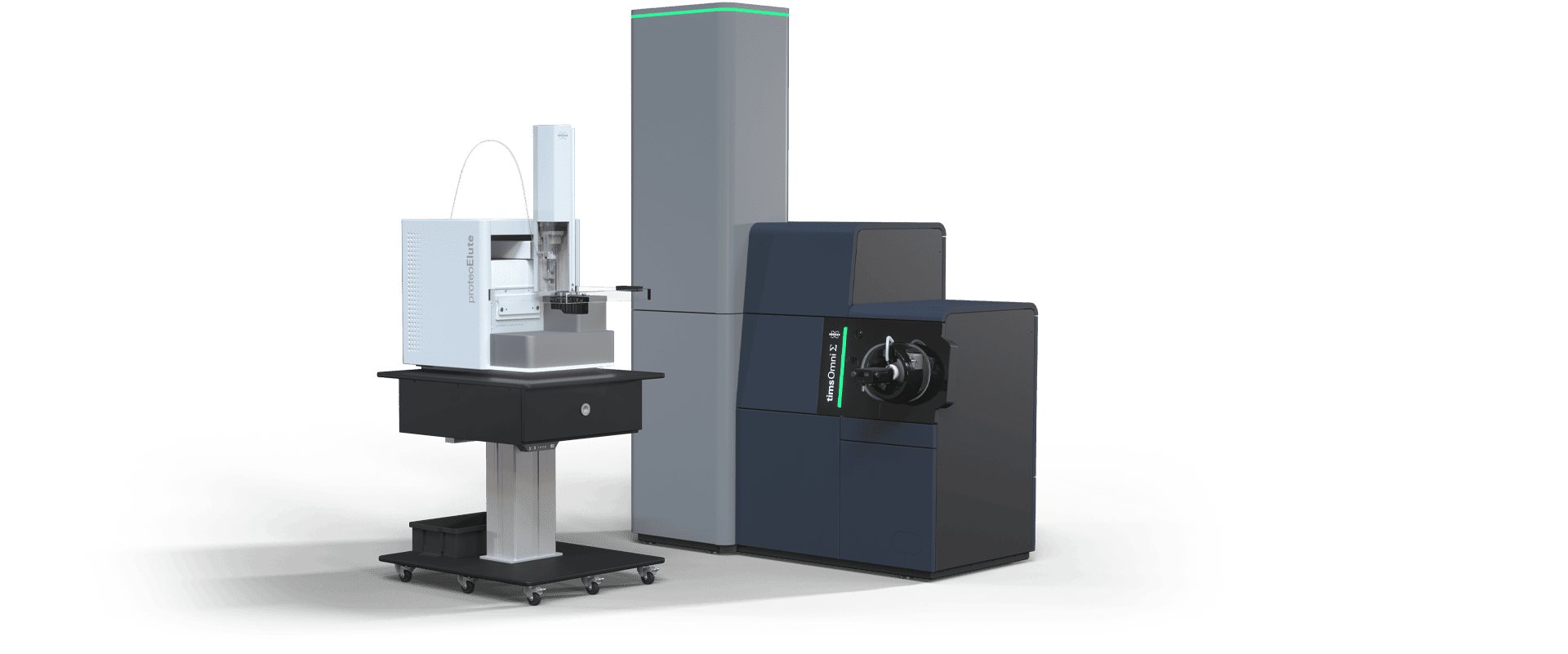
Advanced structural elucidation by MSn eXd coupled to the power of TIMS
Introducing the timsOmni™ ∑
Leverage advanced structural elucidation with MSn eXd coupled to the power of TIMS. timsOmni™ ∑ features a unique blend of technology to deliver maximum versatility:
- TIMS for accurate CCS values to determine conformational heterogeneity
- Precise control of electron-based fragmentation for detailed molecular profiling
- Omnidirectional MSn combined with ion accumulation for unmatched sensitivity
- Trapped eXd mode for optimal precursor utilization, boosting fragment ion yield
- Utilization of all PASEF® modes for bottom-up proteomics and multiomics

Experience Unparalleled MS and MSn sensitivity
timsOmni™ ∑ features unparalleled full scan MS and MSn sensitivity through omnidirectional MSn and precursor enrichment for signal amplification of the lowest abundance ions.
By precise modulation of selected ion packets, any ion irrespective of its intensity, can be targeted for superior electron-based fragmentation. Made possible by the omnidirectional multi-stage MSn eXd workflow.
Precise modulation of electron energy and reaction time
Precisely tune electron energy to investigate various fragmentation regimes and adjust eXd reaction time for optimal results. With access to the entire electron fragmentation landscape, design new solutions toward deep sequencing and structural elucidation.
Trapped eXd
In trapped ion eXd mode, precursor ions are confined and rapidly fragment upon electron irradiation. Adapting the trapping time enables to boost the fragment yield and reach optimal precursor consumption (>90%). This unique capability differs from traditional passthrough electron-based fragmentation techniques.

Connecting PTMs and Biology: Advance glycobiology with timsOmni™ Σ
Glycoproteomics presents unique analytical hurdles: labile glycan structures, high heterogeneity and isomeric species raise the need for tools beyond traditional bottom-up.
timsOmni™ Σ was designed to tackle these challenges head-on, combining Trapped Ion Mobility Spectrometry (TIMS) with multimodal fragmentation to deliver both high-throughput discovery and deep structural characterization of glycopeptides. With PASEF-EXD, researchers can identify more glycopeptides with greater confidence and decipher glycan structures in unprecedented detail using a single instrument platform.
Fit-for-purpose workflows for glycoproteomics
The timsOmni™ Σ platform offer an unprecedented control for the fragmentation of PASEF selected precursor ions. Electron fragmentation takes place in theOmnitrap region, trapped ions are confined in the electron beam beforetravelling through the collision cell where product ions can be further activated, giving researchers the opportunity to adjustconditions for their analytical objectives.
Low electron energy (ECD: 0-2 eV) promotes peptide fragments with intactglycans, ideal for O-glycan localization
Higher electron energy (EXD 12-17 eV and EID 35 eV) favors the fragmentationof the glycan and enables structural insights


Breaking the cycle: A dedicated workflow for characterizing cyclic peptides
Cyclic peptides are modular polypeptide chains composed of canonical and non-canonical amino acids that are connected at distant positions to form macrocyclic structures. Large libraries can be easily created for biological screening.
The timsOmni™ ∑ collision-based and electron-based fragmentation techniques areused to linearize and sequence cyclic peptides. The exquisite control on the collision-based and electron-based activation as well as the ability to combine multipleactivation steps allows to generate easy-to-read fragment ion ladders forunambiguous characterization.


timsOmni™ ∑: Exceptional Sensitivity for High-Confidence Bottom-Up Proteomics
timsOmni™ ∑ is an evolution of the timsTOF Ultra 2 system developed with improved bottom-up proteomics and a focus on glyco-peptides, small molecules structural identification with EXD capabilities and AIP.
Peptides and protein groups in a Promega K562 digest measured by DIA-PASEF. A 22min gradient was used with an Aurora Ultimate column at 250 nl/min flow rate. Results were searched against the Swissprot human database.









For Research Use Only. Not for use in clinical diagnostic procedures.