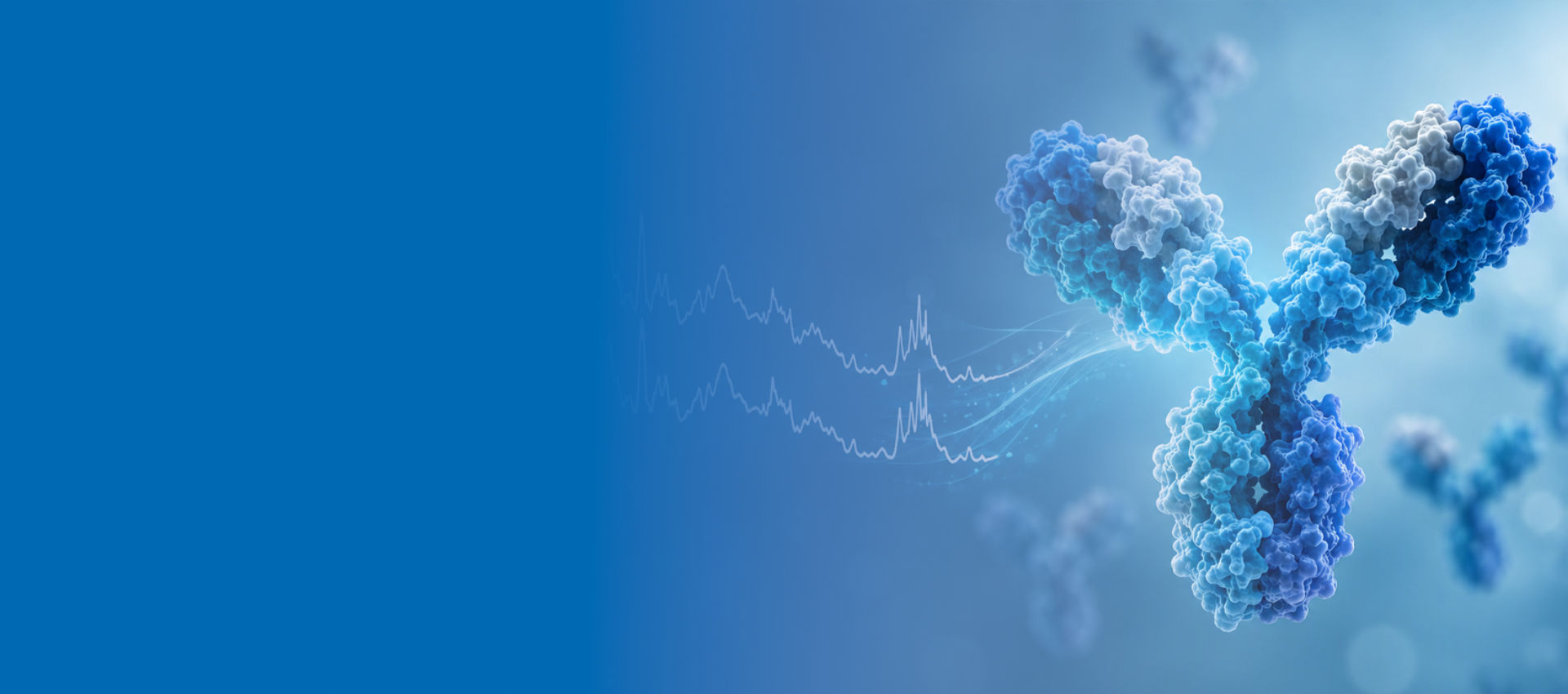
Biologics HOS by NMR
Why higher order structure matters in biologics
Biologics such as monoclonal antibodies, antibody-drug conjugates, and therapeutic proteins are structurally complex molecules. Their higher order structure influences product quality, stability, and biological activity. Maintaining structural consistency is therefore an important consideration throughout development, manufacturing, comparability studies, and quality control.
Higher order structure describes how a biologics is structurally organized beyond its amino acid sequence. Secondary structure includes local structural elements such as α-helices and β-sheets. Tertiary structure describes the overall three-dimensional folding of the molecule, while quaternary structure describes the arrangement and interactions of multiple molecular subunits.
Changes at these structural levels will affect molecular conformation, stability, biological activity, aggregation behavior, or other quality attributes. Not every detected structural difference is necessarily relevant to clinical performance. However, meaningful differences should be investigated using appropriate analytical methods and considered together with other product-quality data.
How NMR supports higher order structure assessment
NMR spectroscopy produces a molecular fingerprint that reflects the chemical environment of atoms within a biologics. One-dimensional or two-dimensional NMR spectra from a new sample can be compared with spectra from an appropriate reference.
Changes in signal position or amplitude can indicate structural differences. BioHOS supports objective evaluation using Protein Fingerprint by Line shape Enhancement (PROFILE 1D), Principal Component Analysis (PCA), Projection to Latent Structures (PLS), Easy Comparability of HOS (ECHOS), and Combined Chemical Shift Deviation (CCSD).
Statistical results are directly linked to the underlying spectral data. Scientists can therefore examine the spectral regions associated with an observed difference instead of relying only on visual comparison or an overall similarity result.

Features
- High-field NMR spectrometers (600, 800 MHz or 1 GHz) equipped with CryoProbes
Provide the sensitivity and spectral resolution required to study intact biologics like high molecular weight antibodies (~150 kDa). - Standardized acquisition methods
Support consistent data acquisition across laboratories, studies, and time points. - BioHOS statistical analysis
Supports objective evaluation of structural similarity using Protein Fingerprint by Line shape Enhancement (PROFILE 1D), Principal Component Analysis (PCA), Projection to Latent Structures (PLS), Easy Comparability of HOS (ECHOS), and Combined Chemical Shift Deviation (CCSD). - Batch matrix analysis
Enables comparison of multiple batches and supports the identification of similarities and differences. - Linked data and results
Connects statistical results to the underlying spectral data so observed differences can be investigated. - Evaluation guidelines
Provide an established framework for HOS evaluation and help standardize workflows and interpretation. - Integrated workflow
Combines instrumentation, methods, software, guidelines, and application expertise in one solution ecosystem.
1D Profile Analysis

PCA Analysis

PLS Regression

ECHOS Analysis

CCSD Comparison

SIMCA-Based Classification

Benefits
- Greater analytical confidence
Detailed structural information supports product characterization, comparability assessment, and critical decisions during development and manufacturing. - More consistent data
Standardized acquisition parameters support reproducible measurements across laboratories, studies, and time points. - Objective similarity assessment
Statistical analysis supports comparability decisions without relying only on visual interpretation. - Support across the lifecycle
A consistent HOS approach can be applied from research and development through manufacturing, technology transfer, comparability studies, and regulatory submissions. - Reduced implementation complexity
A coordinated workflow with clear guidance reduces the need to assemble instruments, methods and software, independently. - Accessible analysis
Dedicated software makes the workflow accessible to analytical scientists who are not NMR specialists.





Testimonials

Dr. Fabio Baroni, Merck KGaA, Rome, Italy
The need for high-resolution techniques for the characterization of Higher Order Structure of biologics is regarded as being extremely urgent, especially in the case of application to biosimilar development.
NMR, besides assuring an atomic-level fingerprint of the molecule’s structure, grants a resolution and sensitivity to structural changes incomparable with any other spectroscopic technique. Bruker, has led multiple developments in NMR during the last decade in terms of improved instrumentation, clear workflows and enhanced data analysis and finally, has made the employment of the technique in biosimilar R&D.
Frequently Asked Questions
Biologics HOS by NMR is a complete workflow for higher order structure assessment of Biologics. It combines high-field NMR instrumentation, standardized acquisition methods, BioHOS analysis software, guidelines, and application expertise.
Higher order structure describes the structural organization of a biologic across primary, secondary, tertiary, and quaternary levels. Assessing these characteristics helps determine whether the structure remains consistent across development and manufacturing activities.
The solution is intended for monoclonal antibodies, antibody-drug conjugates, and therapeutic proteins.
A 1D 1H or a 2D 1H/13C fingerprint of the biologics is acquired on a high-field NMR instrument equipped with a Cryoprobe. The fingerprint of a batch spectrum can then be compared with a reference, and differences in peak positions and amplitudes can be evaluated with dedicated statistical analysis methods.
Yes. Enhanced acquisition methods enable the study of intact antibodies of approximately 150 kDa at natural abundance in their formulation buffer or other physiologically relevant conditions.
The available methods include PROFILE 1D, principal component analysis, multivariate statistical model building and distance calculations, ECHOS, combined chemical shift deviation, and matrix analysis for batch comparison.
Spectra from batches can be compared with a reference. BioHOS provides statistical evaluation of structural similarity, while linked data and results help identify the spectral regions associated with observed differences.
High-field NMR and BioHOS software provide an objective higher order structure comparison between a biosimilar candidate and its reference product, supporting the scientific evidence used in comparability assessments.
Yes. Products from before and after an upstream or downstream process change can be compared to assess whether higher order structure remains consistent.
No. Biologics HOS by NMR provides orthogonal structural information that complements established analytical workflows rather than replacing other characterization techniques.
No. The dedicated analysis software is designed to make the workflow accessible to analytical scientists who are not NMR specialists.
The workflow is relevant to research and development, analytical and process development, manufacturing, technology transfer, comparability assessment, biosimilar development, quality control, and regulatory submissions.
NMR is particularly relevant when the analytical objective requires:
- Comparison of multiple biologics batches against a reference product fingerprint
- Assessment of a biosimilar candidate against a reference product
- Evaluation before and after a manufacturing or formulation change
- Objective statistical comparison rather than visual assessment alone
- An orthogonal method within a broader characterization strategy

LabScape
Service & Life Cycle Support for Magnetic Resonance and Preclinical Imaging
Bruker’s commitment to provide customers with unparalleled help throughout the buying cycle, from initial inquiry to evaluation, installation, and the lifetime of the instrument is now characterized by the LabScape service concept.
LabScape Maintenance Agreements, On-Site On-Demand and Enhance Your Lab are designed to offer a new approach to maintenance and service for the modern laboratory