
HYPERION II
FT-IR y QCL combinados
Poder analítico e innovación
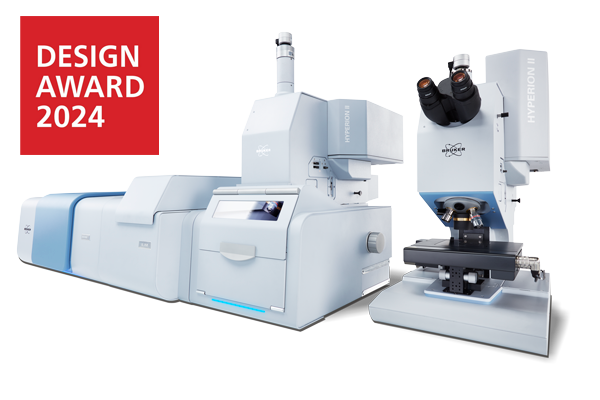
La plataforma de investigación de microscopía e imagen IR
Novedades de HYPERION II:
Cómo integramos las imágenes láser infrarrojas:
Reducción de la coherencia espacial patentada:
Microscopía FT-IR potenciada por QCL | Imágenes láser infrarrojas
El HYPERION II supone una gran innovación en microscopía infrarroja. Proporciona imágenes IR hasta el límite de difracción y supone un punto de referencia en microscopía ATR. Combina la microscopía FT-IR y de imágenes láser infrarrojas (ILIM) por primera vez en un solo dispositivo, ofreciendo los tres modos de medición: transmisión, reflexión y ATR.
Características del HYPERION II:
- Selección de detectores para μ-FT-IR:
LN2-MCT de banda ancha, media y estrecha,
MCT refrigerado termoeléctricamente (TE). - Detector de matriz de plano focal (FPA) para imágenes infrarrojas (64x64 o 128x128 píxeles).
- Implementación opcional del módulo QCL de imágenes láser infrarrojas (ILIM, láser clase 1).
- Selección de lentes objetivo: 3,5x/15x/36x/74x IR, 20x ATR, 15x GIR, 4x/40x VIS.
- Extensión del rango espectral: desde el infrarrojo cercano (NIR) hasta el infrarrojo lejano (FIR).
- Selección de aperturas: aperturas de cuchilla manuales, rueda de aperturas de cuchilla automatizada. Aperturas metálicas para NIR.
- Selección de accesorios y platinas para muestra: accesorio de imagen IR macro, platina para enfriamiento / calentamiento, compartimiento de muestras, etc.
- Selección de herramientas visuales/ópticas: Iluminación de campo oscuro, iluminación de fluorescencia, polarizadores VIS, polarizadores IR, etc.
El HYPERION II proporciona:
- Combinación perfecta de imágenes espectrales y visuales. Se aplica a cualquier modo de medición (incluidas las imágenes ATR).
- Microscopía FT-IR de alta sensibilidad en el límite de difracción y obtención de imágenes IR mediante el uso de un detector de matriz de plano focal (FPA).
- Primera combinación de tecnología FT-IR y QCL mediante el módulo opcional de imágenes láser infrarrojas (ILIM, clase láser 1).
- Imágenes láser infrarrojas en todos los modos de medición: ATR, transmisión, reflectancia.
- Reducción de coherencia patentada para mediciones de imágenes láser sin artefactos y sin pérdida de sensibilidad o velocidad.
- Alta velocidad de registro de imágenes:
0,1 mm2 por segundo (FPA, espectro completo)
6,4 mm2 por segundo (ILIM, número de onda único). - Detector TE-MCT opcional para realizar microscopía IR con alta resolución espacial y sensibilidad sin nitrógeno líquido.
- Opcionalmente, permite realizar espectroscopía de emisión y extender el rango espectral.
Aplicaciones del HYPERION II:
- Ciencias de la vida: células y tejidos.
- Productos farmacéuticos.
- Estudios de emisividad (por ejemplo, LED).
- Análisis de fallos y su posible causa.
- Ciencia forense.
- Microplásticos.
- I+D industrial.
- Polímeros y plásticos.
- Caracterización de superficies.
- Semiconductores.
El microscopio de investigación FT-IR para pioneros e innovadores
Casi ninguno de nuestros microscopios IR encarna a nuestros usuarios como el HYPERION II:
Flexible, preciso, configurable, adaptable y siempre al límite de lo posible.
Asuma el control total
Sobre todo, se trata de tener acceso completo a un instrumento. Acceso al experimento, las muestras y los parámetros. Esta es la base del HYPERION II y su activo más valioso: proporcionar un control total.
Ya sean mediciones FT-IR puntuales, mapeos o imágenes IR con diferentes detectores u objetivos, platinas especiales de muestra o con objetivo ATR o de ángulo rasante. En cualquier momento podrá influir en sus resultados y mejorarlos.
Esta es la clara diferencia con nuestro microscopio IR LUMOS II. Mientras el LUMOS II libera al usuario de los tediosos detalles experimentales y automatiza el proceso de medición, el HYPERION II sigue siendo una herramienta precisa y flexible para el usuario más exigente.

Un monumento a su pasado
Muchos usuarios conocen el HYPERION II y sus puntos fuertes a través de su predecesor. Durante casi 20 años, ha sido un motor de innovación en microscopía e imagen IR. Las características que hicieron del HYPERION un microscopio FT-IR excepcional siguen presentes, solo que ahora es mejor y más rápido.
El HYPERION II mantiene las prestaciones que necesita en su rutina diaria de investigación: MCT de nitrógeno líquido y refrigerado termoeléctricamente, detectores de imagen IR de matriz de plano focal (FPA), herramientas de mejora de la imagen visual e infrarroja y, por supuesto, una gran cantidad de accesorios dedicados.
Queríamos establecer una vez más el punto de referencia en microscopía e imagen FTIR, y estar a la altura de nuestro nombre como líder en innovación, mediante la introducción de una tecnología nueva, pero manteniendo a la vez los métodos ya establecidos y ampliamente valorados.

Ampliación del FT-IR mediante imágenes láser infrarrojas (QCL)
QCL y FT-IR en un solo instrumento
Por primera vez, los usuarios pueden acceder a un microscopio IR que combina la tecnología FT-IR y QCL en un solo instrumento. Con esto, estamos abriendo una puerta completamente nueva a la investigación en ciencias de la vida y materiales.
Registre un espectro FT-IR, seleccione las longitudes de onda que desea investigar utilizando QCL y cree impresionantes imágenes químicas en cuestión de segundos.
Con este enfoque completamente nuevo de FT-IR e imágenes láser infrarrojas, brindamos a los usuarios, investigadores y científicos no solo una herramienta para desarrollar nuevas aplicaciones, sino también para mejorar los enfoques ya establecidos y probados.
Un verdadero microscopio QCL con un rendimiento excepcional
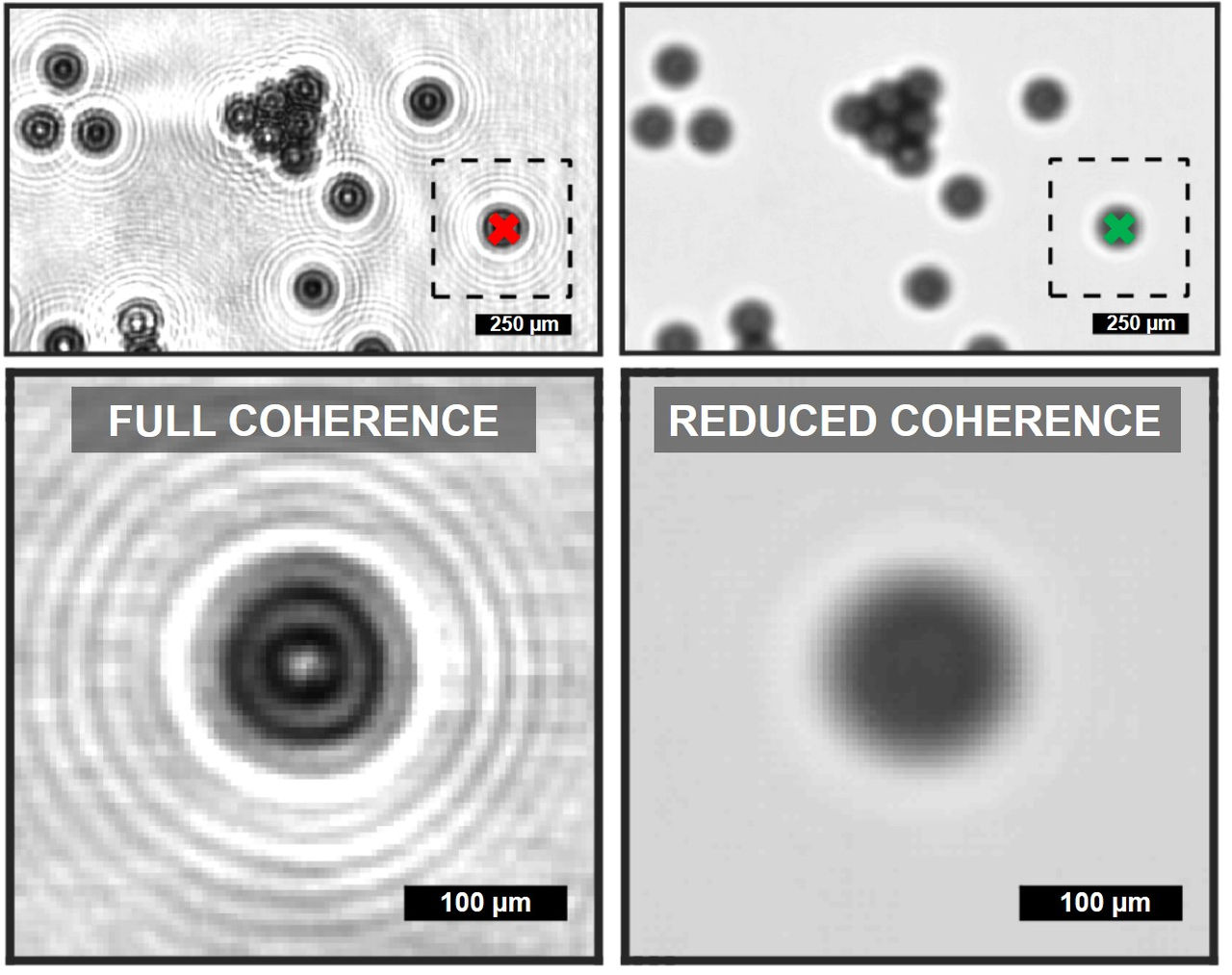
El HYPERION II ofrece microscopía QCL sin limitaciones en un microscopio FT-IR de última generación. De hecho, hemos desarrollado y patentado específicamente una novedosa tecnología de reducción de coherencia que permiten un rendimiento de imágenes láser IR sin precedentes, sin necesidad de realizar un posprocesamiento digital.
Para ilustrarlo: En el FT-IR clásico, la coherencia espacial no es relevante. Sin embargo, en las mediciones microscópicas IR con un QCL, es inevitable que ocurran fenómenos de coherencia espacial. Estas franjas y distorsiones en las imágenes y espectros IR generalmente se consideran perjudiciales para las imágenes químicas (ver adyacente; DOI: 10.1002/jbio.201800015).
De hecho, no es trivial separar la información química de la muestra de la información física que describe la relación de fase de los fotones dispersos. El HYPERION II aborda este problema de manera pragmática y lo resuelve mediante un diseño de hardware inteligente que permite adquirir datos de imágenes químicas sin artefactos.
Comparación de la espectroscopía FT-IR y QCL
Comparar las técnicas implicaría que ambos pueden realizar la misma tarea igualmente bien, pero esto es un concepto erróneo. Las imágenes FT-IR y láser infrarrojas tienen ventajas distintivas y solo una combinación práctica de ambas puede lograr los mejores resultados.
Sabemos que la mayoría de los científicos e investigadores no quieren perderse la universalidad del FT-IR. No les gusta estar restringidos a una sola técnica de vanguardia. Afortunadamente, el HYPERION II puede considerarse ambos: un microscopio de imagen FT-IR excepcional y un ambicioso microscopio QCL.
Hemos abordado esta dualidad y la tecnología QCL permite registrar datos significativamente más rápido con la misma señal a ruido, pero limitada a un pequeño rango espectral en el MIR. Una vez más, nos mantenemos fieles al concepto del HYPERION II. Usted elige. Usted tiene el control total.

Aplicaciones de microscopía IR (FPA, MCT, QCL)
Análisis biológico de tejidos

Ciencia de los materiales

Ciencia Forense

Desarrollo de fármacos

Geología y Mineralogía

Análisis de microplásticos

Energy Materials / Photonic Crystals

In the study by Arpin et al. (2013), 3D self-assembled tungsten photonic crystals retain their structure up to ~1,400 °C, while exhibiting tailored IR reflectance/emissivity spectra that show enhanced useful thermal emission and suppressed undesired IR emission.
The role of HYPERION: researchers used reflectance IR to infer spectral emissivity via Kirchhoff’s law and applied reflectance analysis to directly link to emissivity control of tungsten photonic crystals.
Nanophotonics / Bioanalytics

Amenabar et al. (2013) demonstrated infrared nanospectroscopy (nano-FT-IR) mapping of individual protein complexes (e.g. ferritin, insulin fibrils) with ~30 nm lateral resolution, interpreting local broadband spectra in the amide I/II region to deduce secondary structure at the nanoscale.
The role of HYPERION: FT-IR spectra were acquired as reference spectra and to compare peak positions and band shapes with the nano-FT-IR data, thereby supporting assignments of local secondary-structure resonances.
Plastmonics / Supercrystals

Mueller et al. synthesized three-dimensional, self-assembled gold nanoparticle “supercrystals” and demonstrated that plasmon polaritons in these crystals induce strong near-field enhancement across visible to mid-IR bands, enabling both SERS and SEIRAS of ligand molecules.
The role of HYPERION: IR reflectance and transmittance spectra on plasmonic supercrystal films where collected demonstrating coupling between plasmonic modes and molecular vibrations and quantifying SEIRAS enhancement.
On-Chip-Screening / Biomedical

In Benz et al. (2020) a dendrimer-based, patterned indium-tin-oxide (ITO) slide was used to generate >50,000 nanodroplet vessels per plate, enabling on‐chip chemical synthesis and ultra-sensitive MALDI-TOF MS, UV–Vis reaction monitoring (RM) and on-chip IR spectroscopy for RM and characterization in high-throughput drug discovery.
The role of HYPERION: IR spectra from the droplet array spots provided molecular vibrational absorption signatures to complement MS and UV-Vis data, thus supporting high-throughput characterization of the synthesized library.
Plasmonics / Metamaterials

Paggi et al. (2023) demonstrate an over-coupled metasurface resonator that enhances molecular vibrational absorption across the mid-IR range (5–10 μm) by coupling weak plasmonic modes to molecular vibrations, achieving reflectivity variations up to 1% per nanometer of molecular layer thickness.
The role of HYPERION: IR spectra in the mid-IR allowed to assess the influence of the metasurface resonator on vibrational modes, shed light onto the broadband SEIRA mechanism and supported the design of detection platforms.
Polariscopy / Nanomaterials

Honda et al. (2019) demonstrated infrared (IR) polariscopy using hyperspectral imaging with a focal plane array (FPA) detector in the IR spectral region under illumination by thermal and synchrotron light sources. They show that the time required for polariscopy at IR wavelengths can be substantially reduced by the FPA-FTIR imaging.
The role of HYPERION: Both the offline FPA-FT-IR experiments and the synchrotron based hyperspectral imaging were performed on the Hyperion enabling the analysis of the targeted sub-wavelength features via polariscopy.
Energy Materials / Metamaterials

Dyachenko et al. report the design and fabrication of a refractory multilayer metamaterial composed of tungsten and hafnium dioxide that exhibits an optical topological transition between epsilon-near-zero and hyperbolic dispersion. This transition allows control over the material’s thermal emission properties at high temperatures, enabling selective tuning of emissivity.
The role of HYPERION: Reflectance spectra were collected in the NIR region to determine the spectral position and strength of optical resonances in the multilayer structure.
Optics / IR Imaging

Stavitski et al. (2013) achieved diffraction-limited spatial resolution by coupling synchrotron infrared (IR) beamlines to focal plane array detectors (FPA), enabling full-field imaging with high chemical sensitivity and rapid acquisition times. Using this approach, they successfully map chemical composition in heterogeneous samples with spatial resolution down to approximately 5 µm.
The role of HYPERION: Equipped with an FPA detector, the HYPERION served as the imaging platform coupled to the synchrotron which was used for the chemical and compositional analysis.
Catalysis / Energy Materials

Cao et al. report using operando synchrotron radiation FT-IR (SR-FT-IR) under working potentials to detect a reversible vibrational absorption band at ~764 cm⁻¹ of an atomically dispersed Ru₁–N₄ catalyst, which they attribute to the adsorption/desorption of an oxygen intermediate (O*), thereby revealing the dynamic involvement of O species at the Ru site during catalysis.
The role of HYPERION: An operando SR-FT-IR setup was used to spatially and spectroscopically interrogate the catalyst under bias, capturing the vibrational signature of O* on the Ru site and supporting direct linkage between intermediate adsorption and catalytic function.
Catalysis / Energy Materials

In Su et al., the authors design CuO clusters supported on N-doped carbon and show that under applied potential the clusters dynamically reconstruct into Cu₂–CuN₃ species with charge asymmetry, which correlate with high Faradaic efficiency toward C₂⁺ products (notably ethanol). They combine operando XAS, quasi-in situ XPS, and operando FT-IR (with DFT support) to trace structural, electronic, and adsorbate changes in real time.
The role of HYPERION: As part of their operando FTIR setup, it was used to focus the synchrotron-based IR beam into the reaction cell and collect reflectance spectra under applied potentials. These measurements enable tracking of molecular vibrational features and charge-asymmetry signatures linked to the Cu₂–CuN₃ clusters and thus substantiate the structure–activity correlations under working conditions.
Accesorios de muestreo IR y objetivos
Pletina de validación

Soporte de muestra con pinza

Accesorio de imagen macro ATR

Portafiltro

Platina para calentamiento y enfriamiento

Objetivo de imagen 3,5x

Objetivo de transmisión estándar

Objetivo ATR

Objetivo del ángulo de incidencia rasante

Celda de compresión de diamante

OPUS Release 9.0 Highlights for HYPERION II | Q1 2025
New Feature: The Autonomous Composition Identifier (A.I.D.) simplifies search and identification.
The Autonomous Composition Identifier (A.I.D.) is an AI-driven software tool for identifying the chemical composition of samples based on IR or Raman spectral data. It incorporates the previous O/SEARCH features and adds a multi-step algorithm to find the best match from reference spectral databases, whether dealing with pure substances or complex mixtures. A.I.D. intelligently evaluates and recommends optimal matches with a balance of reliability and sensitivity—automatically generating diagnostics and visual reports, including residual spectra and hit quality graphs. It delivers high-performance results in seconds and supports in-depth, interactive analysis of alternative identifications.

New Feature: Co-local Measurement – Unified Analysis Across IR and Raman
The Co-local Measurement function, part of the OPUS/OBJECT package, enables seamless analysis of the same region of interest on microscopic samples using both IR and Raman microscopy. It allows the transfer of overview images and measurement areas between LUMOS II, HYPERION II, and SENTERRA II instruments. This ensures that IR and Raman data are collected from precisely the same spot, enabling complementary chemical insights. Co-local Measurement bridges the gap between two techniques, improving data correlation and boosting confidence in results for heterogeneous or complex samples.

Updated Feature: OPUS/OBJECT now combines "Find Particle" and "Cluster ID"
The Particle Identification function (part of the OPUS/OBJECT package) combines the power of “Find Particles” and “Cluster ID” into one streamlined workflow. It detects particles within IR and Raman chemical images, determines their dimensions, and identifies their chemical makeup—all in one go. This integrated approach simplifies analysis and accelerates decision-making for complex samples.

Lanzamiento OPUS 8.7 | HYPERION II | Q3 2021
Nueva función: Generación de imágenes químicas de alto rendimiento mediante una nueva función de agrupación K-means adaptativa.
Esta nueva función es el siguiente paso lógico en el desarrollo de nuestra conocida función de análisis de grupos (Cluster Analysis). La función de agrupación según K-means adaptativo se basa en un nuevo algoritmo que permite una determinación no supervisada y autónoma de la varianza espectral dentro de sus resultados de imagen o mapeo.
- Ya no es necesario predecir o buscar la cantidad de clases químicas incluidas, ya que el algoritmo puede predecirlas por sí mismo.
- Esta función principal es importante para todo tipo de análisis de imágenes químicas y de distribución de muestras desconocidas o pequeñas estructuras dentro de conjuntos de datos más grandes.
- Hacer el análisis y la evaluación es realmente fácily le permite ahorrar su valioso tiempo.
Nueva función: Función “Cluster ID” para identificación de clases en datos espectrales 3D.
Nuestra nueva función "Cluster ID" permite la identificación de grupos dentro de los datos de imagen y mapeo utilizando las funciones de OPUS: búsqueda de espectros en bibliotecas, comparación rápida o prueba de identidad.
- Determinación sencilla de la identidad química de componentes de muestras clasificadas para partículas, capas en laminados, componentes de comprimidos farmacéuticos y otros materiales no homogéneos.
- Se proporcionan informes estadísticos fiables y completos sobre la cantidad, el tamaño y, por supuesto, la identidad de todas las estructuras analizadas, lo que lleva el análisis de partículas y de limpieza técnica a un nuevo nivel autónomo.
Función actualizada: La función "Find Particles" ahora incluye un nuevo método de detección de partículas.
El probado software "Find Particle" puede aplicarse ahora tanto a la imagen visual como a la IR. Con esta función actualizada, se puede realizar la detección de partículas basándose en las imágenes químicas que fueron medidas por el LUMOS II.
- Mientras que el reconocimiento de partículas para estructuras de bajo contraste y partículas/fibras blanquecinas/transparentes en membranas de filtro blanquecinas puede ser tedioso, una determinación de partículas posterior a la ejecución basada en la imagen IR química le permite determinar la cantidad y el tamaño de las partículas a partir de sus resultados de imagen o mapeo.


Sala de Literatura
Obtenga más información sobre nuestros microscopios y soluciones FT-IR descargando literatura relacionada.