
OPUS: Latest Release
OPUS Workstation
OPUS 9.3 is the latest releases of OPUS, the leading software for measurement, processing and evaluation of IR, NIR and Raman spectra. OPUS is a true 64 Bit software, delivering utmost performance under native 64 Bit operation.
OPUS 9.3 is released for Windows 11.
OPUS 9.3 contains further improvements for FT-IR, QCL- and Raman microscopy and the new VERTEX NEO Ultra and the OMEGA 5 runs with the validation program OVP-X.
New OPUS 9.3 features include:
New OPUS 9.3 features include:
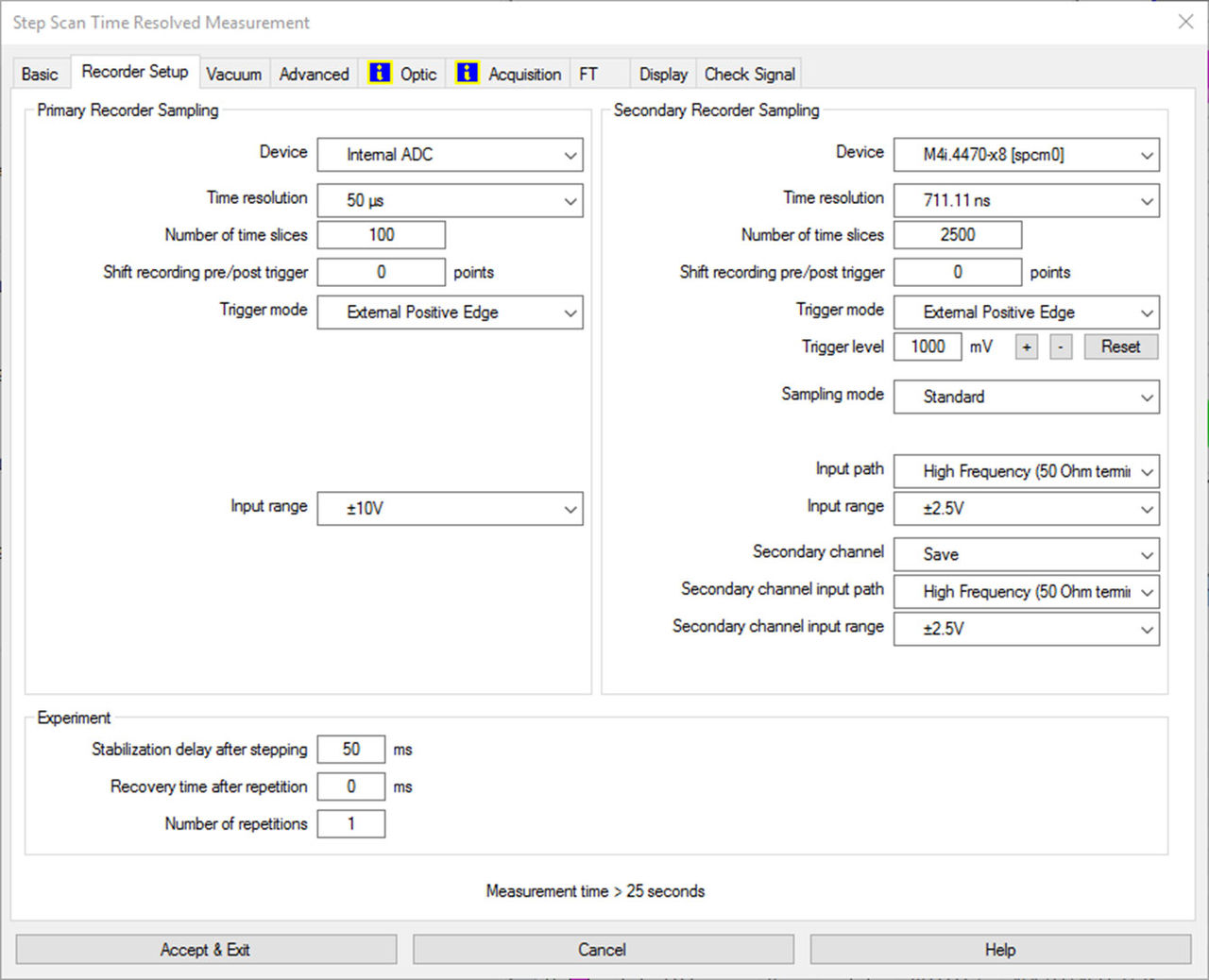
- Combined StepScan Support for Multi-Scale Kinetics: The latest OPUS version introduces full support for combined Step-Scan measurements, enabling seamless acquisition of fast (nanosecond) and slower (microsecond/millisecond) kinetics within a single experiment. Unlike traditional workflows that require two consecutive step-scan runs, OPUS now synchronizes data collection for both time regimes in one pass through the interferogram. This significantly reduces measurement time for studies spanning multiple kinetic scales.
The software integrates transient recorder functionality for high-speed events (up to 2.5 ns resolution) alongside standard ADC sampling for slower processes (up to 6 μs), ensuring efficient memory usage and minimizing redundant data. Users benefit from improved signal-to-noise ratios and streamlined analysis, making it easier than ever to capture and interpret dynamic processes across diverse time domains.
- Sample Compartment Purge Mode: The new OPUS version introduces a dedicated purge mode for the sample compartment, allowing users to purge with dried air or nitrogen while the rest of the optical bench remains under vacuum. This feature is particularly valuable for samples that cannot be placed in a vacuum environment, ensuring optimal measurement conditions without compromising sample integrity. By isolating the purge to the sample compartment, users can maintain high spectral quality and minimize atmospheric interference, even when working with sensitive or vacuum-incompatible materials.

- OPUS writes into new OPUS_XXX.db when defined file size is reached: Performance of OPUS decreased when OPUS.db became too large due to too many audit trail entries.
The number of audit trail (AT) entries per database can be defined with the new command parameter /MAXAUDITTRAILROWS=<Number of AT entries>. About 1400 AT entries correspond to 1 Mbyte. - Export more than one file as a new format: The system allowed in the past a user to save one file or a block or blocks of one file as a new format. The new opus function allows a user to export more than one file with a new format at once.
OPUS-TOUCH
With the newest release version 7, OPUS-TOUCH starts its next generation. It is the first true touch-operated software for infrared spectroscopy without the need for another second software on the side. It guides users through workflows with clarity and precision, reduces training time, and minimizes operational errors.
Method Creator & Editor for Quick Compare
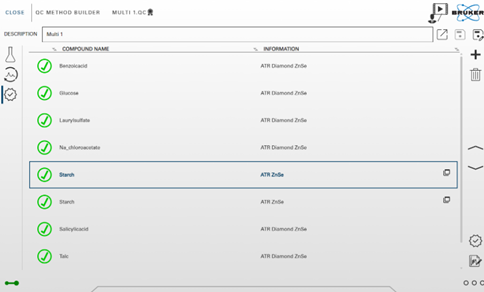
Quick Compare methods can now be created and edited directly in OPUS TOUCH. The built-in editor provides the full functionality of classical OPUS and adds convenient enhancements such as automated group creation and method signing directly within the editor.
Automated Product Creation
Products can now be created automatically from Quick Compare method files, either for all included components or for individually selected ones. There is no need to manually generate an MEV file anymore. The expected reference for each product is assigned automatically. In addition, MEV files that contain Quick Compare data can also be used for automated product creation.
Product Editor
The product workflow now supports editing existing products. All relevant components of an already existing product, such as method files or product images, can be modified.
As a new product customization option, the editor allows adding up to five additional input fields and supports overwrite parameters for measurement time and resolution.

Product Workflow Improvements
The loading time for multiple products has been significantly reduced.
Method Creator & Editor for Quant 1
OPUS TOUCH now enables the creation of Quant 1 methods using an intuitive method builder that offers multiple integration techniques, a graphical results view, and a comprehensive calibration report.

Full OVP-X Support
OVPX can now be fully managed via OPUS TOUCH. Individual tests can be activated or deactivated, and validity periods can be defined for each test routine.

C/O Analysis with MappIR and Map300
The latest update introduces a powerful new workflow that enables users to create maps of measurement points on wafers of various diameters. Following the measurements, the carbon and oxygen content is accurately determined and can be easily exported for further analysis.

User Experience Improvements
OPUS TOUCH now offers extended customization options, including new color themes, an image gallery, and an optional non‑full‑screen windowed mode allowing users to adapt the software to their individual preferences and to various hardware setups such as panel PCs, laptops, or desktop systems. Animated button highlights and a set of new tutorial videos further improve user guidance and make training even easier.
BRAVO
Version 2.2.4 is the latest release of the BRAVO handheld Raman spectrometer software, supported by OPUS 8.8.4. Be guided straightforward through a reasoned workflow, including various analysis tools and reporting options, while simply touching icons on a large touch screen. BRAVO is designed for the operation in validated environments of the pharmaceutical industry and offers all required functionality to meet regulatory requirements out of the box.
New BRAVO handheld Raman features include:
- BRAVO Web Access: A secure https interface enables to access system information, licensing functionality, EAP-TLS certificate management and a BRAVO screen sharing functionality.
- BRAVO Viewer: The secure https web access enables screen sharing of the BRAVO GUI as well as full remote control of the BRAVO software via a web browser.
- Device Diagnostics: Updated device diagnostics functionality for fast and easy access to performance status information.
- EAP-TLS WiFi Authentication: Support of EAP-TLS protocol with custom certificates.
- Service Mode: New service mode functionality to enable flawless maintenance by Bruker service.
- NTP time server connection: A new option for controlling the system date & time is the stand-alone connection to a NTP time server.

ONET
The ONET 3.1 software is a server application accessed via a browser-based web interface (WebUI), allowing to set up, administrate and control a network of FT-IR or FT-NIR instruments from anywhere in the world. All data measured on local spectrometers are centrally stored. Nevertheless, all data and required files are still available locally, allowing for analysis of samples at any time even when the network is temporarily disconnected.
New ONET 3.1 features include:
- New, modern Web User Interface
- Faster and more efficient communication with ONET clients
- Easy assignment of reference values via .csv import.


CMET
CMET 3.1 is the latest release of the process software forming the link between Bruker’s outstanding FT-NIR process analyzers and the customers Distributed Control System (DCS). Commands given by the DCS are transferred to CMET which in return starts a specific measurement and transmits the data back to the DCS for visualization and archiving as well as process monitoring and optimization. CMET supports various standard communication protocols such as Modbus, Profibus DP, 4-20 mA and OPC ensures optimal connectivity.
New CMET 3.1 features include:
- Online BIAS, recipe control (simplified handling for batch processes) and CMET as a Service.
- Emission Head Q412-series and its additional single-source mode is supported.
- Trend Chart with a new interface, login functionality and database connection.