
M4 TORNADO
ニーズに合わせて構成可能
究極のスピードと精度
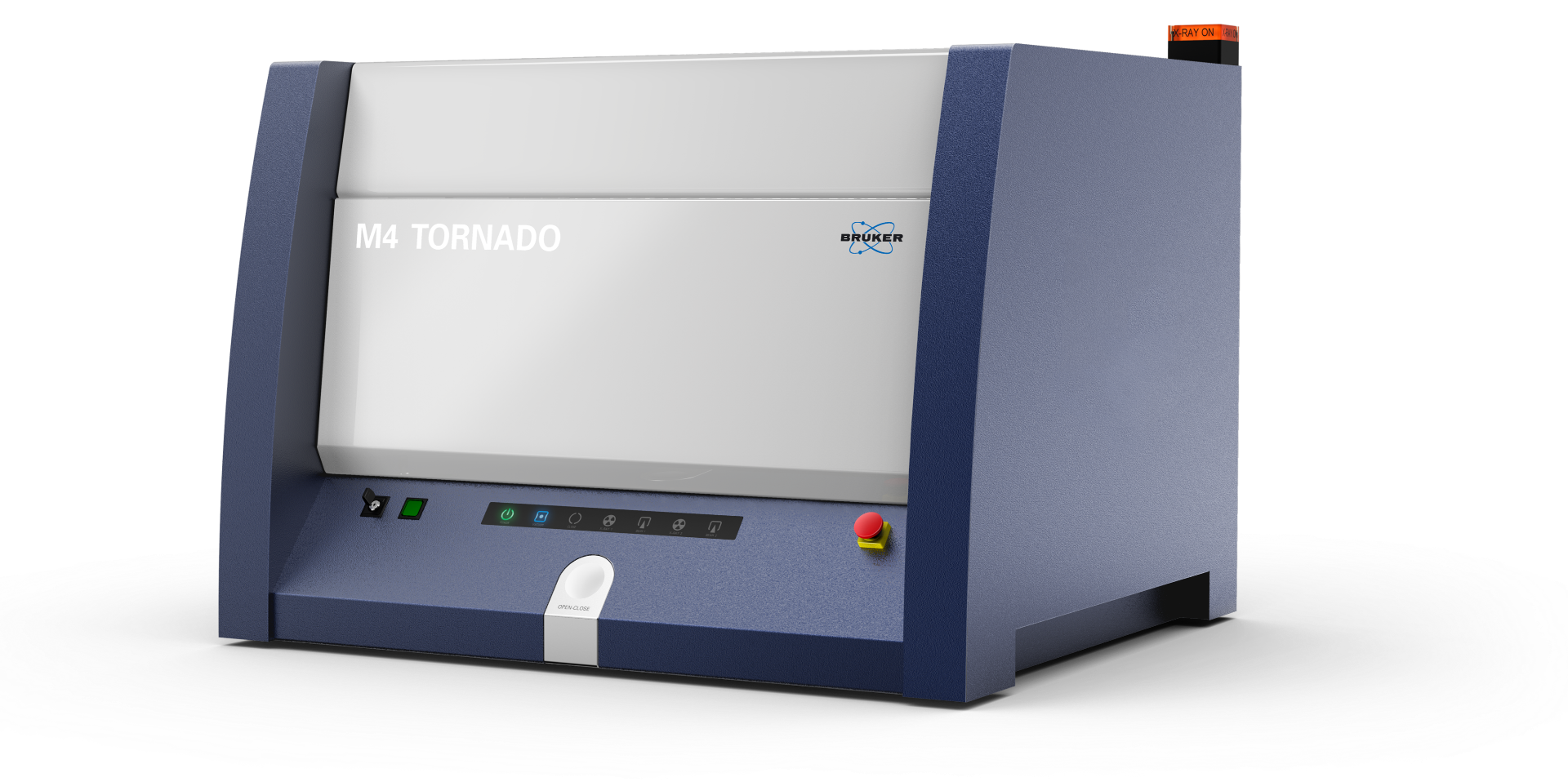
市場をリードするスピードと柔軟性を備えた高性能マイクロXRF

M4 TORNADOは微小点に絞ったマイクロ蛍光X線を使用してサンプルの元素情報を得るための装置です。その測定は表面の下からでも、組成および元素の分布に関する情報を与えます。BrukerのマイクロXRF分光計は、有機、無機、液体などあらゆる種類のサンプルの点、線、2Dエリアスキャン(元素マッピング)の高速分析に最適化されています。
一次X線励起は小さいスポットサイズおよび高いX線の強度を提供するポリキャピラリーレンズを使用します。M4 TORNADO は、さまざまな Bruker XFlash® シリコンドリフト検出器 (SDD) で構成可能で、エネルギー分解能を損なうことなく高スループットを実現します。
M4 TORNADOの優れた構成オプションの1つは、別のターゲット材料と拡張分析機能のためのコリメータチェンジャーを提供する追加のX線管です。
その他の最先端の設定オプション:
- チャンバー内の大気圧を維持しながら、軽い要素の性能を高めるためのHe置換機構
- 薄いセクションおよびドリルコアのためにパッケージ化されたクイック交換段階および地理サンプルのホールダー
- 標準サポートおよび完全標準ベースの定量化と層厚計算のための XMethod ソフトウェア
- 自動鉱物分析用のAMICSソフトウェア
M4 TORNADOはどのように分析をサポートできますか?

測定時間を短縮します。最適化されたX線励起経路、ハイスループット検出器、ピクセル時間を1ミリ秒までの「オンザフライ」マッピング。
7kgまでのサンプルを測定可能。大真空チャンバー、自由に調整可能な、2つの庫内気圧調整機構、自動ヘリウムまたは窒素フラッシュにあなたのサンプルを保護するために一定の真空保持機構。
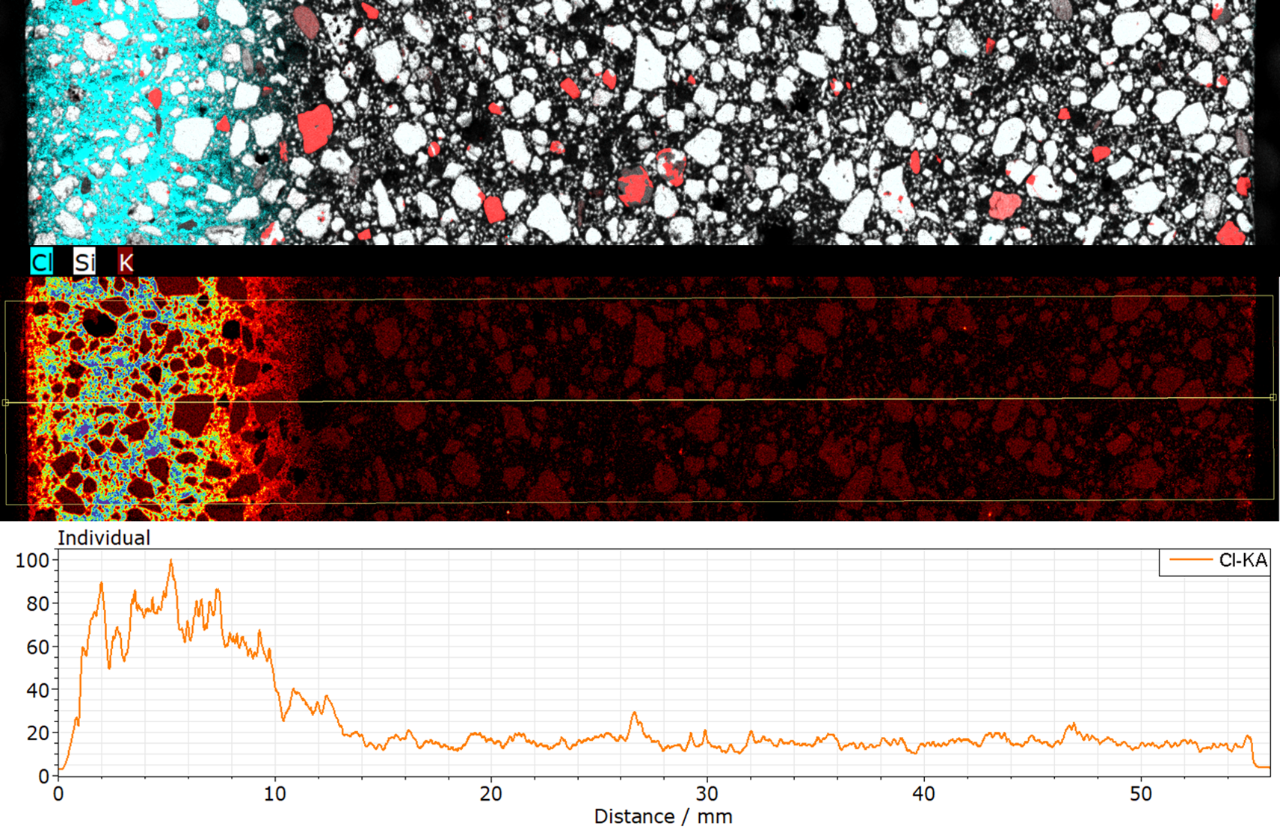
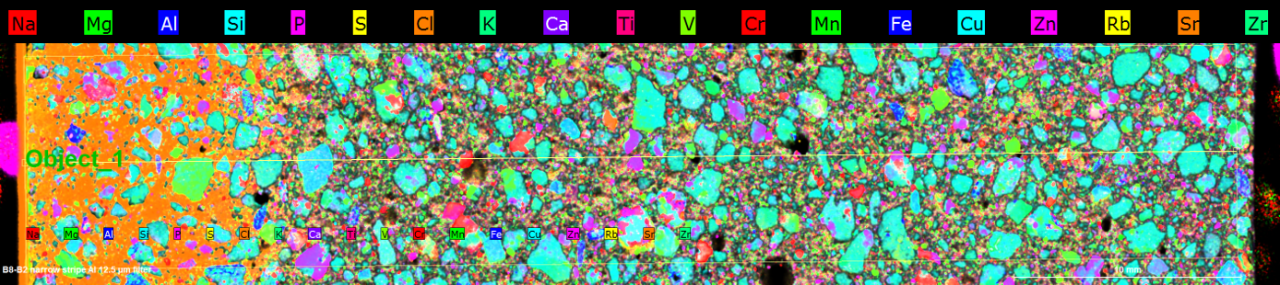
最大190 x 160 mm²のエリアをマップします。一度の測定で40Mピクセルまでの記録が可能で、データ ストレージをハイパーマップとしてピクセルごとの完全なスペクトル情報が得られます。
スペクトル、ラインスキャン、マッピングを定量化します。構成可能な基本的なパラメータメソッド、レイヤーまたは標準ベースの定量化のためのオプションのXMethodソフトウェアパッケージ、マッピングのレイヤー解析。
データを処理します。強力なソフトウェアパッケージ、任意のオブジェクト合計スペクトル(楕円、長方形、多角形)の抽出、ラインスキャンの抽出、単一の測定場所(MaximumPixelSpectrum)にのみ存在する元素の決定、化学相分析(オートフェーズ)。
機能を拡張します。お客様の分析ニーズに合わせて、幅広い構成から利益を得ることができます。
Further Enhance your Analytical Capabilities
The M4 TORNADO can be further enhanced with optional features to address your analytical challenges. From the analysis of light elements to the high-resolution imaging of samples with complex topographies.
LE Option: Light Element Detection with the M4 TORNADO
Light element analysis is possible using the M4 TORNADO Light Element (LE) option.
The LE option significantly improves sensitivity in the low-energy range of 0.5–4 keV facilitating the micro-XRF analysis of elements as light as oxygen. This is achieved through advanced detector technology with ultra-thin windows, a fully controlled vacuum system that enhances low-energy X-ray transmission, and a magnetic electron trap that reduces noise and protects the detector.
Together, these features deliver clear, reliable results for elements such as sodium, magnesium, aluminum, and fluorine.
If even greater levels of light element detection are required we recomend using the M4 TORNADO PLUS.

AMS Option: Sharper Results with Smart Aperature Management System
The Aperture Management System (AMS) option for the M4 TORNADO enhances micro-XRF performance by reducing beam divergence and maintaining a nearly constant spot size, even on samples with uneven surfaces. By reshaping the polycapillary output into a more focused beam profile, AMS preserves high intensity while delivering improved spatial resolution without the need for additional optics.
AMS is available in two options (500 or 1000) which, when needed, can be seamlessly inserted into the beam path via software control.
The AMS Option is particularly valuable for the analysis of samples with fine structural details and surfaces of high topography, such as geological samples, cultural heritage objects and advanced materials.




リソースとパブリケーション
アプリケーションノート
- XRF 470 - Analysis of natural and processed food samples
- XRF 469 - Mineral composition analysis using the M4 TORNADO AMICS
- XRF 467 - Combining Micro-XRF and Micro-CT: Mineral measurements of drill cores
- XRF 465 - Standardless and standard-supported fundamental parameter quantification of steel samples
- XRF 464 - Qualitative and quantitative analysis of a large welding joint
- XRF 463 - Fast crystal domain screening using energy dispersive Laue mapping
- XRF 462 - Spatially resolved layer thickness analysis of thin metal coatings
- XRF 461 - Improving the quantification of non-homogeneous samples
- XRF 457 - Analyzing thin layers under vacuum
- XRF 456 - Analysis of geological thin sections
- XRF 451 - Analysis of steel corrosion using micro-XRF
- XRF 455 - Analysis of a large granite sample from the Vredefort Dome
- XRF 452 - Analysis of small particles with micro-XRF
- XRF 447 - distribution analysis of electronic components
- XRF 446 - Elemental composition of Daphnia
- XRF 443 - Analysis of a Roman sword
- XRF 442 - Analytical performance of the M4 TORNADO
- XRF 441 - Elemental distribution analysis on geological samples
出版 物
- 2022 - Nature: The Mesozoic terminated in boreal spring
- 2022 - Paleoceanography and Paleoclimatology: Sub-Annual to Interannual Arabian Sea Upwelling, Sea Surface Temperature, and Indian Monsoon Rainfall Reconstructed Using Congruent Micrometer-Scale Climate Proxies
- 2021 - Analytical Chemistry: When Red Turns Black: Influence of the 79 AD Volcanic Eruption and Burial Environment on the Blackening/Darkening of Pompeian Cinnabar
- 2021 - Palaeogeography, Palaeoclimatology, Palaeoecology:The environmental context of carbonaceous compressions and implications for organism preservation 1.40 Ga and 0.63 Ga
- 2021 - Journal of Paleolimnology: (Open Access) Human actions were responsible for both initiation and termination of varve preservation in Lake Vesijärvi, southern Finland
- 2021 - ACS Earth Space Chem.: Geochemical Characterization of the NWA 11273 Lunar Meteorite Using Nondestructive Analytical Techniques: Original, Shocked, and Alteration Mineral Phases
- 2021 - Science Advances - Globally distributed iridium layer preserved within the Chicxulub impact structure
- 2020 - Materials Characterization: Surface analysis of corroded XV–XVI century copper coins by μ-XRF and μ-PIXE/μ-EBS self-consistent analysis
- 2020 - Science of The Total Environment: Decay processes in buildings close to the sea induced by marine aerosol: Salt depositions inside construction materials
- 2020 - Minerals Engineering: Elemental and mineralogical constraints on environmental contamination from slag at Gulf Creek copper mine
- 2020 - Minerals Engineering: Elemental and mineralogical constraints on environmental contamination from slag at Gulf Creek copper mine
- 2020 - Spectrochimica Acta Part B: Atomic Spectroscopy: Energy dispersive X-ray fluorescence quantitative analysis of biological samples with the external standard method
- 2020 - CrystEngComm: Tunable pore size in diopside glass-ceramics with silver nanoparticles
- 2020 - International Journal of Legal Medicine: Arrow entrance wounds with blackened margins simulating bullet wipe
- 2020 - Palaeogeography, Palaeoclimatology, Palaeoecology: Benchtop μXRF as a tool for speleothem trace elemental analysis: Validation, limitations and application on an Eemian to early Weichselian (125–97 ka) stalagmite from Belgium
- 2020 - Journal of Crystal Growth: Growth of CuFeO2 single crystals by the optical floating-zone technique
- 2020 - Radiation Physics and Chemistry: Study of composition and structure of demineralized bone using X-ray techniques
- 2019 - International Journal of Energy Research: Development of the inorganic composite phase change materials for passive thermal management of Li‐ion batteries: material characterization
- 2019 - Materials Science and Engineering: Relating micro-segregation to site specific high temperature deformation in single crystal nickel-base superalloy castings