Characterization of the Elastic Properties of Cartilage Tissue by Indentation
Articular cartilage is a specialized connective tissue suited for the distribution of contact loads within diarthordial joints. It is a biphasic material that exhibits anisotropic and nonlinear elastic behavior. The liquid phase, primarily water, makes up 65% to 80% of the cartilage by weight. The solid phase consists of dispersed proteoglycans within an extracellular matrix (ECM) of collagen and glycoproteins. The structure contains four zones based on the arrangement of the collagen fibril network as shown in Figure 1.1,2 Mechanical properties vary across the four zones, meaning that high-spatial-resolution is needed for characterization of the localized regions of the tissue.
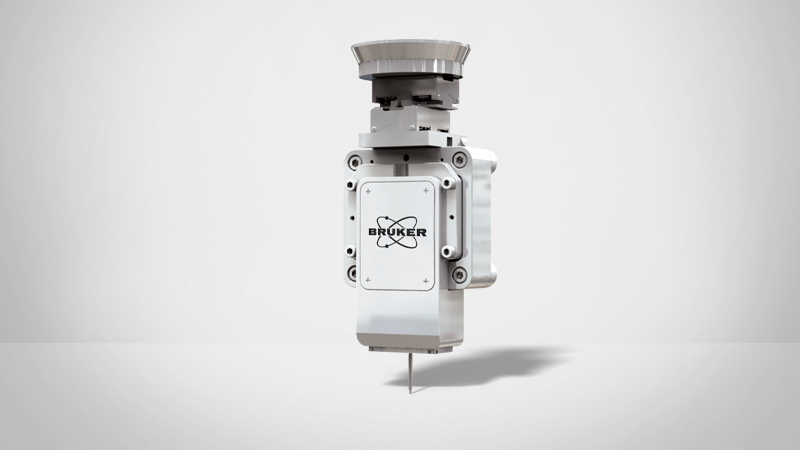
This application note shows how Bruker’s Hysitron® BioSoft™ In-Situ Indenter was successfully used to probe local mechanical properties across the sample, and examines the applicability of various data analysis models.

The Hysitron BioSoft In-Situ Indenter is an exceptional tool for the characterization of tissue. Indentation is a popular mechanical characterization technique capable of nondestructive and in-situ measurements of biomaterials that can provide a greater understanding of a tissue’s characteristics.3 The confined volume of the indentation zone allows one to probe different areas of the tissue for local properties.

Experiment
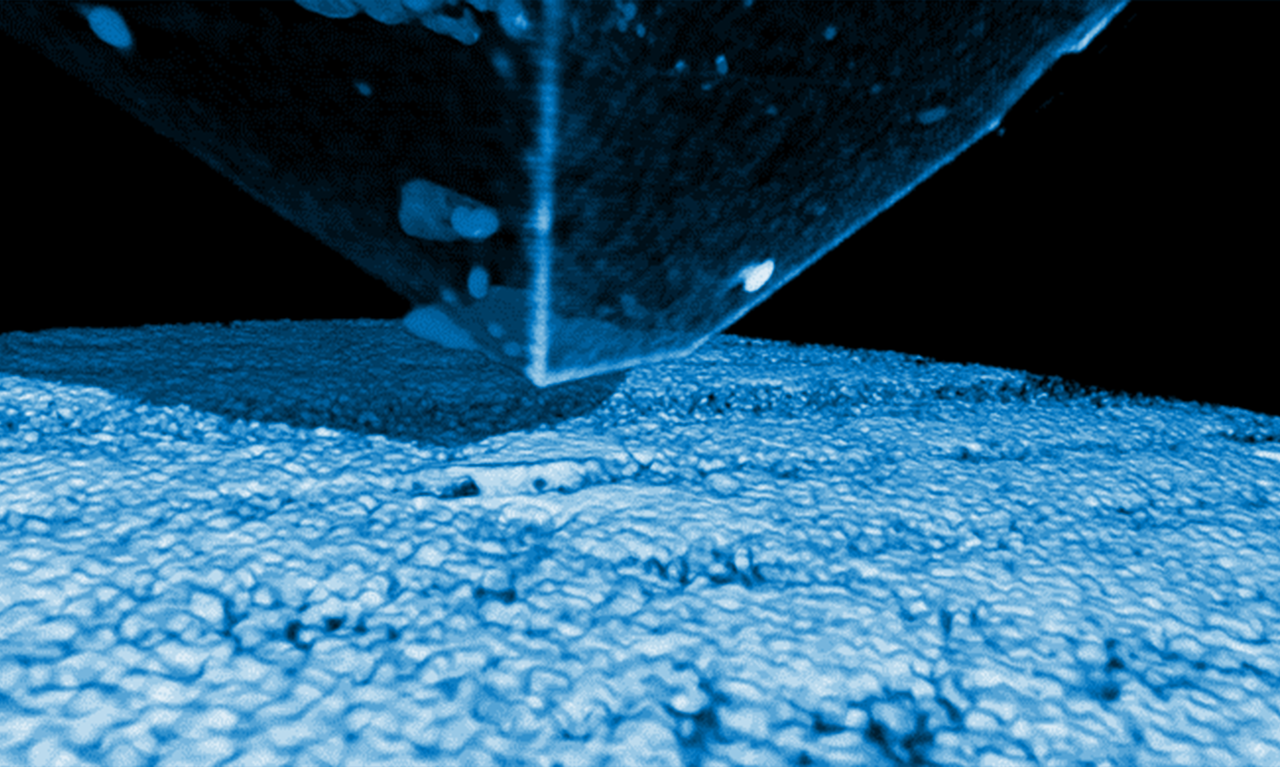
A Hysitron BioSoft indenter attached to an inverted microscope was used to indent articular cartilage submerged in phosphate-buffered saline with a 20 μm spherical probe. Load relaxation tests were performed where the peak displacement was held constant while the load was monitored. The hold period was fit using an exponential decay equation:

where P∞ is the load extrapolated to infinite time when fluid flow has ceased. At this point, hydraulic pressure is relieved and only the phase-separated response of the cellular ECM remains.3,4

Indentation Depth Profile
A depth profile obtained on articular surface is shown in Figure 3. Indentations were performed on the same sample location while allowing sufficient time for the cartilage to recover between tests, which resulted in good repeatability. The extrapolated loads were calculated using Equation 1.


Several models were fit to the data to obtain the elastic modulus of the solid phase, as shown in Table 1. The JKR model reduced to Hertz upon fitting. The large reduced chi squared, Xv2 , values of Hertz and Sneddon indicate poor model fits. However, both the Fung and Mooney-Rivlin hyperelastic models fit the data well. The hyperelastic models contain an additional parameter to account for non-linear elastic behavior of the tissue. The moduli given are for zero strain. A Mooney-Rivlin analysis of indentations into several locations on the surface results in a modulus of 135.2 ± 9.8 kPa, which is comparable to results found in other studies.4,5
Cross-Sectional Profile
Indentation of the cross-sectional surface gives the property gradients across zones of the cartilage. Three lines of 11 indentations were performed with 100 μm spacing. Results from a Mooney-Rivlin analysis are shown in Figure 4. The modulus is observed to decrease from the deep zone to the STZ. This makes sense as the fluid content, which inversely correlates with modulus, increases near the STZ.1 The modulus approaches that measured on the articular surface, but plateaus at a slightly higher value. This anisotropy is likely due to preferential alignment of the collagen fibrils parallel to the articular surface. The greater deviation observed near the deep zone may be attributed to an increased disparity of the material structure between indent locations.

Conclusions
The Hysitron BioSoft is a powerful tool for testing biological tissues, including the characterization of anisotropy, homogeneity, and property gradients. For indentation depths that are small in comparison to the probe size, Hertz theory has been shown to work well. However, for large depths, where strains are greater, hyperelastic models are clearly better suited.7
References
- Margareta Nordin, Victor H Frankel. Basic Biomechanics of the Musculoskeletal System. Lippincott Williams & Wilkins, Baltimore, Maryland. 2001. Ch. 3, p. 74-77.
- Rami K. Korhonen and Simo Saarakkala (2011). Biomechanics and Modeling of Skeletal Soft Tissues, Theoretical Biomechanics, Dr. Vaclav Klika (Ed.).
- Xin L. Lu, Van C. Mow. Med. Sci. Sports Exerc., 2008 Feb; 40(2): 193-199.
- Hadi Tavakoli Nia, Lin Han, Yang Li, Christine Ortiz, Alan Grodzinsky. Biophysical Journal, Vol. 101 Nov. 20111, 2304-2313.
- Cheng Chen, Dhananjay T. Tambe, Linhong Deng, Liu Yang. Am J. Physiol. Cell Physiol., 149: C1202–C1208, 2013
- Ian N. Sneddon. Int. J. Engng Sci., Vol 3, pp. 47-57. Pergamon Press, 1965.
- David C. Lin, David I. Shreiber, Emilios K. Dimitriadis, Ferenc Horkay. Biomech Model Mechanobiol (2009) 8: 345–358.
- Brian G. Busha, Jenna M. Shapiro, Frank W. DelRio, Robert F. Cook, Michelle L. Oyen. Soft Matter. 2015 Sep 28; 11(36): 7191-200.
Authors
- Ben J. Stadnick (benjamin.stadnick@bruker.com), Bruker Nano Surfaces Division
- Prof. Melih Erten, Prof. Corinne Henak, Guebum Han, and Cole Hess, University of Wisconsin-Madison
BioSoft and Hysitron are trademarks of Bruker Corporation. All other trademarks are the property of their respective companies. © 2017 Bruker Corporation. All rights reserved. AN1500, Rev. A0