
HYPERION II
FT-IRとQCLの融合
分析力とイノベーション
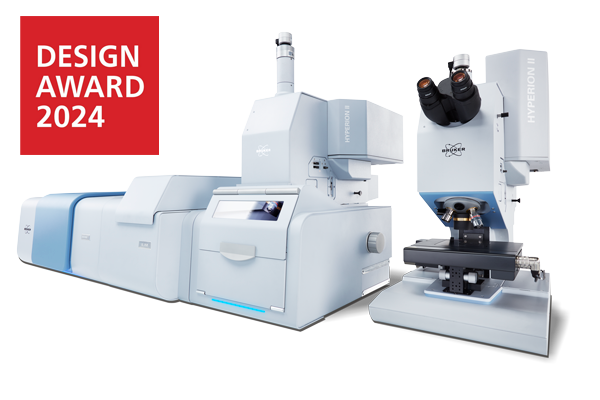
リサーチ赤外顕微鏡 / イメージングプラットフォーム
HYPERION IIの新機能:
QCL イメージング機能の統合:
ブルカー特許、空間コヒーレンスの低減:
QCL による FT-IR 顕微鏡の拡張|赤外レーザーイメージング
HYPERION II は、赤外顕微鏡における技術革新です。赤外イメージングを回折限界に到達させ、顕微 ATR における基準を作りました。さらには透過・反射・ATR のすべての測定モードにおいて FT-IR 顕微鏡と赤外レーザーイメージング顕微鏡機能 (ILIM) の両方を 1 台で実現する、世界初のシステムです。
HYPERION II の主な仕様:
- 顕微 FT-IR 用検出器の選択:
液体窒素冷却式 MCT 検出器
(広帯域、中帯域、狭帯域) - 電子冷却式 MCT 検出器(TE-MCT)
- 赤外スペクトルイメージング用
フォーカルプレーンアレイ検出器
(FPA、64 x 64 または 128 x 128 素子) - QCL 赤外レーザーによる
イメージングモジュールオプション(ILIM、レーザークラス 1) - 対物鏡の選択: 3.5x / 15x / 36x IR、20x ATR、15x GIR、4x/40x(観察専用)
- 波数範囲拡張 – 近赤外から遠赤外まで
(NIR-MIR-FIR) - 視野絞りの選択: 標準ナイフエッジアパーチャ、電動ナイフエッジアパーチャホイール、近赤外用メタルアパーチャ
- アクセサリオプション: マクロ ATR イメージングアクセサリ、冷却/加熱ステージほか
- 観察用オプション: 暗視野照明、蛍光照明、可視偏光子、赤外偏光子ほか
HYPERION II の特長:
- すべての測定モードにおける赤外スペクトルと可視像の完全一致
- 回折限界に迫る空間分解能と優れた感度の FT-IR 顕微鏡およびイメージング顕微鏡(FPA 検出器採用)
- 世界初、FT-IR + QCL 統合システム
赤外レーザーイメージングオプション
(ILIM、レーザークラス 1) - すべての測定モードに対応するQCLイメージングオプション(透過、反射、ATR)
- 特許技術により空間コヒーレンスを低減した高感度・高速レーザーイメージング
- 高速イメージング:
毎秒 0.1 mm2 (FPA、フルスペクトル)
毎秒 6.4 mm2 (ILIM、波数固定時) - 液体窒素なしで高い感度と空間分解能を実現した TE-MCT 検出器オプション
- エミッション測定および波数拡張オプション
HYPERION II アプリケーション:
- ライフサイエンス | 細胞イメージング
- 製薬・医薬
- 放射率測定 (LED 等)
- 障害と根本原因の分析
- 法科学・科学捜査
- マイクロプラスチック
- 産業研究開発
- ポリマーおよびプラスチック
- 表面特性評価
- 半導体
開発者・革新者のためのリサーチ顕微 FT-IR
HYPERION II ほどユーザーのニーズを具体化した赤外顕微鏡はありません。柔軟性、正確性、構成の自由度、適用性、そして常に可能性の限界に挑戦しています。
すべてをコントロールする
何よりも、装置に完全にアクセスできることです。実験条件、試料、そして測定パラメータへのアクセス。これこそが HYPERION II の基本であり、完全なコントロールを提供することが最も重要であり価値のあるものと考えます。
FT-IR によるピンポイント測定、マッピング測定、あるいはイメージング測定。検出器や対物鏡の使い分け。さらには試料の環境制御など、あらゆる点で測定系を自在にコントロールが可能で、より良い結果を得ることができます。
これはブルカーのもう1つの赤外顕微鏡、 LUMOS II との明確なコンセプトの違いです。LUMOS II ではほぼすべての操作を自動化しているのに対して、HYPERION II はオペレータの意図に応える精密ツールと言えます。

不朽の業績
多くのユーザーは、その前身を通じて HYPERION II の強みを知っています。HYPERION は、約20年にわたり赤外顕微鏡とイメージングの分野で革新をもたらしてきました。HYPERION が優れた FT-IR 顕微鏡であると認められた特長は今も健在であり、より優れた性能とスピードを求めて改良したに過ぎません。
液体窒素冷却 MCT 検出器、電子冷却 MCT 検出器、フォーカルプレーンアレイ検出器、可視および赤外強調ツール、豊富な専用アクセサリーなど、HYPERION II は日々の研究に必要な機能のすべてを備えています。
最終的に、確立された価値ある手法を維持することで顕微 FT-IR およびイメージングシステムとしての基準をもう一度確立するとともに、イノベーションリーダーとしての名に恥じないよう、エキサイティングな新技術の導入を進めてきました。

QCL 赤外レーザーイメージング
QCL システムと FT-IR を1台で実現
FT-IR と QCL を1台の装置に組み込んだ初の赤外顕微鏡です。これにより、ライフサイエンスや材料研究の分野に全く新しい扉を開くことができます。
FT-IR スペクトルを収集し、その情報をもとに QCL を使って調べたい波数を選択すると、瞬く間に高精度なケミカルイメージを得ることができます。
この FT-IR と赤外レーザーイメージングによる全く新しいアプローチにより、ユーザーに対して新しいアプリケーションを生み出し、既存の実績あるアプローチをさらに向上させることができる機能を提供します。
卓越した性能を持つ真の QCL 顕微鏡
HYPERION II は、最先端の FT-IR 顕微鏡でありながら、妥協のない QCL 顕微鏡を提供します。HYPERION II は、データの後処理なしで比類のない赤外レーザーイメージを実現するために、新たなコヒーレンス低減技術を開発し、特許を取得しました。
解説: 古典的な FT-IR では、空間コヒーレンスは問題になりません。一方、QCL を用いた顕微赤外測定では、光源の特性上、空間コヒーレンス現象の発生を避けることができません。その影響は赤外イメージやスペクトルにフリンジやスペックルとして現れ、ケミカルイメージング解析の妨害となります(参照: DOI: 10.1002/jbio.201800015)。
実際、試料に関する化学情報を、散乱光子の位相関係を反映する物理情報から分離することは、些細なことではありません。HYPERION II は、この問題に現実的に取り組み、スマートなハードウェア設計によって解決し、アーチファクトのないケミカルイメージデータを取得することが可能となっています。
FT-IR と QCL 分光法の比較
両者を比較すると、同じ作業を同じようにこなせると思われがちですが、これはよくある誤解です。FT-IR と赤外レーザーイメージングにはそれぞれ異なる利点があり、両者を実用的に組み合わせることで初めて最高の結果を得ることができます。
多くの科学者や研究者は、FT-IR の普遍性を重視していることを我々は知っています。彼らの多くは、比較する基準を持たない 1 つ最先端の技術に制限されることを好みません。幸いなことに、HYPERION II は、優れた FT-IR イメージング顕微鏡であると同時に、前衛的な QCL 顕微鏡でもあります。
私たちはこの二重性に対処し、QCL 技術が高 S/N のデータを高速に記録する場合でも、中赤外領域の小さな範囲に制限されています。繰り返しになりますが、HYPERION II のコンセプトに忠実です。あなたが選択し、あなたが完全にコントロールすることができます。


IR顕微鏡アプリケーション(FPA、MCT、QCL)
生体組織解析

材料科学

法科学

医薬品開発

地質学と鉱物学

マイクロプラスチック分析

Energy Materials / Photonic Crystals

In the study by Arpin et al. (2013), 3D self-assembled tungsten photonic crystals retain their structure up to ~1,400 °C, while exhibiting tailored IR reflectance/emissivity spectra that show enhanced useful thermal emission and suppressed undesired IR emission.
The role of HYPERION: researchers used reflectance IR to infer spectral emissivity via Kirchhoff’s law and applied reflectance analysis to directly link to emissivity control of tungsten photonic crystals.
Nanophotonics / Bioanalytics

Amenabar et al. (2013) demonstrated infrared nanospectroscopy (nano-FT-IR) mapping of individual protein complexes (e.g. ferritin, insulin fibrils) with ~30 nm lateral resolution, interpreting local broadband spectra in the amide I/II region to deduce secondary structure at the nanoscale.
The role of HYPERION: FT-IR spectra were acquired as reference spectra and to compare peak positions and band shapes with the nano-FT-IR data, thereby supporting assignments of local secondary-structure resonances.
Plastmonics / Supercrystals

Mueller et al. synthesized three-dimensional, self-assembled gold nanoparticle “supercrystals” and demonstrated that plasmon polaritons in these crystals induce strong near-field enhancement across visible to mid-IR bands, enabling both SERS and SEIRAS of ligand molecules.
The role of HYPERION: IR reflectance and transmittance spectra on plasmonic supercrystal films where collected demonstrating coupling between plasmonic modes and molecular vibrations and quantifying SEIRAS enhancement.
On-Chip-Screening / Biomedical

In Benz et al. (2020) a dendrimer-based, patterned indium-tin-oxide (ITO) slide was used to generate >50,000 nanodroplet vessels per plate, enabling on‐chip chemical synthesis and ultra-sensitive MALDI-TOF MS, UV–Vis reaction monitoring (RM) and on-chip IR spectroscopy for RM and characterization in high-throughput drug discovery.
The role of HYPERION: IR spectra from the droplet array spots provided molecular vibrational absorption signatures to complement MS and UV-Vis data, thus supporting high-throughput characterization of the synthesized library.
Plasmonics / Metamaterials

Paggi et al. (2023) demonstrate an over-coupled metasurface resonator that enhances molecular vibrational absorption across the mid-IR range (5–10 μm) by coupling weak plasmonic modes to molecular vibrations, achieving reflectivity variations up to 1% per nanometer of molecular layer thickness.
The role of HYPERION: IR spectra in the mid-IR allowed to assess the influence of the metasurface resonator on vibrational modes, shed light onto the broadband SEIRA mechanism and supported the design of detection platforms.
Polariscopy / Nanomaterials
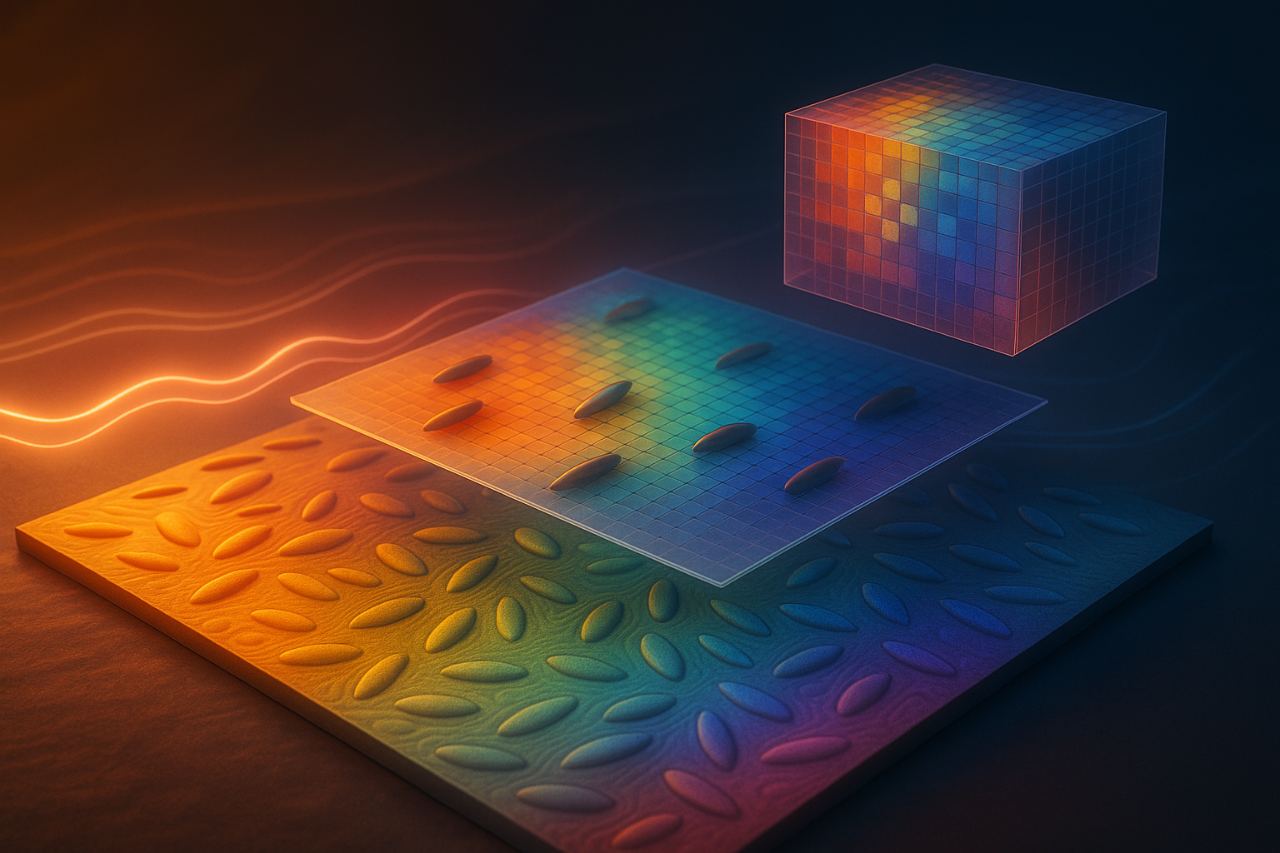
Honda et al. (2019) demonstrated infrared (IR) polariscopy using hyperspectral imaging with a focal plane array (FPA) detector in the IR spectral region under illumination by thermal and synchrotron light sources. They show that the time required for polariscopy at IR wavelengths can be substantially reduced by the FPA-FTIR imaging.
The role of HYPERION: Both the offline FPA-FT-IR experiments and the synchrotron based hyperspectral imaging were performed on the Hyperion enabling the analysis of the targeted sub-wavelength features via polariscopy.
Energy Materials / Metamaterials

Dyachenko et al. report the design and fabrication of a refractory multilayer metamaterial composed of tungsten and hafnium dioxide that exhibits an optical topological transition between epsilon-near-zero and hyperbolic dispersion. This transition allows control over the material’s thermal emission properties at high temperatures, enabling selective tuning of emissivity.
The role of HYPERION: Reflectance spectra were collected in the NIR region to determine the spectral position and strength of optical resonances in the multilayer structure.
Optics / IR Imaging

Stavitski et al. (2013) achieved diffraction-limited spatial resolution by coupling synchrotron infrared (IR) beamlines to focal plane array detectors (FPA), enabling full-field imaging with high chemical sensitivity and rapid acquisition times. Using this approach, they successfully map chemical composition in heterogeneous samples with spatial resolution down to approximately 5 µm.
The role of HYPERION: Equipped with an FPA detector, the HYPERION served as the imaging platform coupled to the synchrotron which was used for the chemical and compositional analysis.
Catalysis / Energy Materials

Cao et al. report using operando synchrotron radiation FT-IR (SR-FT-IR) under working potentials to detect a reversible vibrational absorption band at ~764 cm⁻¹ of an atomically dispersed Ru₁–N₄ catalyst, which they attribute to the adsorption/desorption of an oxygen intermediate (O*), thereby revealing the dynamic involvement of O species at the Ru site during catalysis.
The role of HYPERION: An operando SR-FT-IR setup was used to spatially and spectroscopically interrogate the catalyst under bias, capturing the vibrational signature of O* on the Ru site and supporting direct linkage between intermediate adsorption and catalytic function.
Catalysis / Energy Materials

In Su et al., the authors design CuO clusters supported on N-doped carbon and show that under applied potential the clusters dynamically reconstruct into Cu₂–CuN₃ species with charge asymmetry, which correlate with high Faradaic efficiency toward C₂⁺ products (notably ethanol). They combine operando XAS, quasi-in situ XPS, and operando FT-IR (with DFT support) to trace structural, electronic, and adsorbate changes in real time.
The role of HYPERION: As part of their operando FTIR setup, it was used to focus the synchrotron-based IR beam into the reaction cell and collect reflectance spectra under applied potentials. These measurements enable tracking of molecular vibrational features and charge-asymmetry signatures linked to the Cu₂–CuN₃ clusters and thus substantiate the structure–activity correlations under working conditions.
サンプリングアクセサリーと対物鏡
バリデーションプレート

マイクロバイスサンプルホルダー

マクロ ATR
イメージングアクセサリー

フィルターホルダー

加熱および冷却ステージ

3.5x イメージング対物レンズ

対物鏡

ATR対物鏡

グレイジングアングル対物鏡
(高感度反射対物鏡)

ダイヤモンドコンプレッションセル

OPUS Release 9.0 Highlights for HYPERION II | Q1 2025
New Feature: The Autonomous Composition Identifier (A.I.D.) simplifies search and identification.
The Autonomous Composition Identifier (A.I.D.) is an AI-driven software tool for identifying the chemical composition of samples based on IR or Raman spectral data. It incorporates the previous O/SEARCH features and adds a multi-step algorithm to find the best match from reference spectral databases, whether dealing with pure substances or complex mixtures. A.I.D. intelligently evaluates and recommends optimal matches with a balance of reliability and sensitivity—automatically generating diagnostics and visual reports, including residual spectra and hit quality graphs. It delivers high-performance results in seconds and supports in-depth, interactive analysis of alternative identifications.

New Feature: Co-local Measurement – Unified Analysis Across IR and Raman
The Co-local Measurement function, part of the OPUS/OBJECT package, enables seamless analysis of the same region of interest on microscopic samples using both IR and Raman microscopy. It allows the transfer of overview images and measurement areas between LUMOS II, HYPERION II, and SENTERRA II instruments. This ensures that IR and Raman data are collected from precisely the same spot, enabling complementary chemical insights. Co-local Measurement bridges the gap between two techniques, improving data correlation and boosting confidence in results for heterogeneous or complex samples.

Updated Feature: OPUS/OBJECT now combines "Find Particle" and "Cluster ID"
The Particle Identification function (part of the OPUS/OBJECT package) combines the power of “Find Particles” and “Cluster ID” into one streamlined workflow. It detects particles within IR and Raman chemical images, determines their dimensions, and identifies their chemical makeup—all in one go. This integrated approach simplifies analysis and accelerates decision-making for complex samples.

OPUS 8.7 | HYPERION II | 2021年Q3リリース情報
新機能:適応的K平均クラスタリング機能による高性能ケミカルイメージング生成法
この新しい機能は、当社の定評あるクラスター分析機能の論理的な次の開発ステップです。適応的K平均クラスタリング機能は、新しいアルゴリズムに基づいており、イメージングまたはマッピングデータ内のスペクトル分散を監視なしで自律的に決定できます。
- このアルゴリズムでは、試料に含まれる化学物質を自ら予測することができるため、ピーク強度を用いて量的に解析したり、時間をかけて検索する必要がなくなります。
- 本機能は、あらゆる種類のケミカルイメージングに適用でき、未知試料の分散状態や、大きなデータセット内に隠れている微小構造の分析などにおいても有効です。
- 分析と解析を可能な限り簡単にし、貴重な時間を節約することができます。
新機能:3Dスペクトルデータからクラスを識別する”クラスターID”機能
新規クラスターID機能により、OPUSの標準機能(スペクトル検索、クイックコンペア、判別テスト)を使用して、イメージングおよびマッピングデータ内のクラスターを識別することができます。
- 粒子、ラミネート層、医薬品錠剤の成分など、不均一な材料について各成分が自動的に分類され、化学的同一性を簡単に決定することができます。
- 分析されたすべての構造物の量、サイズはもちろん、同一性に関する信頼性の高い包括的な統計レポートが提供され、粒子および技術的な清浄度分析を新しい自律レベルに導きます。
機能アップデート:「パーティクルファインド(粒子検出)」機能に新たな粒子検出法が追加
実績のある「パーティクルファインド」機能が、可視画像だけではなくケミカルイメージにも適用できるようになりました。 これにより、LUMOS IIを用いて測定し作成されたケミカルイメージデータについても粒子の検出を行うことができます。
- コントラストの低い構造物や、オフホワイト色のフィルターメンブレン上にある透明な粒子やファイバーの認識は難しい場合がありますが、本機能を用いてケミカルイメージに対してパーティクルファインド機能を実行することにより、イメージングまたはマッピングデータにおける粒子の量とサイズを決定することができます。


資料ダウンロード
当社のリサーチ用顕微FT-IRシステム 分析装置とソリューションの詳細については、こちらから資料をご確認頂けます。