Simultaneous Acquisition of Crystallographic and Elemental Information in the SEM Using Unique On-Axis Detectors
Bruker’s unique XFlash® FlatQUAD EDS detector with its ultra-high solid angle of up to 1.1 sr can be used simultaneously with OPTIMUS 2 for the acquisition of maps containing chemical and respectively crystal orientation data from electron transparent samples with unmatched spatial resolution and speed.
Accurate quantitative EDS analysis can be performed using methods designed for electron transparent samples:
- Cliff-Lorimer-factor method
- Zeta-factor-method
Combined EDS and TKD measurements are ideal for characterizing little known samples containing multiple crystallographic phases, e.g. precipitates and/or inclusions. The combined dataset can be used for offline phase identification and reanalysis with great efficiency gains enabled by ESPRIT 2’s capability of indexing up to 60,000 patterns/sec.


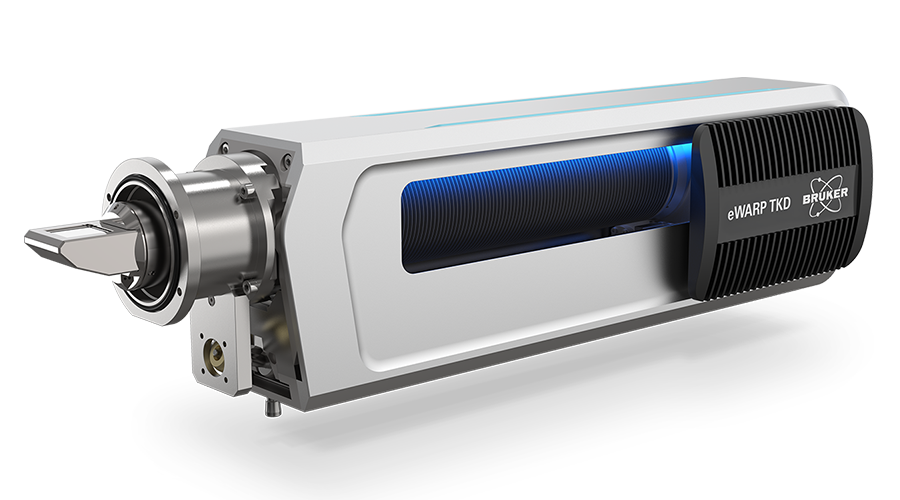
On-Axis TKD and EDS with eWARP TKD
This webnote discusses on-axis TKD and EDS analysis using our legacy TKD solution, the eFlash FS detector equipped with an OPTIMUS 2 detector head, which has now been replaced by our next-generation eWARP TKD detector for ultra-fast, high-resolution transmission kikuchi diffraction.
Thanks to hybrid pixel sensor technology design, eWARP TKD for on-axis TKD provides the highest sensitivity available, enabling higher data quality at low beam energies, ideal in combination with Bruker's XFlash® FlatQUAD 2L EDS detector.