
HYPERION II
FT-IR encontra QCL
Poder Analítico e Inovação
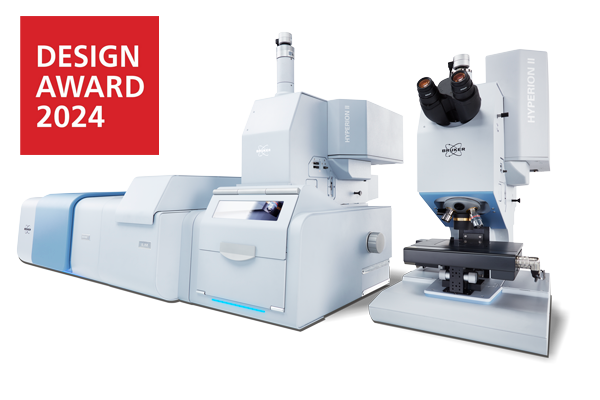
A Plataforma de Pesquisa em Microscopia e Imagem do IR
O que há de novo com HYPERION II:
Como integramos imagens a laser infravermelhas:
Nossa redução patenteada da coerência espacial:
Microscopia FT-IR Aumentada pela QCL | Imagem a laser infravermelha
O HYPERION II é uma força de inovação em microscopia infravermelha. Fornece imagens ir até o limite de difração e define o benchmark em microscopia ATR. Combina microscopia ft-IR e laser infravermelha (ILIM) pela primeira vez em um único dispositivo, oferecendo todos os três modos de medição: transmissão, reflexão e ATR.
CARACTERÍSTICAS HYPERION II:
- Seleção de detectores para μ-FT-IR:
Banda larga, média, banda estreita LN2-MCTs,
MCT refrigerado termoeletricamente (TE). - Detector de matriz focal-plano para imagens infravermelhas (64 x 64 ou 128 x 128 pixels).
- Implementação opcional de QCL por Módulo de Imagem Infravermelha a Laser (ILIM, classe laser 1)
- Seleção objetiva de lentes: 3,5x/15x/36x/74x IR, 20x ATR, 15x GIR, 4x/40x VIS.
- Extensão de alcance espectral – de Infravermelho Próximo (NIR) a Infravermelho Distante (FIR)
- Seleção de aberturas: roda manual de borda da faca, roda de abertura automatizada de borda da faca. Aberturas metálicas para NIR
- Seleção de acessórios e estágios amostrais: acessório de imagem macro IR, estágio de resfriamento/aquecimento, compartimento de amostra, etc.
- Seleção de ferramentas visuais/ópticas: Iluminação darkfield, iluminação de fluorescência, polarizadores VIS, polarizadores de RI, etc.
HYPERION II fornece:
- Combinação perfeita de imagens espectrais e visuais. Aplica-se a qualquer modo de medição (incluindo imagens ATR).
- A difração limitou a microscopia FT-IR de alta sensibilidade e a imagem usando o detector de matriz de plano focal (FPA).
- Primeira combinação de tecnologia FT-IR e QCL por (opcional) Módulo de Imagem a laser infravermelha (ILIM, classe laser 1).
- Imagem a laser infravermelha em todos os modos de medição (ATR, Transmissão, Reflectance).
- Redução patenteada de coerência para medições de imagem a laser livres de artefatos sem sensibilidade ou perda de velocidade.
- Altas velocidades de imagem:
0,1 mm2por segundo (FPA, espectro completo)
6,4 mm2 por segundo (ILIM, número de ondas únicas) - Detector TE-MCT opcional para realizar microscopia ir com alta resolução espacial e sensibilidade sem nitrogênio líquido.
- Capacidade de espectroscopia de emissões e extensões opcionais de alcance espectral.
Aplicações HYPERION II:
- | de ciências da vida imagem celular
- Produtos farmacêuticos
- Estudos de emissividade (por exemplo, LEDs)
- Falha e Análise de Causas Básicas
- Forense
- Microplásticos
- P&D industrial
- Polímeros & Plásticos
- Caracterização superficial
- Semicondutor
O microscópio de pesquisa FT-IR para pioneiros e inovadores
Quase nenhum dos nossos microscópios de RI incorpora nossos usuários como o HYPERION II:
Flexível, preciso, configurável, adaptável e sempre no limite do que é possível.
Assuma o controle total
Acima de tudo, trata-se de ter acesso completo a um instrumento. Acesso ao experimento, às amostras e aos parâmetros. Esta é a base do HYPERION II e seu ativo mais valioso: fornecer controle total.
Se as medições ft-IR no modo de ponto único, mapeamento ou imagem com diferentes detectores ou objetivos, estágios especiais de amostra ou com objetivo ATR ou Grazing Angle. A qualquer momento você pode influenciar o resultado de seus resultados - e torná-los melhores.
Esta é a clara diferença para o nosso microscópio DE IR LUMOS II. Quando o LUMOS II alivia o usuário de detalhes experimentais tediosos e automatiza o processo de medição, o HYPERION II continua sendo uma ferramenta precisa que só faz o que o usuário exige.

Um Monumento ao seu Passado
Muitos usuários conhecem o HYPERION II e seus pontos fortes através de seu antecessor. Por quase 20 anos, tem sido uma força de inovação em microscopia e imagem de IR. As coisas que fizeram do HYPERION um excelente microscópio FT-IR ainda estão lá - só que melhor, mais rápido e melhorado.
O HYPERION II continua a ter todas as características que você precisa em sua rotina diária de pesquisa: nitrogênio líquido e MCTs refrigerados termoeletricamente, detectores de imagem de matriz focal, ferramentas de aprimoramento visual e infravermelho, e, claro, uma abundância de acessórios dedicados.
No final, queríamos estabelecer o benchmark em microscopia e imagem FT-IR mais uma vez e fazer jus ao nosso nome como líder de inovação, introduzindo tecnologia nova e emocionante, mantendo métodos estabelecidos e valorizados.

Aumento do FT-IR por Imagem a laser infravermelha (QCL)
QCL e FT-IR em um único instrumento
Pela primeira vez, os usuários podem acessar um microscópio de RI que combina tecnologia FT-IR e QCL em um único instrumento. Com isso, estamos abrindo uma porta completamente nova para a ciência da vida e a pesquisa material.
Colete um espectro FT-IR, selecione os comprimentos de onda que deseja investigar usando QCL e crie imagens químicas impressionantes em questão de segundos.
Com essa abordagem completamente nova de IMAGENS A laser ft-IR e infravermelho, finalmente damos aos usuários, pesquisadores e cientistas uma ferramenta para desenvolver novas aplicações, mas também para melhorar abordagens estabelecidas e comprovadas.
Um verdadeiro microscópio QCL com desempenho excepcional
O HYPERION II oferece microscopia QCL não comprometida em um microscópio FT-IR de última geração. Na verdade, desenvolvemos e patenteamos especificamente uma nova tecnologia de redução de coerência para permitir um desempenho incomparável de imagens a laser de IR - sem pós-processamento digital.
Para ilustrar: No FT-IR clássico, a coerência espacial não desempenha um papel. Em medições microscópicas de RI com um QCL, no entanto, fenômenos de coerência espacial ocorrem inevitavelmente. Essas franjas e manchas em imagens de RI e espectros são geralmente considerados prejudiciais para imagens químicas (ver adjacente; DOI: 10.1002/jbio.201800015).
De fato, não é trivial separar as informações químicas da amostra das informações físicas que descrevem a relação de fase dos fótons dispersos. O HYPERION II aborda esse problema pragmaticamente e o resolve por design de hardware inteligente e permite que você adquira dados de imagem química sem artefatos.
Comparando espectroscopia FT-IR e QCL
Comparar as técnicas implicaria que ambos podem executar a mesma tarefa igualmente bem - um equívoco popular. A imagem a laser FT-IR e infravermelha têm vantagens distintas e apenas uma combinação prática de ambos pode alcançar os melhores resultados.
Sabemos que a maioria dos cientistas e pesquisadores não querem perder a universalidade do FT-IR. Eles não gostam de ficar restritos a uma única técnica de ponta sem ponto de referência. Felizmente, o HYPERION II pode ser considerado ambos: um microscópio de imagem FT-IR excepcional e um ambicioso microscópio QCL.
Nós abordamos essa dualidade e onde a tecnologia QCL registra dados significativamente mais rápidos no mesmo sinal de ruído, ele ainda está limitado a uma pequena gama do MIR. Mais uma vez, mantemos-nos fiéis ao conceito do HYPERION II. Você escolhe. Você tem controle total.


Aplicações de Microscopia de RI (FPA, MCT, QCL)
Análise de tecido biológico

Ciência material

Ciências Forenses
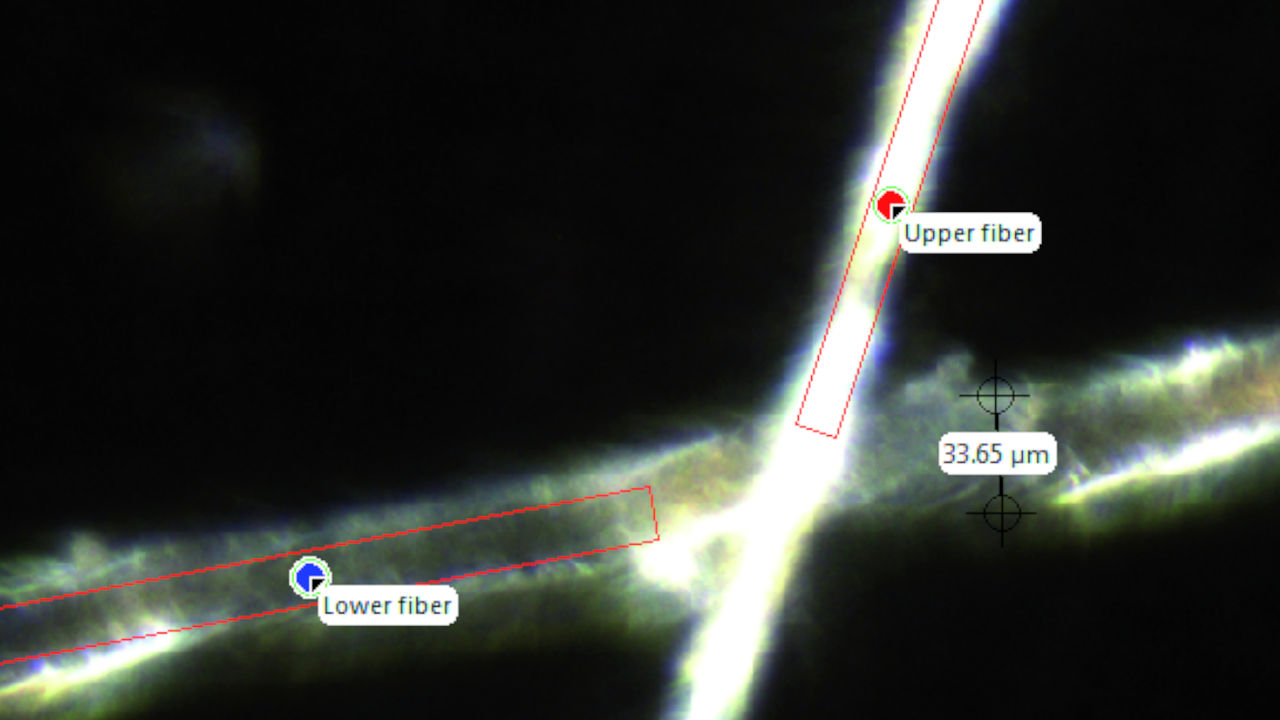
Desenvolvimento de drogas

Geologia e Mineração

Análise microplástica

Energy Materials / Photonic Crystals

In the study by Arpin et al. (2013), 3D self-assembled tungsten photonic crystals retain their structure up to ~1,400 °C, while exhibiting tailored IR reflectance/emissivity spectra that show enhanced useful thermal emission and suppressed undesired IR emission.
The role of HYPERION: researchers used reflectance IR to infer spectral emissivity via Kirchhoff’s law and applied reflectance analysis to directly link to emissivity control of tungsten photonic crystals.
Nanophotonics / Bioanalytics

Amenabar et al. (2013) demonstrated infrared nanospectroscopy (nano-FT-IR) mapping of individual protein complexes (e.g. ferritin, insulin fibrils) with ~30 nm lateral resolution, interpreting local broadband spectra in the amide I/II region to deduce secondary structure at the nanoscale.
The role of HYPERION: FT-IR spectra were acquired as reference spectra and to compare peak positions and band shapes with the nano-FT-IR data, thereby supporting assignments of local secondary-structure resonances.
Plastmonics / Supercrystals

Mueller et al. synthesized three-dimensional, self-assembled gold nanoparticle “supercrystals” and demonstrated that plasmon polaritons in these crystals induce strong near-field enhancement across visible to mid-IR bands, enabling both SERS and SEIRAS of ligand molecules.
The role of HYPERION: IR reflectance and transmittance spectra on plasmonic supercrystal films where collected demonstrating coupling between plasmonic modes and molecular vibrations and quantifying SEIRAS enhancement.
On-Chip-Screening / Biomedical

In Benz et al. (2020) a dendrimer-based, patterned indium-tin-oxide (ITO) slide was used to generate >50,000 nanodroplet vessels per plate, enabling on‐chip chemical synthesis and ultra-sensitive MALDI-TOF MS, UV–Vis reaction monitoring (RM) and on-chip IR spectroscopy for RM and characterization in high-throughput drug discovery.
The role of HYPERION: IR spectra from the droplet array spots provided molecular vibrational absorption signatures to complement MS and UV-Vis data, thus supporting high-throughput characterization of the synthesized library.
Plasmonics / Metamaterials

Paggi et al. (2023) demonstrate an over-coupled metasurface resonator that enhances molecular vibrational absorption across the mid-IR range (5–10 μm) by coupling weak plasmonic modes to molecular vibrations, achieving reflectivity variations up to 1% per nanometer of molecular layer thickness.
The role of HYPERION: IR spectra in the mid-IR allowed to assess the influence of the metasurface resonator on vibrational modes, shed light onto the broadband SEIRA mechanism and supported the design of detection platforms.
Polariscopy / Nanomaterials

Honda et al. (2019) demonstrated infrared (IR) polariscopy using hyperspectral imaging with a focal plane array (FPA) detector in the IR spectral region under illumination by thermal and synchrotron light sources. They show that the time required for polariscopy at IR wavelengths can be substantially reduced by the FPA-FTIR imaging.
The role of HYPERION: Both the offline FPA-FT-IR experiments and the synchrotron based hyperspectral imaging were performed on the Hyperion enabling the analysis of the targeted sub-wavelength features via polariscopy.
Energy Materials / Metamaterials

Dyachenko et al. report the design and fabrication of a refractory multilayer metamaterial composed of tungsten and hafnium dioxide that exhibits an optical topological transition between epsilon-near-zero and hyperbolic dispersion. This transition allows control over the material’s thermal emission properties at high temperatures, enabling selective tuning of emissivity.
The role of HYPERION: Reflectance spectra were collected in the NIR region to determine the spectral position and strength of optical resonances in the multilayer structure.
Optics / IR Imaging
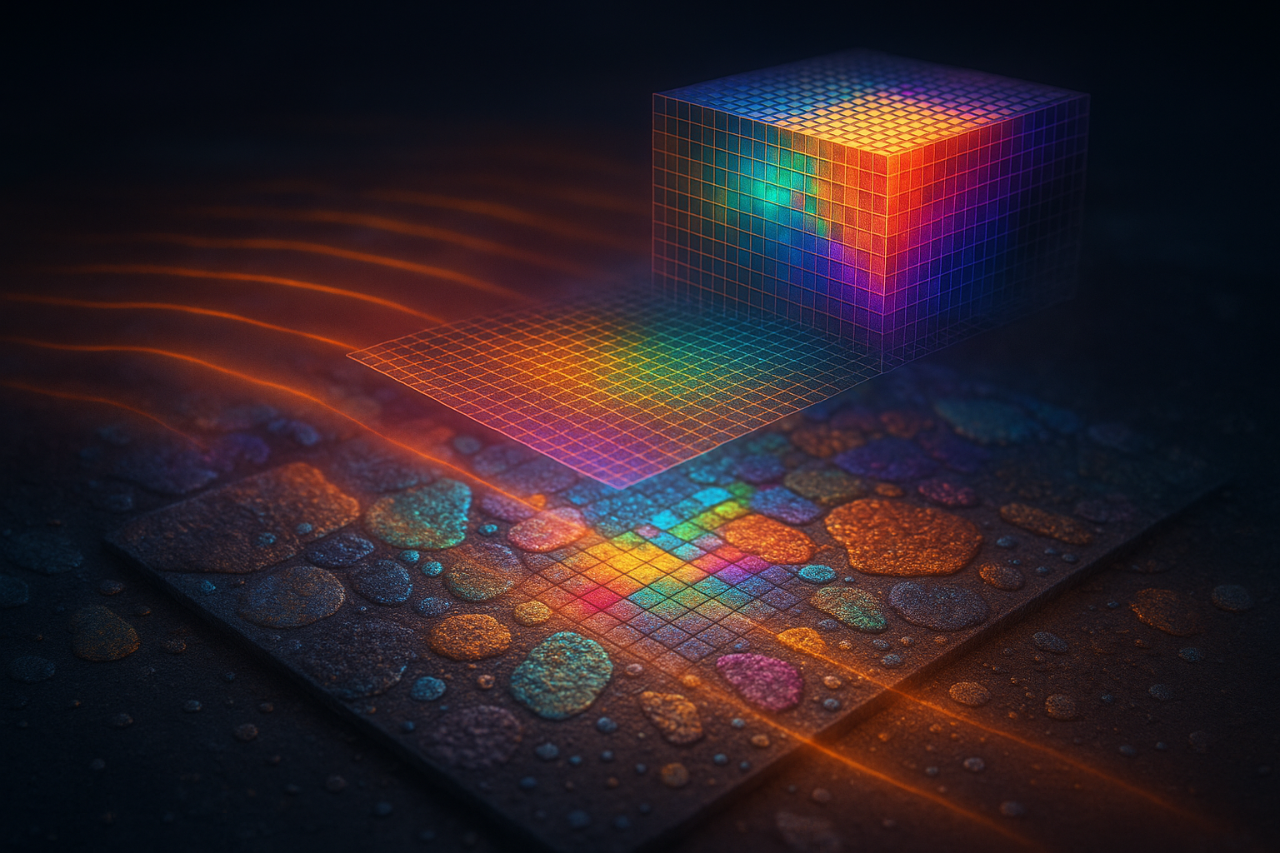
Stavitski et al. (2013) achieved diffraction-limited spatial resolution by coupling synchrotron infrared (IR) beamlines to focal plane array detectors (FPA), enabling full-field imaging with high chemical sensitivity and rapid acquisition times. Using this approach, they successfully map chemical composition in heterogeneous samples with spatial resolution down to approximately 5 µm.
The role of HYPERION: Equipped with an FPA detector, the HYPERION served as the imaging platform coupled to the synchrotron which was used for the chemical and compositional analysis.
Catalysis / Energy Materials

Cao et al. report using operando synchrotron radiation FT-IR (SR-FT-IR) under working potentials to detect a reversible vibrational absorption band at ~764 cm⁻¹ of an atomically dispersed Ru₁–N₄ catalyst, which they attribute to the adsorption/desorption of an oxygen intermediate (O*), thereby revealing the dynamic involvement of O species at the Ru site during catalysis.
The role of HYPERION: An operando SR-FT-IR setup was used to spatially and spectroscopically interrogate the catalyst under bias, capturing the vibrational signature of O* on the Ru site and supporting direct linkage between intermediate adsorption and catalytic function.
Catalysis / Energy Materials

In Su et al., the authors design CuO clusters supported on N-doped carbon and show that under applied potential the clusters dynamically reconstruct into Cu₂–CuN₃ species with charge asymmetry, which correlate with high Faradaic efficiency toward C₂⁺ products (notably ethanol). They combine operando XAS, quasi-in situ XPS, and operando FT-IR (with DFT support) to trace structural, electronic, and adsorbate changes in real time.
The role of HYPERION: As part of their operando FTIR setup, it was used to focus the synchrotron-based IR beam into the reaction cell and collect reflectance spectra under applied potentials. These measurements enable tracking of molecular vibrational features and charge-asymmetry signatures linked to the Cu₂–CuN₃ clusters and thus substantiate the structure–activity correlations under working conditions.
Acessórios de amostragem de RI e lentes objetivas
Placa de validação

Suporte de amostra microvice

Acessório de imagem de macro ATR

Suporte de filtro

Estágio de aquecimento e resfriamento

3,5x Lente objetiva de imagem

Lentes objetivas de transmissão padrão

Objetivo ATR
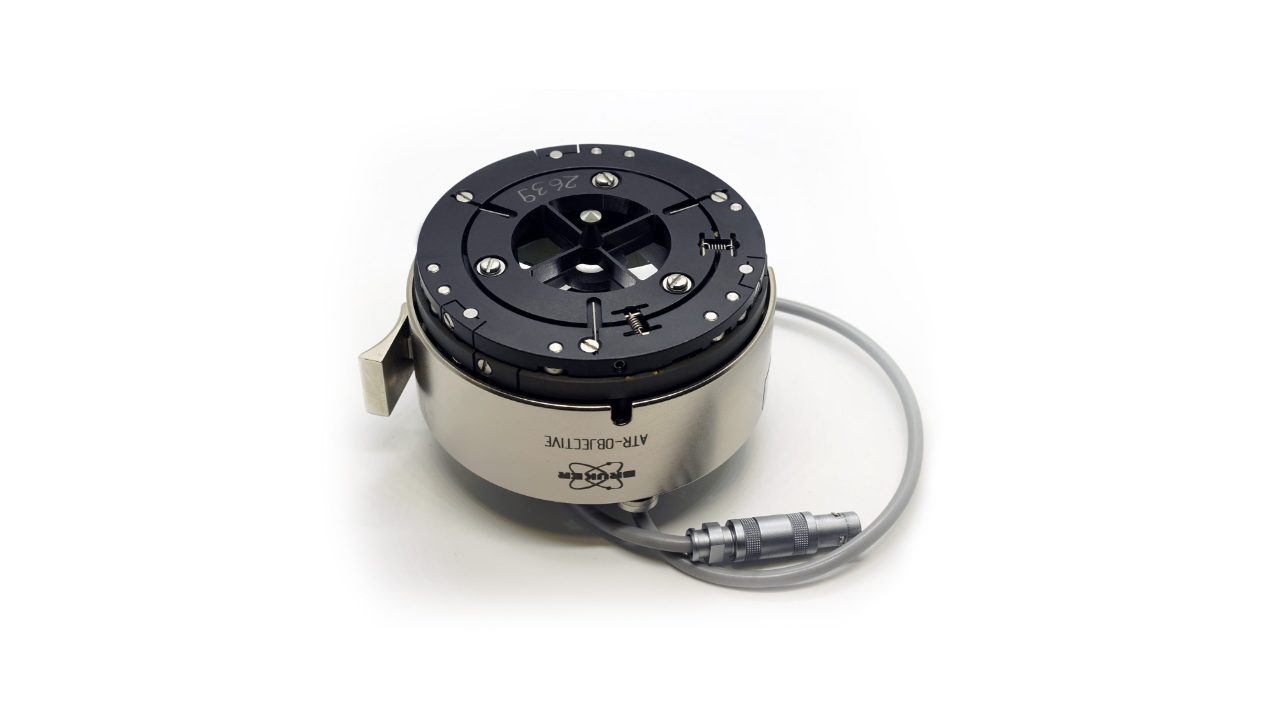
Objetivo do ângulo de pastagem

Célula de compressão de diamante

OPUS Release 9.0 Highlights for HYPERION II | Q1 2025
New Feature: The Autonomous Composition Identifier (A.I.D.) simplifies search and identification.
The Autonomous Composition Identifier (A.I.D.) is an AI-driven software tool for identifying the chemical composition of samples based on IR or Raman spectral data. It incorporates the previous O/SEARCH features and adds a multi-step algorithm to find the best match from reference spectral databases, whether dealing with pure substances or complex mixtures. A.I.D. intelligently evaluates and recommends optimal matches with a balance of reliability and sensitivity—automatically generating diagnostics and visual reports, including residual spectra and hit quality graphs. It delivers high-performance results in seconds and supports in-depth, interactive analysis of alternative identifications.

New Feature: Co-local Measurement – Unified Analysis Across IR and Raman
The Co-local Measurement function, part of the OPUS/OBJECT package, enables seamless analysis of the same region of interest on microscopic samples using both IR and Raman microscopy. It allows the transfer of overview images and measurement areas between LUMOS II, HYPERION II, and SENTERRA II instruments. This ensures that IR and Raman data are collected from precisely the same spot, enabling complementary chemical insights. Co-local Measurement bridges the gap between two techniques, improving data correlation and boosting confidence in results for heterogeneous or complex samples.

Updated Feature: OPUS/OBJECT now combines "Find Particle" and "Cluster ID"
The Particle Identification function (part of the OPUS/OBJECT package) combines the power of “Find Particles” and “Cluster ID” into one streamlined workflow. It detects particles within IR and Raman chemical images, determines their dimensions, and identifies their chemical makeup—all in one go. This integrated approach simplifies analysis and accelerates decision-making for complex samples.

OPUS Release 8.7 | HYPERION II | Q3 2021
New Feature: High Performance Chemical Image Generation by New Adaptive K-means Clustering Function
This new function is the logical next development step for our well known Cluster analysis function.The Adaptive K-means Clustering Function is based on a new algorithm, which enables a non-supervised and autonomous determination of spectral variance within your imaging or mapping results.
- Forecasting or time consuming searching of the included amount of chemical classes is no longer been necessary as the algorithm can predict all included chemical classes by itself.
- This major function is important for all kind of chemical imaging and distribution analysis of unknown samples or small structures within larger datasets.
- Make analysis and evaluation is as easy as possible and safes your valuable time and nerves.
New Feature: “Cluster ID” Function for Identification of Classes in 3D Spectral Data
Our new Cluster ID function enables the identification of clusters within imaging and mapping data using the OPUS functions: spectrum search in libraries, quick compare, or identity test.
- Easy determination of the chemical identity of classified sample components for particles, layers in laminates, components of pharmaceutical tablets and other inhomogeneous materials.
- Reliable and comprehensive statistics reports about quantity, size and of course identity of all analyzed structures is provided and leads particle and technical cleanliness analysis to a new, autonomous level.
Updated Feature: "Find Particles" function now contains a novel particle detection method
The proven "Find Particle" software can now be applied to both: the visual and the IR image. With this updated feature, you are able to do particle detection based on chemical images that were measured by the LUMOS II.
- While particle recognition for low contrast structures and off-white/transparent particles/fibers on off-white filter membranes can be tedious, a postrun particle determination based on the chemical IR image allows you to determine quantity and size of particles from your imaging or mapping results.


Sala de Literatura
Saiba mais sobre nossos microscópios e soluções FT-IR descarregando literatura relacionada.